PuzzleMaster

Flabber Floovers - Owl

Posted on Nov 18, 2013 by Gabriel | 7 comments
Labels: , ,

(Click to Enlarge)
The Owl is my third puzzle from the Flabber Floovers collection. Released by Family Games America, this collection of 12 unique puzzles, mostly rope ones, brings enjoyment to all puzzle fans with four difficulty levels, whether you're an experienced puzzler or just a beginner.

Today, I bring you a more challenging design, a level 4/4, or at least they say. I actually found it a bit easier than I was expecting, but I'll explain in more detail below. The puzzle itself is quite intimidating at first sight, with a large rope length, enough to scary away the most courageous of puzzlers.

No wonder it looks so complicated... With four wooden blocks plus a bead and finally a ring to free, you have many things to worry about and too many parts that can make the puzzle a real mess with knots. Two of the wooden blocks look very similar in shape, but one of them is slightly wider, enough to block the ring from passing over it. There's a couple of knots between these two blocks that need to be untied before doing anything with the ring. Only after that you're going to include the ring in subsequent steps.

As I mentioned above, the puzzle turned out to be much easier than I'd thought. I was clear that those knots between the slotted bars needed to be taken care of before doing anything else, and while they looked complex at first, it was actually pretty intuitive to untie them. When you finally clear the space for the ring to get between the two bars, it immediately reminded me of the classic Horseshoe puzzle. And it wasn't any coincidence, as I was able to perform the same exact steps to free the ring as you do with the Horseshoe puzzle. I was very surprised to solve the puzzle quickly, but even more surprised to see a different and more advanced version of a well known classic. Since the solving process was rather easy to do, putting the ring back to its original position was even easier. I wish more puzzles were like this one, easier than you expected.

(Click to Enlarge)
Closing Comments:

The Owl is now my favorite puzzle from the Flabber Floovers collection. Not because it was easy to solve, but because it takes a simple design like the Horseshoe puzzle and adds its own elements to create one of the best variations I've seen in a while. Definitely recommended, and even if you're a beginner go for it, because it might surprise you by how simple it really is.

Availability: You can find the Owl and all the others in the Flabber Floovers collection at Puzzles de Ingenio, in Spain. Worldwide shipping available.

The Angel

Posted on Nov 15, 2013 by Gabriel | 2 comments
Labels: , ,

(Click to Enlarge)
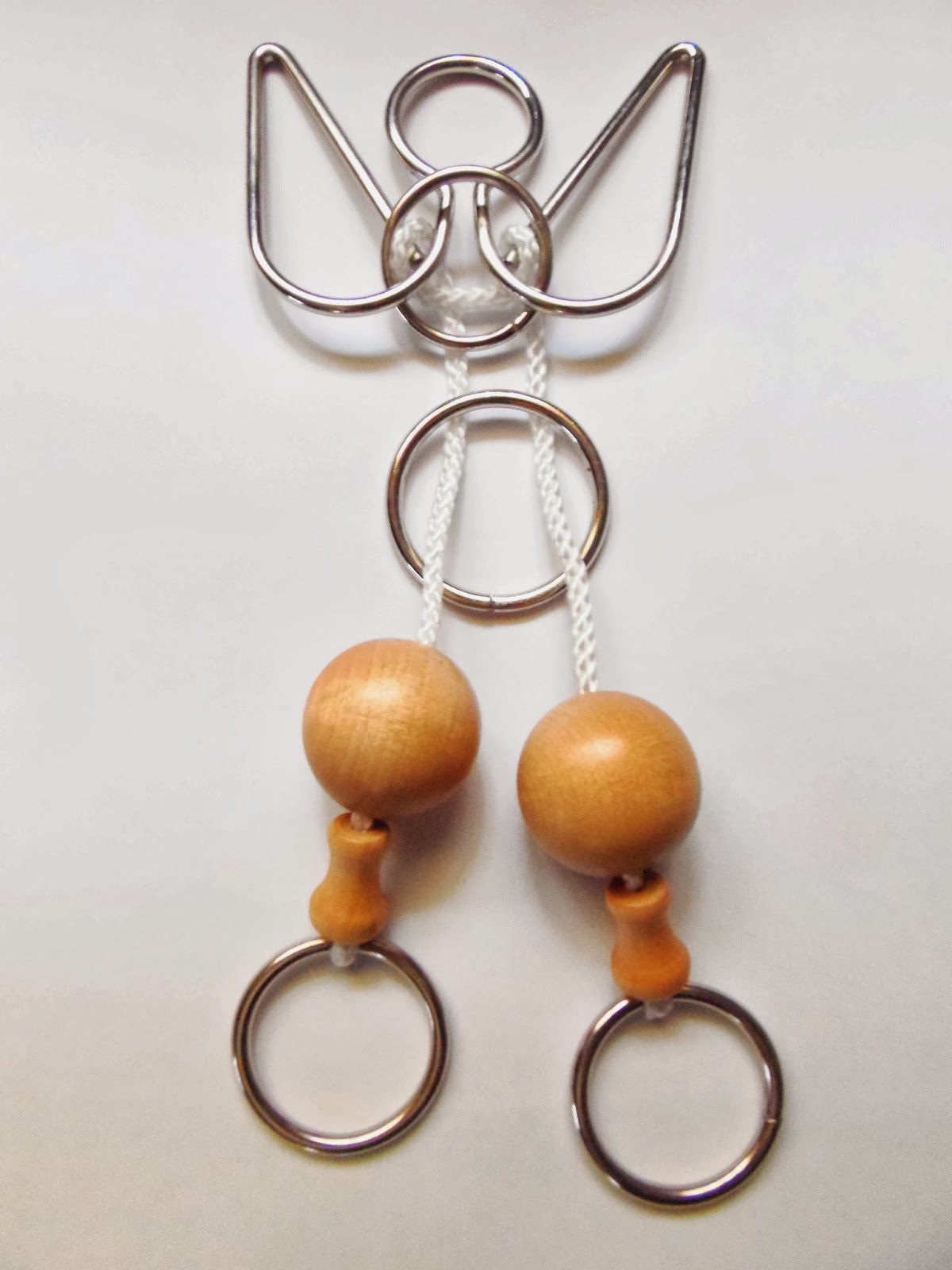
Angels are supposed to be worshiped and harmless, right? Well, not The Angel I got from Sloyd though. Might as well be a fallen angel. This is one tough nut to crack and solving it will require you to learn some new techniques.

The Angel is actually one of the best wire/string puzzles I've seen for a long time, and I've played with a fair share of them before. First, the puzzle is very well designed, with a perfect and symmetric shape. Even the color chosen for the string is white, which goes very well with the theme of the puzzle. The puzzle itself is quite challenging to solve, but when you finally do it you'll certainly feel a great sense of accomplishment.

This is a level 4/5 puzzle and, to be honest, I would've classified it as a pure level 5, mostly because of its complex movements, which in all fairness aren't that many, but enough to create a real mess with the string. The time to solve, at least for me, would also justify a level 5, and in this case it took me over two hours (not straight), between failed attempts and undoing several knots.

As you start, you see a large ring in the middle with two ends of the string going through it. At the ends are two smaller rings, but still large enough so they can't go through the main ring. There are also two wooden beads, and these can actually pass through the ring, but not through the angel's wings nor its head. Based on this information you'll have to come up with a way to remove the large ring from the frame.

Without going too much over the solving process, I can say that while the beads can't pass through the angel's wings, the smaller rings can. Try to do this a couple of times and see what you can do with them and how that helps you. It took me a while to even see this small detail. Putting the ring back in the angel is not at all easier or simpler. I didn't remember all the steps it took me to remove the ring in the first time, so I must have taken another hour or so to finally do it. I haven't gathered enough courage to solve the puzzle a second time, but considering the time it took me to solve and reset it (about 3 hours) I really am not looking forward to that. I know that I still have to learn the solution by heart to fully solve it and comprehend it, but I guess I'll leave that for another time...

(Click to Enlarge)
Closing Comments:

Solving a difficult puzzle is always a great and rewarding feeling. You know you have conquered its secret, but above all you feel you can tackle harder challenges afterwards. Wire puzzles sometimes share similar techniques and movements and when you solve a new one, you always learn something new. It's because of this that The Angel is now among my favorite wire/string puzzles.

Availability: You can buy The Angel at Sloyd in Finland for just €6.05.


Auge

Posted on Nov 13, 2013 by Gabriel | 5 comments
Labels: , , ,

(Click to Enlarge)
Jean Claude Constantin continues to surprise me, even after I've seen all kinds of original and outstanding designs from him. The latest addition to my collection is Auge (German for 'eye' - and curiously, Portuguese for peak), and at first sight it doesn't look that peculiar. It's only after you unfold it that it truly reveals its form, and it's nothing short of amazing.

Auge has an equilateral triangular shape made of two contrasting wood colors and covered with a sheet of transparent acrylic in both sides. At the center you can see a wheel, which is actually a two-layer wheel united at the center by a metal pin. It's this very wheel that you should be removing from the frame, but not before you figure out how to move the six wooden pieces surrounding it.

(Click to Enlarge) - Backside
The movable pieces are attached by pins at the tips of the triangle and are only allowed to rotate about 200º, but you have to move them in the correct order or they will be blocked by the other pieces. When you open all six pieces the wheel will easily be removed, and that's when the true challenge begins... Well sort of.

When in place, each of the wheel's two layers fit perfectly with the concave curved lines of the pieces (the wheel's protuberances have different sizes), but when you take it out and shuffle the position of the two wheels, putting it back and close the rotating pieces becomes an exercise of trial and error until you find the exact fit. You'll be doing the same thing for each side of the wheel, but the actual challenge is far from from being, well... challenging.

(Click to Enlarge)

I was actually a bit scared when I tried to put the wheel back, because I thought it was going to be really hard to find the correct positions for the wheel. Turns out, it's very easy. Once you put the wheel in place, you just need to keep rotating one of the layers until it makes a perfect fit with the inline of the rotating pieces. When you're done, close the other two parts and do the same for the other layer. It's that simple and you should be able to do this in just a couple of minutes. This was supposed to be a level 7/10, but for me it's hard to give it more than a 5/10. It's very easy to solve, and even a beginner won't find it challenging.

Closing Comments:

The design of the Auge puzzle is superb and the mechanism is quite ingenious. Coming from Constantin that's hardly surprising given the high quality standard he has already accustomed us. Having said that, the puzzle itself doesn't provide any real challenge and I can't recommend this one unless you're a fan of Constantin's puzzles.

Availability: You can find the Auge puzzle at PuzzleMaster for $19 CAD. You can also browse dozens of other Constantin designs.

Links:


Flabber Floovers - Pulley

Posted on Nov 11, 2013 by Gabriel | 0 comments
Labels: , ,

(Click to Enlarge)
Today, I present to you another one of the Flabber Floovers' puzzles, the Pulley, manufactured by Family Games America. These are pocket-sized puzzles, usually no more than 10cm (4"), excluding the length of the rope that can sometimes be too long and cause an undesired string of knots. The collection features 12 different designs grouped in four difficulty levels, and the pulley sits at level 3, which means it's supposed to be a little challenging to solve.


The quality of these puzzles is superb, and it's even more surprising knowing they have a low asking price. The material is not your average plywood, it's actually hardwood, and from the looks of it, it seems it's made of birch wood, and carefully polished. The design is sleek and elegant, featuring complex and odd shapes, as if it were made by the most highly skilled craftsmen.

The puzzle consists of three different wooden parts held together by two lengths of rope. One of the parts has a slot large enough to let the part with the bead attached pass through it, but it can't go much further, since the bead is larger than the slot's opening. At the end of the longer rope is a trapezium shape and a ring. This ring is what you should be removing from the puzzle, but as you can see with a closer inspection, the trapezium can't pass through it. A different approach is then needed to solve the Pulley.

How hard is it, you ask? Well, not as hard as the difficulty rating makes it seem. As a level 3, I was expecting a real challenge, since level 4 is the hardest and this one is just a notch down. Turns out, I was able to solve it in a couple of minutes on my first attempt. And the solving process is really simple, with about three different steps needed. I didn't have too much trouble putting it back in its starting position either. It's just one of those puzzles you don't have to think very hard to uncover their secret.

(Click to Enlarge) - Solved
Closing Comments:

Even though I think the puzzle was easier than I was expecting, and while this could be interpreted as a let down, I was actually glad it didn't take me that long to solve, because I've had my fair share of frustrations with rope puzzles. This one, was actually a pleasant surprise. I would recommend it to anyone on the fence thinking it might be too challenging. Believe me, it's not. Once you know how it's solved it's hard to forget it, so unfortunately it doesn't have much replay value. Nevertheless, it's still a great puzzle.

Availability: The Flabber Floovers - Pulley came from the Spanish store PuzzlesdeIngenio.com. Worldwide shipping available. Click here to see the other designs in the collection.


Roadside Rescue

Posted on Nov 8, 2013 by Gabriel | 2 comments
Labels: , ,

(Click to Enlarge)
Are you a big fan of the classic Rush Hour by ThinkFun? If your answer is yes, then the Roadside Rescue is perfect for you. The theme is simple: you're stuck on a highway jam and you have to make way for the emergency vehicles to get on the rescue site. It's a very original sliding block puzzle, invented by Hank Atkins and challenges developed by Serhiy Grabarchuk.

The puzzle consists of 12 vehicles, including the three emergency ones that will serve as the main tokens. There are also six blockers that can be placed in the tray and these will not be movable, they're just there to limit your movements. The frame is a 3x5 grid, so it's not your typical sliding puzzle, but the solving process is pretty much the same. At the start of each challenge you'll always have only one empty space to move your tokens, and even though sometimes it appears there are more empty spaces, the blockers ensure you will not be using them.

The tokens aren't all the same and you'll soon notice this as you try to solve your first challenges. Some of the vehicles are neatly placed at the middle of the token base, but these are the simpler ones. You'll also see a few vehicles that overhang the front or back of the token bases and even front and back, like the Fire Truck. The different sizes of tokens will add a higher complexity level to the challenges, as you'll sometimes be limited to only one valid move, instead of multiple path choices.

There are 42 challenges - Odd number, might as well been 50 - and they start quite simple, but soon it gets rather complex. The first set of challenges rotates between one of the emergency vehicles, but as you progress you'll start seeing combinations of two and then all three special vehicles in the same challenge. You play a specific challenge by sliding the pieces in the four main directions until the emergency vehicles are on their designated positions. It won't suffice to just have them reach the right side of the tray.

I haven't solved all 42 challenges, but I did enough of them, even the harder ones, to have a good grasp of the difficulty level. All I can say is that they're not at all difficult, even when you're using all three special vehicles. If you're good at sliding puzzles, Roadside Rescue won't cause you much frustration, but it can still be fun to play through all of the challenges.

Closing Comments:

I still think Rush Hour is the best ThinkFun puzzle game, but after playing with Roadside Rescue I reckon they're pretty close in terms of fun factor. As for difficulty, I also consider Rush Hour to be much more challenging, but here it's just a question of personal preference, whether you're more inclined for harder puzzles or more accessible ones. The design is quite clever and while I've played with lots of different sliding puzzles before, it's the first time I've seen this concept. Definitely recommended for puzzle fans of all skills.

Availability: You can get a copy of Roadside Rescue at Sloyd.fi. You can also take a look at other puzzles by ThinkFun here. For the Deal of the Week, you can get a 15% discount on ALL ThinkFun puzzles by just mentioning the name of my blog. Offer valid until November 15.

Challenges:

(Click to Enlarge) - Easy (1 emergency vehicle)


(Click to Enlarge) - Medium (2 emergency vehicles)


(Click to Enlarge) - Hard (All 3 emergency vehicles)


209

Posted on Nov 7, 2013 by Gabriel | 2 comments
Labels: , , ,

(Click to Enlarge)
209 is another fascinating puzzle, by Jean Claude Constantin, that uses four different mazes in combination with five pins that you need to move sequentially. I'm not sure what exactly 209 means or maybe it was the designer who didn't have inspiration for a better name. Either way, the puzzle looks stunning and that's what really counts.

Manufactured with laser-cut natural wood, in contrasting colors, and finished with transparent acrylic, the puzzle looks and feels like any other quality designs from Constantin. It's a nice sized puzzle measuring 19.5cm x 4cm in length and 2.5cm in width (that's 7.7" x 1.6" x 1"). The four wooden boards also give it a nice weight that makes it comfortable to hold in your hands.

(Click to Enlarge) - Bottom View
The concept of the puzzle is somewhat familiar in the way that it uses multiple mazes that need to be navigated simultaneously. This one's actually a step up in difficulty to another similar design by Constantin, the BonBon, where it uses only two mazes instead of four. There's a lot to think about as you go about solving this one with four different mazes, so be prepared for a serious challenge. You need to be constantly moving the five pins up and down to unblock the next move, as you try to push and pull the four boards at the same time.

(Click to Enlarge) - Partially Disassembled
There's one important thing that might be overlooked as you first try to solve the puzzle. Contrary to what you'd expect, not all four boards are to be taken out of the frame. Actually, only one of them is possible to remove, and that's the top one. The others only serve to block most of your movements. You can flip the puzzle to take a better look of the bottom mazes, but even then it's difficult at times to know which board is blocking your next move. The fact that the actual mazes are only a couple of centimeters wide and you're trying to see through four of them doesn't help either. In this case, I believe a larger puzzle would be best, as the looks were clearly favored in place of functionality.

As for the difficulty level, well it's as challenging as you'd expect from such a sequential movement puzzle. It took me well over an hour to get the board out of the frame and, as of right now, I'm yet to put it back to the start. It's that tough and I need to gather some patience to attempt another frustrating session.

(Click to Enlarge) - Solved
Closing Comments:

If you like an incredibly difficult challenge, then the 209 is the perfect puzzle for you. If you're easily frustrated, I would then recommend you to stay away from this one. If you're like me and you're a fan of Constantin's designs, well I guess you have no choice but to add this brilliant puzzle to your collection.

Availability: You can purchase the 209 puzzle at Brilliant Puzzles for about $30 USD. Click here to browse other puzzles from Constantin.

Links:


Gear Shift

Posted on Nov 6, 2013 by Gabriel | 0 comments
Labels: , , ,

(Click to Enlarge)
Back in 2009, Oskar van Deventer was responsible for inventing a new type of puzzle that would forever change the landscape of Twisty Puzzles. This new and revolutionary type of puzzle featured gears instead of rotating faces and was simply called Gear Cube. Since then, we've seen a plethora of different Twisty Puzzles with gears being launched, some by Oskar himself, while others were designed by fans of the concept. Some of these even took the concept to the next level by making it much harder than the original.

The Twisty Puzzle I have here today for review is another great one by Oskar, the Gear Shift, which is actually based on an idea by Bram Cohen, who has teamed up with Oskar on other several occasions. The Gear Shift could be described as the beginners version of the original Gear Cube, because it's a little easier to solve, but it's actually much more than that, since it introduces us to an ingenious new way of manipulating the core of the puzzle itself and change the way the corner pieces interact with each other.

(Click to Enlarge)
In terms of size, the Gear Shift is exactly the same size as the Gear Cube (6.1cm or 2.4"), but the pieces are much bigger in the new version. The number of pieces, however, is much smaller in the Gear Shift, totaling just 8 corner pieces, four big gears and four small ones. Also manufactured by Meffert's, the Gear Shift is presented with the classic high quality fluorescent stickers, which are almost peeling-resistant.

Unlike the original Gear Cube, a single move of the Gear Shift is able to rotate all eight pieces at the same time, this way easily scrambling it with just a few moves. Solving it is just as simple, but here you can add an extra "twist" and make it more interesting. As hinted above, you can change the way the pieces interact with each other by pulling the core apart along one of its three axis at a time. By doing this, you'll be able to move two opposite faces independently. In other words, four pieces at a time.

I believe it's because of this pulling apart method that the puzzle is much easier to solve, since you can focus on one face at a time. Once you have solved a face do the same for the opposite one and the puzzle should be solved in no time. For an added difficulty, you can try to have in each face four different colors and solve it from there.

(Click to Enlarge) - Opposite Faces Pulled Apart
Closing Comments:

The appearance of the Gear Shift can be a little intimidating at first, but once you get to know how the puzzle works it actually becomes quite fun to play with. Manipulating the core is a touch of genius and, knowing how easily Oskar can set new standards in the Twisty Puzzle community, I wouldn't be surprised to see new puzzle variations of movable cores in the near future.

Availability: You can get your Gear Shift at PuzzleMaster for just $20 CAD. Click here to browse other Oskar's designs and here for other puzzles from Meffert's.

Links:


Bermuda

Posted on Nov 1, 2013 by Gabriel | 0 comments
Labels: , , , ,

(Click to Enlarge)
One of the best things about Siebenstein-Spiele is that their designs are so varied you can pretty much find any type of puzzle you like. A type of puzzle I particularly like very much is the Picture Frame Puzzles, which are a special kind of packing puzzles. What makes them so appealing are the pieces themselves, with irregular shapes and special features, that need to be taken full advantage in order to save space in the frame to pack all the pieces. Bermuda, designed by Jürgen Reiche, is one of such fascinating puzzles, and I reckon you'll love this one.

Like most of Siebenstein's puzzles, Bermuda is made with a combination of contrasting colors that beautifully enhances its appearance. However, unlike all the other Picture Frame Puzzles I currently own, this one is actually pretty small in comparison, measuring only 11.5cm x 9cm (4.5" x 3.5"). This isn't necessarily a bad thing, and looking at the puzzle, I think it's perfect this way.

The puzzle is comprised of seven unique pieces, representing animals from the ocean, all made with laser-cut wood. It comes with six pieces already packed and an extra one, the whale, in a special slot. The challenge is to get that extra piece to fit in the same space provided.

Another cool feature of the Bermuda puzzle is the oval shape of the tray, also different from the regular square ones. It doesn't make it much more challenging though, just different in a nice way. Here, you'll want to study each piece thoroughly and find parts that can be combined with other pieces to save the maximum space. For example, the curved shape of the star will easily fit with the belly of the seahorse. Don't worry about spoilers, you'll still need to figure out which part of the star goes with the seahorse and where exactly they belong in the tray.

Difficulty-wise, I found the Bermuda to be a littler easier than the other Picture Frame Puzzles I've tried before. The main reason, basically, is that the Bermuda has less pieces than the majority of Picture Frame Puzzles I know, cutting down the difficulty to a much less stressful level. Regardless, it was still challenging, taking about 15 minutes to be solved. I wouldn't bet the Bermuda puzzle has multiple solutions, mainly because the design was thought out to have a unique and optimal solution. Note that you shouldn't force a piece down. If it doesn't fit it's because it's not meant to be placed that way.


Closing Comments:

What can I say more about the Bermuda puzzle to convince you? It's a great packing puzzle, built with high quality wood and a gorgeous design worthy of an award. Definitely one of the best from Siebenstein-Spiele and highly recommended.

Availability: You can find the Bermuda puzzle at Sloyd, in Finland, for €16. Worldwide shipping available.


Glass Puzzle - Pineapple

Posted on Oct 30, 2013 by Gabriel | 8 comments
Labels: , ,

(Click to Enlarge)
Pineapple is another interesting design from the Glass Puzzle collection, designed by the genius of Nob Yoshigahara and launched by Beverly Enterprises. There are eight different puzzles in this collection, each with a unique take on packed food in a jar. A piece of advice: don't play with them if you're hungry, as they're almost identical in appearance to the real thing which can be mouth-watering.

The Pineapple, like all the other puzzles in the Glass series, comes in a real glass jar, about 7cm in height and 7cm in diameter (2.8"), and inside are 12 irregular-shaped pieces in the form of pineapple slices. The puzzle doesn't come already solved though, as the pieces are just randomly fitted for the packaging. This is a good thing, because you'll feel the need to have all the pieces neatly packed inside the jar.

I noticed a very cool thing as I was touching the pieces for the first time. It almost felt as if you were in the presence of real pineapple slices, only with less moisture, but featuring the same rugged texture. This goes to show how far they went just to simulate the real textures of the food items in their puzzle series.

(Click to Enlarge)
These Glass Puzzles are also known for their high difficulty level, and the Pineapple is no different. It's a level 8/10, and even though it's not the hardest one in the series, it can still pack a punch. This one took me a little over half an hour to solve. As far as multiple solutions go, I'm not sure it has many, because the one I came up with was the same as the solution found on PuzzleMaster's website, only reversed.

I actually found an interesting fact that I had completely overlooked when I was playing with it and only saw it when looking at the solution. The pieces are a distorted view of pentominos - A pentomino is a piece comprised of five equal units, and there are exactly 12 different ways to build one. When analyzing the pieces more carefully, I found out that the 12 pieces in the Pineapple puzzle are indeed all 12 possible pentominos. It's fascinating how by looking at things in a different way you can miss the obvious things right in front of you. Nob was indeed a genius in the puzzle making and designing.

(Click to Enlarge) - All 12 Pentominos with a Twist
I wouldn't have been able to discover all these interesting facts if I hadn't downloaded PuzzleMaster's solution. And I was just curious to see if my solution was the same as the official one. This proves how looking up the solution to a puzzle you already solved can still be positive even though you don't need to. There's so much you can learn about your puzzles this way.

Solution: Click here to download the solution.

Closing Comments:

The Glass Puzzle - Pineapple is an amazingly designed puzzle, and an example of how making a slight change in the appearance of a puzzle can have a totally different outcome. I strongly recommend this one to all puzzle enthusiasts out there. It's a great puzzle to study visual perception and spatial cognition.

Availability: You can buy the Glass Puzzle - Pineapple at PuzzleMaster for $16 CAD. You can also get all the others here.


The Nightmare

Posted on Oct 25, 2013 by Gabriel | 0 comments
Labels: , , ,

(Click to Enlarge)
Prepare for your worst nightmare, as this new puzzle from the German manufacturer Siebenstein-Spiele promises to deliver you some sleepless nights. The Nightmare, designed by Jürgen Reiche, is a very well crafted slide puzzle with an interesting concept, but above all it's a rather challenging puzzle.

Siebenstein-Spiele is rapidly growing as one of the most prolific puzzle manufacturers right now, since I can no longer keep up with so many new designs, each one better looking than its predecessor. The Nightmare couldn't be more fitting for the description, because it's now one of my favorite puzzles from them, after the Safe, of course. So, does it play as good as it looks? Not quite, but nothing worrying either.

(Click to Enlarge)
The puzzle is built from two types of wood, the board is a dark tone and the pieces are of a contrasting lighter color. The top is covered by a sheet of transparent acrylic glass and the metal screws, that keep the pieces in the sliding paths, give the puzzle this extra shiny and elegant look.

The challenge consists of eight sliding pieces, two of them being just blockers and the rest are numbered from 1 through 6. You start by removing the acrylic tile in the middle, leaving you with enough space for two pieces and a bit more. The puzzle comes already with the correct starting positions for all the pieces. In other words, they're sort of scrambled, but not too much, since each number is already in its layer. Your task is - you guessed - to reorder the numbers, as seen below.

(Click to Enlarge)
If you look closely at each of the numbered tiles, you'll see that they all have these entrances that perfectly fit the ends of the central path. The twist is that three of them have their entrance pointing towards the left and the other three have it pointing towards the right. You'll have to plan ahead each movement and play with the little space you have available in order to slide each piece to its corresponding slot. You'll have to "rent" slots along the way for other tiles that don't belong there, since you won't be able to put them all in their slots right away.

The movement of the tiles is not entirely smooth, due to the fact that some paths (where each tile goes) are tighter than others. This problem might fade away as you keep playing with the puzzle and the paths will widen a little. It doesn't happen so often that will hinder your experience, and may actually vary from puzzle to puzzle, but it can be annoying sometimes.

Difficulty-wise, The Nightmare is rated as very hard, with a difficulty level of 7/7 in the manufacturers scale. With this in mind, I was a little apprehensive to solve it, thinking it could take hours to solve. Much to my surprise, I was able to solve it in about 10 minutes, and it certainly wasn't any luck involved. I just didn't find it as challenging as it makes you believe. You just have to think about where each tile needs to go and how to get there. Yes, it's elemental, but believe me, it's not that hard actually, or I may just be very used to slide puzzles...

Closing Comments:

It's getting harder and harder to find enough adjectives to describe how good Siebenstein puzzles really are. Built with high quality materials and designed to be visually pleasing, giving any collector a sudden urge to own them, these puzzles are certainly a puzzler's dream. The Nightmare is just another beautiful example of the craftsmanship and attention to detail that goes into any Siebenstein puzzle. It's hard to resist, very, very hard...

Availability: The Nightmare is available at Sloyd, in Finland, for €23.50.


Flabber Floovers - Shackle

Posted on Oct 24, 2013 by Gabriel | 2 comments
Labels: , ,

(Click to Enlarge)
Flabber Floovers - Now that's a name you don't see everyday. This is a collection of 12 rope puzzles released by Family Games that will push your patience to the limit. If you dread any kind of rope puzzles stay away from these, very, very far away...

These puzzles are very well crafted with high quality and polished hard wood, giving it a sleek and elegant appearance, despite their low asking price. Each design is unique and quite intimidating actually. They come in four different levels of difficulty, but in my opinion, they're all pretty tough to solve, even the easier ones. You've been warned.

The first of these Flabber Floovers I have for review is the Shackle, and the name couldn't be more appropriate. This one's supposed to be a difficulty level 2/4 in the manufacturers scale, but it was a pain to solve. Now, after solving it multiple times, I find it easier than the first time, but I would still classify it as a level 3.

What makes the puzzle harder than it looks is its many parts, and each one plays an important part - no pun intended - in the solving process: the top, which has a hole and a knot passing through it; two rings with rope passing through them; a block attached to the end of the rope; a slotted bar which is the part you should remove from the puzzle and a bead that prevents the bar from getting easily freed. With so many things to worry about, what could possibly go wrong here? Featuring an exceptionally long rope, you've got yourself a recipe for disaster.

Before attempting to solve the puzzle, take a moment to study all the features of the puzzle and how the rope can be disentangled to free the bar. The first thing you need to tackle is the knot from the top part. When you solve that problem the puzzle is half solved. Now, you only need to figure out how to get past the rings and the rest of the rope, but believe me, that part is the easiest. I found it a little more challenging to reset the puzzle, and again, the hardest part was to make the top knot again. I recommend taking a picture of the puzzle in its original state to check how the knot is done.

(Click to Enlarge)
Closing Comments:

I don't know why I put myself in these situations. I find rope puzzles extremely difficult and yet, time and time again, I end up with a few of them in my hands to review. There's an upside to this though. Solving these puzzles is highly rewarding, because you know you tackled something you thought was far beyond your limits. Yes, you may be out of patience for a while to try another one, but I tell you it's totally worth it.

Availability: The Flabber Floovers - Shackle came from PuzzlesdeIngenio.com, an online Spanish puzzle store. Worldwide shipping available.


1 2 3

Posted on Oct 23, 2013 by Gabriel | 3 comments
Labels: , , ,

(Click to Enlarge)
1 2 3. A strange name for a puzzle, right? Apparently, not only Jean Claude Constantin's puzzles are very original, but their names are quite unconventional sometimes. Well, the name is not random. It actually has a pretty good reason to be simply called "1 2 3". Read on.

1 2 3 can be described as a hidden maze with movable parts, or a dynamic maze. There's a steel ball inside and your task is to guide it through the exit. Easier said than done, since you can't really see what's going on inside. The puzzle is made from several plates of laser-cut wood stacked together to form a 2.7cm (1.1") thick block. On the top there's this engraved image of a maze (looks more like two mazes side by side), but looking closely at how the puzzle works I believe the image is just there for decoration purposes, as it doesn't represent the actual mechanism. The other measurements are 9.5cm x 7.2cm (3.7" x 2.8").

The mechanism looks quite simple, and it is... But given the fact that you're only able to see a small part of it turns things a tad more difficult. There are three sliding bars that move independently, and each bar has notches in different places that, when aligned with the other bars, allows the ball to move back and forth. Sort of like the notches you can see on pieces of a Burr puzzle.

(Click to Enlarge)
The ball is already inside the maze when you get the puzzle, so it's difficult to know where it is. Removing the ball from the maze becomes then an exercise of random moves with the bars until you're successful. Surprisingly, this took less time than what I was expecting, only a couple of minutes. Once you have the ball out of the maze you can reset it by inserting the ball in the back opening. Here, you can have a little understanding of where the ball might be at first, but pretty soon you'll lose track of it and becomes yet another game of random moves and wishing on lady luck to intervene. This time, it took me a bit longer to free the ball, so I suspect the ball was closer to the exit on my first try. Even though you can't see the actual mechanism, it's perfectly possible to learn the necessary movements and shorten the solving time. I recently had a similar experience with Robrecht Louage's Escape from Alcatraz, so I know exactly what I'm saying.

(Click to Enlarge)
Closing Comments:

Hidden maze puzzles seem to defy the logic of solving them with more luck rather than skill. With practice, however, you can change those odds and be in control of the puzzle with just a few successful attempts. The 1 2 3 puzzle is surely a worthy addition to any collection and deserves at least a try. Even beginners can have a go and feel satisfied and rewarded.

Availability: Unfortunately, the 1 2 3 puzzle is currently out of stock at PuzzleMaster. You can still check back regularly to see if it's back on stock, but in the meantime, you can browse dozens of other designs by Constantin.

Links:


The Snail

Posted on Oct 18, 2013 by Gabriel | 0 comments
Labels: , ,

(Click to Enlarge)
Another string puzzle, another tortuous moment for me this week... Or was it? The Snail is an interesting puzzle from Sloyd, made with strong 3mm nickel plated wire, which gives that extra smooth and shiny look that other metal puzzles can't do.

When I first saw The Snail I immediately recognized the shape, since I have seen it before in a slightly different puzzle, the Derringer. A derringer, as you might know, is a pocket pistol, and looking at the puzzle at a different angle it does resemble the shape of a pistol. There's also a major difference between these two versions, and that's the inclusion of a ring above the two beads. Suffice it to say, the version with the ring is much more difficult, so The Snail might just be a simpler version for beginners. Unfortunately, I don't know anything about either version's designer, but I have to assume they were both designed by the same person.

This puzzle is classified as a level 3/5, and despite featuring that fiendish string, I didn't find it so intimidating as I was expecting, so I reckon the difficulty level is just right. I wouldn't say this is the perfect puzzle for a beginner, because it can still be a bit challenging, but if you're used to solving wire puzzles I'm sure you won't have much trouble.

I did find it trickier to get the string back in the frame, because it's not so easy to learn the steps the first time you solve it. You need to do it a few times in a row to fully understand what's going on, but it's a problem when you need to reset the puzzle in order to solve it again. From what I've seen of string puzzles, this has to be one of the easier ones out there.

(Click to Enlarge)
Closing Comments:

The Snail is right in the middle when it comes to difficult wire puzzles. It's not difficult enough to make you feel frustrated, but it's challenging enough to make you think a little harder of the steps you should take. I really liked this one. It was surprisingly easier than I expected and when it comes to wire puzzles, that's an awesome feeling.

Availability: The Snail came from Sloyd, in Finland, and you can buy one for just €6.


Who's the Boss?

Posted on Oct 16, 2013 by Gabriel | 0 comments
Labels: , , ,

(Click to Enlarge)
Siebenstein-Spiele is fast becoming one of the best puzzle manufacturers out there. Their puzzles always have something fresh in their designs. You might have seen similar concepts before, whether they're slide piece puzzles, packing puzzles or even interlocking puzzles, but their approach to visual appealing designs is their strong suit.

To my knowledge, all of the Siebenstein-Spiele mechanical puzzles are designed by Jürgen Reiche. Note that the company also publishes interesting board games, but even those are also designed by Jürgen, with the exception of maybe a couple of them. Also, judging by the number of new puzzles I keep seeing from him, it doesn't look like he's running out of ideas anytime soon. Jürgen must be a fascinating person to have a conversation with, especially if you're a puzzle enthusiast like me.

One of the most recent additions to my collection is the "Who's the Boss?". This is a very interesting slide puzzle with a twist, which you'll be able to find out as soon as you try to solve it. The puzzle itself is not very big, but you won't have too much trouble to move the pieces. It measures approximately 10cm in diameter (about 4"), and it's made from laser-cut wood, both pieces and frame, except the cover which is made from acrylic. The materials ensure a very light puzzle that feels nice to hold and play with.

The object of the puzzle might be a little confusing, at first... And this is where the "twist" comes into play. It consists of six tiles, three are displayed in the vertical and the other three in the horizontal. Each tile has a fragment of a symbol inlaid in it and, when arranged correctly, they will form the symbols for the male and female genders. The trick is that you can only rearrange the tiles to form one of the symbols at a time. When you solve one of them, you have to slide the pieces around to form the other. It's just not possible to have the two solved at the same time.

Sliding the pieces from one state to another seems simple, but it can actually be quite difficult. Not surprisingly, the puzzle is rated as a level 8/10, and I have to agree with this classification. This is not your typical 3x3 slide puzzle. The fact that half the pieces have a different orientation begs for a different approach. There are four holes in the acrylic cover and these can be used to help you move the pieces wherever you want - Well, sort of...

The empty space, unlike the traditional slide puzzles, is not the equivalent of one tile, but actually two. This seems like too much, but trust me, you'll find it too small when you're trying to solve it. Solving time will greatly depend on your slide puzzle skills. It took me about 10 minutes to solve the first symbol, but I found that to solve the other, you only need a few extra moves, cutting the solving process to a fraction of the time.

(Click to Enlarge) - Male and Female Symbols Solved

Closing Comments:

Slide puzzles are among my favorite types of puzzles. Ideas like these that introduce you to a new way of thinking and how to go about solving them deserve all the praise they can get. Siebenstein-Spiele always surprise me for their bold creations and, as a designer, Jürgen Reiche seems to outdo himself every time I see a new puzzle from him. "Who's the Boss?" is a fantastic puzzle and I highly recommend it to anyone that knows and loves any type of slide puzzle.

Availability: "Who's the Boss?" is currently available at PuzzleMaster for $20 CAD. You can also find here a wide variety of puzzles from Siebenstein-Spiele.


Related Posts Plugin for WordPress, Blogger...