PuzzleMaster
Showing posts with label Coordinated Motion. Show all posts

Slideways

Posted on Oct 29, 2019 by Gabriel | 0 comments
Labels: , ,

(Click to Enlarge)
Slideways is part of the recently successful Indiegogo project, which had some beautifully-made anodized metal puzzles, each one with a different shiny color. These puzzles are now available at PuzzleMaster for anyone to purchase.

Designed by Ray Stanton, the Slideways, as the name suggests, will have a slightly different solution than your average burr puzzle. Discovering the secret move and mastering the solution will surely require some creative thinking, and some dexterity as well...

The puzzle is very well made with a stunning purple color. It's small, measuring only 6cm (2.4"), but still handles quite well. Since the pieces can slide quite well, it can happen that the puzzle will fall apart by accident if handled in a certain way. Nevertheless, taking it apart is the easy part. You will have your hands full trying to find out how to put it back together.

This is rated as a level 6/10, but by no means don't underestimate it. Taking it apart is as easy as a level 5, but reassembling it is more like a level 7, so maybe the 6 is the average between the two parts. If you're familiar with the concept of coordinated motion, then it might be easier to visualize the solution and subsequently its reassembly. In coordinated motion, all pieces must come together in a single and symmetrical sliding move, so it takes some planning and careful study of how the pieces fit together.

(Click to Enlarge)
Closing Comments:

The Slideways was a very interesting puzzle to play with. It has a clever solution and a great design on top of that. I did find the solution more enjoyable than a regular burr puzzle, so I definitely recommend this one. And with this beautiful color it can certainly be used as a cool decorative object.

Availability: The Slideways is available at PuzzleMaster for just $19.99. Check out other interesting metal puzzles also worth your time and money.


Cast Galaxy (捻)

Posted on Apr 1, 2015 by Gabriel | 4 comments
Labels: , , ,

(Click to Enlarge)
The Cast Galaxy is yet another one to add to my favorite Hanayama puzzles...Along with the Cast News, Cast Harmony, Cast Radix, Cast Starfish, Cast Enigma...You get the idea...There are a lot of good ones, and to be among the best is saying something, as I'm very picky when it comes to choosing favorites.

What surprised me first about the design of the Cast Galaxy was its actual size. From the pictures it looked a bit bigger, but when I first looked at it in person, I was a bit disappointed by its small size. I guess I was expecting it to be at least 10% bigger, since there are other bigger Cast Puzzles, and it would look fantastic just a tad bigger.

Nevertheless, despite the size, the puzzle looks gorgeous. I love astronomy and anything space-related, so combining two of my favorite subjects is just amazing. The Cast Galaxy was designed by Bram Cohen, who also created the Cast Marble and Cast Rattle. The theme for the Galaxy is "Knot". Are you prepared to untie this one?

The Galaxy consists of two pairs of identical pieces, as each pair has its ends cut at different angles. Other than that, the pieces are pretty much the same. The pieces are shaped like hooks and in its initial state it forms a symmetrical shape in the form of a spiral galaxy, its arms extending outwards. The puzzle is coated with a silver finish, but I would've liked to see contrasting colors. Like any other Cast Puzzle, your task is to take the puzzle apart and put it back together. Rated as a level 3/6, this should probably be a walk in the park, no?

Well, the first part of the puzzle - taking it apart - is not that difficulty, since the pieces move and slide quite easily. While it looks like it might come apart in a random fashion, or chaotic if you like, the solving process is actually something you have to do orderly and simultaneously with all four pieces. If you're familiar with the concept of coordinate-motion, then you'll know exactly what I'm talking about.

Even though you have to perform the exact same steps for taking it apart and putting it back together, the second part of your task is curiously much harder, because it's difficult to get all four pieces to move at the same time. I reckon I must've taken 10 times longer to put it back to its original state. It's all about dexterity and good hand-eye coordination. You know what you have to do, but your hands refuse to cooperate. After several successful attempts, I can now do it effortlessly. You see, practice makes perfect...

(Click to Enlarge)
Closing Comments:

The Cast Galaxy is not a difficult puzzle at all, but it challenges your motor skills like no other Cast Puzzle. The solution is not that complex like other Hamayama puzzles, but its symmetry and simplicity are rather beautiful, and for that, the Galaxy is now one of my favorites from the Cast family.

Availability: To get a copy of the Cast Galaxy, or any other puzzle in the Cast Series, visit PuzzlesdeIngenio.com.

Links:

New Hanayama Website (in English)

Hanayama Cast (in English) - Very useful website in English, with plenty of information on all things Cast.

Hanayama's Factory Visit (Many thanks to Roxanne Wong for sharing these pictures)


E Box

Posted on Jul 17, 2013 by Gabriel | 0 comments
Labels: , , ,

(Click to Enlarge)
Who do you immediately think of when you hear the term Coordinate-Motion? For me, it has to be Václav Obšivač (Vinco). It's true, most of his designs use the same basic mechanism and solving technique, but who cares, right? His creations are among the best you can see from independent craftsmen. I only wish I had more...

The latest addition to my collection is the E Box, a three-piece puzzle where the goal is to take it apart and reassemble it back to its original cubic form. Vinco always uses high-quality wood in his puzzles and this one is no exception. It's also surprisingly small, measuring only 5cm in diameter (2"). Nevertheless, it won't be because of its size you'll have trouble solving it.

The outside of the puzzle, for someone that doesn't know Vinco's puzzles very well, looks like a three-piece Burr puzzle, which would have a completely different way of solving it. By knowing Vinco's work, however, you already know what to expect and as such, the solving process takes a little less longer. You still need to find the correct way to separate the pieces, though, and since you're working with a coordinate-motion puzzle you'll need to do it simultaneously for all three pieces.

(Click to Enlarge)
The difficulty of the puzzle is not very high, but still tricky especially in the reassembling process. Vinco has a rating of 3/5 and PuzzleMaster classifies it as a level 8/10. I don't think it's that challenging though, but then again, I already solved quite a few similar ones from Vinco, so this might have helped me a little.

When you pick up the puzzle for the first time you'll hear a rattle inside indicating there's something loose inside. That's actually a small sphere put there to add a little extra challenge for the reassembly. When you try to put the pieces back together you'll need to put the sphere back in before sliding the pieces all the way in. There's only a small window of space where you can do this, and taking into account that it takes a bit of dexterity to align the three pieces so they slide all together, it can take you a few extra attempts.

(Click to Enlarge)
Closing Comments:

Like always, it's a pleasure to add a Vinco puzzle to my collection. Even though he mostly uses the same mechanism, his designs are quite diverse and use a lot of different wood types and color tones. It'll be a long while before you can say you have all of his distinct designs.

The E Box is an excellent choice if you're just starting with coordinate-motion puzzles. I'm sure it won't be your last coordinate-motion puzzle or Vinco puzzle.

Availability: You can get a copy of the E Box at PuzzleMaster for $16 CAD. For other Vinco puzzles, you can browse their dedicated Vinco page with a wide variety of designs.


Diagra

Posted on Jun 6, 2013 by Gabriel | 0 comments
Labels: , , ,

(Click to Enlarge)
Václav Obšivač (Vinco) is a master of Coordinate-Motion puzzles. Most of his designs use this interesting technique, which is the only way to solve them. Diagra, which by the way is a very nice name for a puzzle, makes use of coordinated motions to solve it into several different shapes. For more info on Coordinate-Motion puzzles, check John Rausch's website.

(Click to Enlarge)
Diagra is comprised of eight unusual pieces. No two pieces have the same arrangement, which makes it even more difficult than already is. The main challenge is to assemble the pieces into a perfect cube, and you'll be forced to do this, since the puzzle comes in a box with the pieces taken apart. However, the cube is only one of many possible shapes you can achieve with the eight pieces. There are ten shapes included in the leaflet, but I believe you can attempt to create much more than that. Just use your own imagination. The only rule is that no hooks shall be showing on the outside of the shape.

(Click to Enlarge)
The puzzle is very well made, with different kinds of natural wood, which provides a beautiful palette of colors and contrasts. It's not a big puzzle, but still very easy to manipulate, measuring 6.5cm in diameter (about 2.5").

This is not an easy puzzle to solve, and even the basic cube shape is quite difficult to assemble. I spent about an hour just to solve the cube, and after gaining some courage I attempted to build another shape. It took a little less, but still more than I was expecting. I found it extremely difficult to find the right connection between the pieces. I always ended up short of two or three pieces that didn't fit into the shape I was trying to. The shape I ended up solving first was not my first choice, as I was constantly trying a different one until I was lucky enough to make the L-shape. I also photographed a second shape, besides the cube, but I had to look up its solution. My patience had reached its limit...

(Click to Enlarge)

If the puzzle wasn't difficult enough to solve already, the coordinated motions make it even harder. You can start to assemble any shape piece by piece, but as you progress you figure out that it's impossible to fit the last two or three pieces individually. They need to be slid into place simultaneously. Now, which pieces should do that, that's another matter you need to figure out, so some trial and error is needed.

Closing Comments:

Vinco's puzzles are always a pleasure to add to my collection, and Diagra is a superb design that deserves its place in any puzzle collection. As for solving it, prepare to some serious puzzling, because this is a level 5/5. Nevertheless, it's quite rewarding to solve one or more shapes on your own.

Availability: The Diagra came from Brilliant Puzzles, but at the moment it's out of stock. They have another similar one, the Prism Halfcube, or if you really want this one you can try to contact Vinco directly. You can also check out other puzzles from Vinco available from Brilliant Puzzles.


Hexagon Cube

Posted on Jul 12, 2012 by Gabriel | 2 comments
Labels: , , ,

(Click to Enlarge)
Coordinate-motion puzzles are fascinating in that they always have a tricky way to be disassembled. You have to find out which parts must be pulled and on top of that, you'll have to do it simultaneously. The Hexagon Cube is a nice design that cleverly uses the coordinate-motion technique. The designer is unknown to me, but if I had to guess, I'd say it could be a work done by Vinco - No offense to the designer, if it happens to be another craftsman.

Edit: I have just learned that the design is in fact by Stewart Coffin and it's called Seven Woods (made from seven different woods). It's Coffin's #42 from his numbering system. It's a shame that the version I have is only made from one wood type, otherwise it would have been even prettier. I guess for $10, you can't ask for much, now can you?

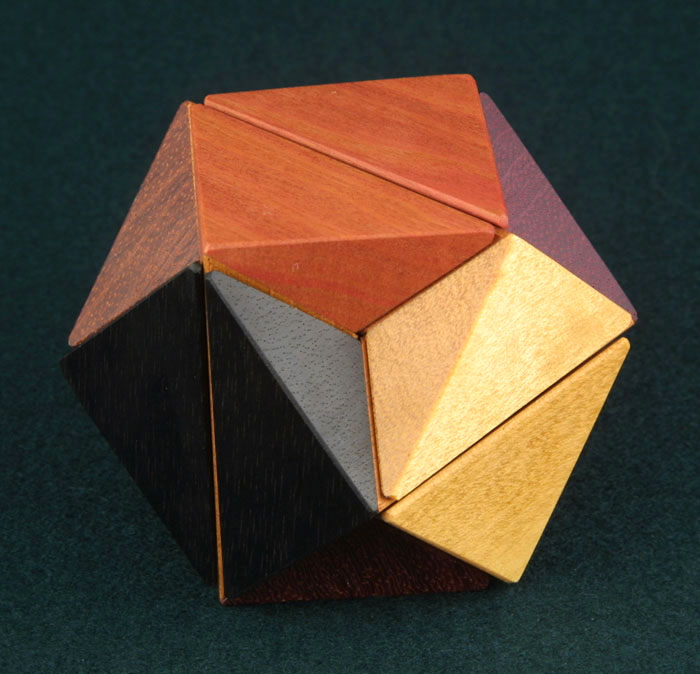
The Hexagon Cube is comprised by six identical pieces (in the shape of a bow tie) made from a darker tone wood, and it measures approximately 7.5cm (about 3"). It's called Hexagon Cube because it has six cubic faces that when viewed at a certain angle, it shows a hexagon shape (Top photo). The overall shape of the puzzle is quite interesting, actually: Depending on the angle you're seeing it, you'll notice different shapes.

(Click to Enlarge)

Most coordinate-motion puzzles have one thing in common: their pieces are usually identical and when they're not, they share some kind of symmetry or they're mirrored from one another. This is because when you're separating the pieces they'll slide off in opposite directions, which is difficult or impossible to achieve when you have completely different pieces.

The puzzle is rated as a level 3/5 by Brilliant Puzzles and even though the coordinate-motion can be a little tricky, it's not the harder one I've seen. For one, the pieces are somewhat loose and you can see where they intercept with each other. Moreover, the movement required to separate the pieces is not very difficult to discover, either.

(Click to Enlarge) - Partially Disassembled

After you have disassembled the puzzle, getting it back together may be a little more complicated, but nothing overly complex. You just need to get five of the six pieces in place, but with plenty of room. Don't get them too tight. Next, try to place the sixth piece so that all pieces are at the same distance from the center and push them in simultaneously. They should slide back to place pretty easily.

(Click to Enlarge)

Closing Comments:

Interlocking puzzles have a way of arouse our curiosity, at least puzzle people. We like to uncover their secret and to know how they work. The Hexagon Cube, although not very challenging, still succeeds in capturing your attention for a brief moment. What I liked most about it was its design and shape. I strongly recommend it if you're into interlocking and coordinate-motion puzzles.

Availability: I got the Hexagon Cube from the American puzzle store, Brilliant Puzzles.


Kamarad

Posted on Jun 7, 2012 by Gabriel | 2 comments
Labels: , , , , ,

(Click to Enlarge)
Having already reviewed a few puzzles from Vinco (Václav Obšivač), their common denominator is high quality and design originality. The Kamarad, a six-piece coordinate-motion interlocking puzzle, is no different.

The Kamarad has such a brilliant and original design that it'll be very hard to write about it without giving too much away about its solution. It's one of those puzzles that you should experience on your own and find out for yourself how it works. There's one phrase that perfectly describes it: "Looks can be deceiving". With this in mind, I'll try to describe it with no major spoilers.

The puzzle is comprised by six identical pieces made from natural wood and the different colors indicate, at least, two types of woods. It measures about 6.3cm in length (2.5") and it's coated with some type of wax that helps disassemble and assembling it. The goal, of course, is to find a way to take it apart and then return it to its original shape.

(Click to Enlarge)

When looking at the puzzle, the first thing that comes to mind is a burr puzzle: One of the pieces should slide off pretty easily - although not every burr is as straightforward and simple as this - leaving the inside mechanism visible. So, the first thing I tried was to push on the various pieces and see if any of them would move. However, there's one thing rattling inside the puzzle, a small bead, that quickly shatters the burr notion. Knowing that inside of a burr there are intersecting pieces, there's little to no room for a bead. With the help of this bead it shouldn't be that hard to imagine how the interior of the puzzle looks like. Now that you have a pretty good idea of the mechanism, you still need to take it apart. I'll leave this part for you to figure out, but I'm sure it won't be much of a challenge.

This puzzle is rated as a 3/5 level of difficulty, and given the fact that the bead gives you a nice clue about the interior of the puzzle, I'd say it's about right. Were the puzzle not featuring this bead, and it could very much be classified as a level 4.

After successfully taking the puzzle apart, you still have to reassemble it. While it might not be harder than figuring out how to take it apart, it still requires a good level of dexterity and hand coordination. You will find yourself a few times having to get the bead inside again, as in the process of reassembly it'll fall off quite easily.

(Click to Enlarge)

Closing Comments:

Overall, the Kamarad is a fantastic design and the concept is a pleasant surprise once you discover how it works. As with many of Vinco's puzzles, besides their high quality you can also count with very affordable prices, taking into account the type of puzzle and level of craftsmanship. A must-have for any collector.

Availability: The Kamarad came from Brilliant Puzzles and it's available for about $20 USD.

Links:


Star of David by Philippe Dubois

Posted on Feb 24, 2012 by Gabriel | 1 comments
Labels: , , ,


Share

(Click to Enlarge)

Philippe Dubois from Israel has some of the coolest wooden puzzles designs I've seen recently. The Star of David (or Logo as Philippe calls it) shows very well his brilliant work.

The puzzle depicts the Jewish symbol "Shield of David" or "Magen David" and is formed by six identical pieces in the shape of a T. Each T piece is a combination of two rhombi and two parallelograms glued in 60º angles. To accentuate the appearance and presentation of the puzzle, a light and dark wood tones are used, making a simple and yet very beautiful contrast.

The goal is to find a way to separate the pieces and assemble it back to its hexagon star shape. The complete absence of 90º angles though, actually make the puzzle trickier than it looks, as it's harder to join the pieces in an unconventional way, by 60º angles.

(Click to Enlarge)

If you have already solved puzzles with coordinated motion, then this one will be no different and taking it apart will be an easy task. If you're unfamiliar with coordinated motion, think of it as simultaneous maneuvering of all pieces at the same time, with no sequential movements. However, the separating of the pieces is only part of the challenge. In my opinion, the hardest part is figuring out how the pieces can be joined together, which can be quite challenging to see when all the pieces are lying flat on a surface.

(Click to Enlarge)

After you've discovered the correct connection for two pieces, the other two pairs are joined in the exact same way. The final step is just a three piece interlocking coordinated motion, but if you were successful in separating them the first time, then it will be a simple process.

(Click to Enlarge)

The Star of David came from Brilliant Puzzles, which is the puzzle's manufacturer and you can buy it for $9.95 USD. A very reasonable price for this kind of puzzle.

Closing Comments:

The Star of David was a wonderful surprise. Besides the captivating design, the concept used by Philippe to recreate the design is highly creative and very well done, not to mention the striking contrasting effect, only possible by using different wood tones. Looks great on a coffee table. Definitely worth a try.

Links:


Star of David

Posted on Mar 11, 2011 by Gabriel | 1 comments
Labels: , , ,

Share
(Click to Enlarge)

The Star of David is yet another puzzle produced entirely and sold exclusively at PuzzleMaster. For many more PuzzleMaster's wooden puzzles, check the following list.

The name of the puzzle comes from the resemblance, in shape, to the Jewish symbol, known in Hebrew as the "Shield of David", which is a hexagram composed by two equilateral triangles.

The design is cleverly done with the use of two different wood colors, enhancing the beautiful contrast seen in the middle of both sides. This easy technique of using two or more colors of wood can maximize the elegance of an otherwise simplistic design.

The object of the puzzle is to separate all of the six interlocking pieces, but it's not actually as easy as it looks. PuzzleMaster has its level of difficulty rated as an 8 out of 10, so it does need some thinking in order to successfully solve it. 

If you're familiar with the technique known as "coordinated motions", then you're half way there... This solving method requires a simultaneous manipulation of the puzzle's pieces instead of a simple sequence of movements. You do need a careful maneuvering of the puzzle, because its pieces are fragile and easily breakable, especially the internal parts, which are cut in a way that may come apart with excessive force. Spoiler alert: The secret in this puzzle is to separate the puzzle in two parts of three pieces each, and then separate the remaining ones, one by one.

One thing I've noticed after solving the puzzle was that, the parts where the pieces fit into one another had spots of the opposite color marked on them. I suppose this was due to the fact that the colored pieces weren't completely dry when the puzzle was assembled. A proof of that is that I was unable to separate the final two pieces, because they were actually glued together, and with the fear of breaking them, I just photographed the pieces like this and assembled them back together.

(Click to Enlarge)

Closing Coments:

Despite the fact of the undried paint, it doesn't throw you off on the solving experience and the challenge it provides. If you don't have a clue about the solution, you may require several tries before being able to solve it. It does look great on a desk or shelf, for its attractive design though...

The Star of David is available only at PuzzleMaster for CAD $11.99.

(Click to Enlarge)

Bicone 2 by Vinco

Posted on Nov 3, 2010 by Gabriel | 1 comments
Labels: , , , ,

Share
(Click to Enlarge)

The Bicone 2 is the second of ten different Bicone versions, designed and built by Vinco (Václav Obšivač). You can read a bit about him at the end of the post. It was entered at the 30th IPP Design Competition.

Perfectly crafted, the Bicone 2 is a beautifully shaped four-piece Interlocking puzzle (or Take-Apart and Put-Together), made with cherry and maple wood. Although it's built with two different wood types, you can clearly see tree different colors, which makes for a wonderful contrast on the checkerboard pattern. As a nice finishing touch, the puzzle is polished and waxed for a nice clean and smoothing surface, making it a visually stunning piece of craftsmanship.

 
(Click to Enlarge)

For an interlocking puzzle, the Bicone is quite difficult to take apart. It's rated as difficulty 5 out of 5 and classified as a coordinated motions puzzle, meaning that you can't use a sequence of movements to open (or close) the puzzle. You need to carefully manipulate its pieces simultaneously in a certain way, so that you can separate all the parts at the same time. There's no need to use excessive force, also because you can break the inner pieces that make the "key" of the puzzle. These key pieces are four triangular prisms that are glued into the inside structure on each of the main pieces and together, they interlock to close and maintain the puzzle in a locked state.

When you're trying to solve the puzzle, you can think about those triangular prisms to figure out how they keep the puzzle from opening. Since they're triangular, there's only one way to separate them: by sliding the four pieces together, each in an opposite direction. Once you have accomplished this "simple" task, you face another big challenge, which is to put the puzzle back together. Now that you know how the puzzle works, this should be easier, right? - Well, not quite, because as I said above, you need simultaneous movement on all four pieces and it also requires a lot of visualization and dexterity to manipulate every part of the puzzle, and slide the pieces back together.

(Click to Enlarge)

As mentioned before, there's six different versions for the Bicone, each with its own design. The solution is the same for every one of them, though. One cool thing about the Bicone is that a particular version may have different wood types used, giving them a slightly distinctive look. For example, the Bicone 4 has at least four of these looks, each with a different wood combination. This is great for a puzzle collector: even though the puzzle is the same, the appearance is different and therefore, highly collectible. The design you own may become rare, because they're produced in small quantities and after they become out of stock, it could be a long time before they're available again. If you really like a particular design, grab it while you can...

Closing Comments

When it comes to wooden puzzles, you can't get any better than this. Vinco's attention to detail and presentation is incredible and his craftsmanship is one of the most outstanding you'll find in the  puzzle market. For €50, you'll get a very high quality handcrafted puzzle, polished and waxed, that will look great in any collection. Vinco's puzzle offer changes quite often, so if you want more puzzles to choose from, check his site regularly, because when he has new puzzles available, they sell like hotcakes...

(Click to Enlarge)

A bit about Vinco:

Václav Obšivač is from the Czech Republic and started to build puzzles in 1999. He often participates in International Puzzle Parties, where you'll get a chance to see some of his exciting new works. He uses a lot of different wood types to build his puzzles, which allows him to make a lot of interesting color combinations and patterns. Some of his puzzles are available in several online stores around the world, including his own website, of course. Below is a list of such stores:


Related Posts Plugin for WordPress, Blogger...