PuzzleMaster
Showing posts with label Hidden Maze. Show all posts

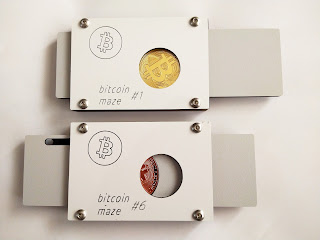
Bitcoin Maze #1 and #6
Posted on Feb 24, 2022 by Gabriel | 2 comments
Labels: , ,

(Click to Enlarge)

It's been almost seven years since I've reviewed a puzzle from Robrecht Louage. At the time, the 8 Stars Labyrinth was yet another great design that I had the pleasure to play with. Fast-forward seven years, and this time, Robrecht presents us with not only one puzzle, but six. This is the Bitcoin Maze, and it's already one of my favorites.

The first design (Bitcoin Maze #1) was entered at the 2021 Puzzle Design Competition. Trespa is Robrecht's material of choice for his puzzles, which has a solid feel in the hands unlike laser-cut wood, not to mention that the white appearance looks stunning. Michel van Ipenburg, who has collaborated in the past with Robrecht when they made Larva and Ladybird, came up with the idea for a series of six puzzles, and what an idea! Each puzzle feels different, and that's expected, since each one provides a different internal maze. #1 is supposed to be the easiest, while #6 is the hardest... In theory.

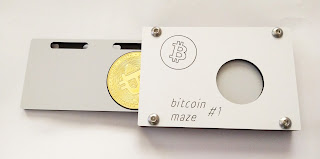
The goal of the puzzle is simple... There's a coin (a Bitcoin at that! - First time I held one in my hands) placed in a sliding platform enclosed within a frame with a labyrinth. Inside, however, there's a steel ball (or more than one) that's preventing the platform to go all the way out of the frame. Your task is to completely remove the coin from the puzzle. There's a position which looks like it's out, but you still can't remove the coin, so it needs just a bit more effort. The coin needs to be out of the puzzle.
(Click to Enlarge)

The funny thing is, design #1 felt more difficult than #6. I started with #1, since I was told it was the easiest, but just couldn't solve it completely. The coin was at that position mentioned above, where it's almost out, but not quite. For a change of pace, I picked up #6 and to my surprise, I solved it within 5 minutes. Luck, perhaps? I kept trying with #1, but wasn't having much luck. It took me more than a hour fidgeting with it, trying to figure out the internal mechanism to finally remove the coin. I still haven't solved it a second time, but this is what makes these puzzles so good. You can try to solve them multiple times until it becomes second nature.

Difficulty may be relative when it comes to hidden mechanism puzzles. You can't see what's going on inside, after all. You have to rely on your other senses, and sometimes you may solve it quickly or more slowly. Either way, you get to feel like a safe cracker and that's what these puzzles give you. A wonderful experience like no other type of puzzle.

(Click to Enlarge)

Closing Comments:

The Bitcoin Maze is a great return to form by Robrecht Louage and I totally recommend it. Whether you're choosing just one or go for the whole series as a collector, you won't regret it. And you also get that shiny coin, so more reason to get it.

Availability: To get a copy of the Bitcoin Maze, please contact Robrecht at: rlouage(at)telenet(dot)be. Note that the e-mail is presented that way to avoid spam. You just need to change what's inside the brackets with a "@" and a "."

Maze Puzzles

Posted on Jun 23, 2020 by Gabriel | 0 comments
Labels: , , , , , ,

(Click to Enlarge)
This time I am venturing on an often neglected type of brainteasers - maze puzzles. These are sometimes viewed as a puzzle more geared towards the casual puzzler, but you'd be surprised by the sheer variety of mazes available right now, and they are the delight of both aficionados and casual puzzlers alike. Read on to find out more about the different types of maze puzzles and some of their history.

Mazes have intrigued and fascinated us since the dawn of civilization. In fact, the Egyptians are thought to be the first ones to come up with this incredible concept over four millennia ago (around the time of the first ancient pyramids). Mazes have come a long way since the era of the Pharaohs. They have evolved in countless different ways and have many different uses, but the approach is the same: to baffle and perplex anyone that witnesses this incredible feat of human inventiveness and ingenuity.

Many people use the terms Maze and Labyrinth interchangeably, and that's probably correct in most cases. However, personally, I prefer to use the word Maze when referring to puzzles. Why? Because a maze always has dead ends and other red herrings, commonly used in puzzles, and a labyrinth is not always used as puzzle, which implies a solving process with a beginning and an end.

Today you can see mazes everywhere in your daily life, but I want to focus particularly on the mechanical maze puzzles, the ones that you can touch and play with, the ones that make me glad I'm a puzzle enthusiast, collector, solver...and writer... There's an array of different types of mazes that can please even the most uninterested of puzzle fans. They can go from simple ball-bearing puzzles, like the popular money puzzles, for the casual puzzler, to more complex structures, like the Perplexus puzzles. Whichever type of puzzle you choose, a maze always has the ability to entertain and satisfy our needs for a good mental challenge.

With so many types of mazes available, how do you choose the best ones? It all depends on what you like most about maze puzzles. One popular type of maze, usually used as an original gift, is the money mazes. This type of puzzles have a wide range of shapes and sizes. The goal is to navigate a ball bearing through a maze and unlock the mechanism that opens the puzzle so you can retrieve what's inside. You can put inside the puzzle anything not thicker than a few sheets of paper, which can be money, gift certificates, event tickets, etc.

(Click to Enlarge)
Hidden Mazes have also been quite popular these last several years, mostly thanks to the Revomaze, although they weren't the first ones to appear, and there are certainly many other interesting designs. The hidden mazes, as the name suggests, have some part or the entirety of its mechanism hidden from view, forcing you to rely on other sensory skills, like touch or hearing. These puzzles are exceptionally harder than the more traditional maze puzzles, but they're quite a treat for the experienced puzzlers who are looking for a serious challenge.

(Click to Enlarge)
If you're a more adventurous type and sometimes feel like a kid on a toy fair, the Perplexus puzzles are a perfect way to immerse yourself with a really cool and fascinating 3D maze. These original and unique puzzles let you explore and navigate with a ball bearing within a large sphere full of contraptions and winding pathways, reminiscent of a roller coaster.

(Click to Enlarge)
If none of these are your thing, why not try a 3D maze with a classic feel but with a new and completely different approach in design. These examples below, from Jean Claude Constantin and Jez Goode, show what 3D mazes have achieved in recent years and how good they can be with a gorgeous but functional design. They are also quite challenging.

(Click to Enlarge)
Mazes that require a good dose of dexterity on your part are also a fun alternative to the previous, more demanding, examples. In these puzzles, perfect hand-eye coordination will dictate your success or your failure as you try to guide a metal sphere with the help of your steady hands and...Gravity.

Double mazes are also fascinating in the sense that you have to keep in mind your progress on both of them simultaneously. There are many good examples, and Jean Claude Constantin is a craftsman that knows very well how to make a good maze puzzle, especially when two, or more, mazes are involved. His puzzles have a great complexity, and are mostly appreciated among expert puzzle enthusiasts for their unique designs and mechanisms.

(Click to Enlarge)
There are still more types of mazes and unique puzzles to discover, but these are the most important ones within the realm of mechanical puzzles. There may be some missing ones here and there, but I believe I compiled enough for you to have a general idea of the subject and to encourage you to research further if some puzzles interest you more.

Final Thoughts:

Mazes have evolved so much over the centuries that it's unfathomable to even think of how they will continue to baffle us in the coming decades. Judging by what history taught us time and time again with new inventions, it's safe to say that mazes are here to stay for as long as civilization exists. It's part of we are, part of our curious minds, and it's essential to our development as an intellectual species. I sincerely hope that, after reading this, you'll be more inclined to try a maze puzzle - any maze - and see for yourself how fascinating these puzzles can really be.

Availability: Most of the puzzles above mentioned are available at PuzzleMaster.


Inside3

Posted on Jan 22, 2018 by Gabriel | 0 comments
Labels: ,

(Click to Enlarge)
Inside3 (formerly known as Insidezecube) is an intimidating and very challenging 3D maze, even for the most seasoned puzzlers. Embark on a journey to the unknown through the darkness, as this maze won't need your visual sense to be solved. Instead, you must rely on your other senses, adding a pinch of patience and large amounts of persistence.

Inside, as the name suggests is a play on words (or better, a play on numbers, as the 3 is represented as the mathematical exponent "cube", hence the name Inside "cube"). Invented by the French Romain-Guirec Piotte, this 3D maze promises to test the puzzle solving and orientation skills of anyone courageous enough to try his puzzles.

The first of six planed seasons, each with six difficulty levels, features the same number of cubes with a different color for each level. The cube you see presented in this review is the third level, or as it's called the Mean Phantom. Be sure to not underestimate these puzzles, as they will certainly prove to be quite the challenge.


(Click to Enlarge) - Both sides of the Journey

Hidden mazes or blind mazes are not a novelty in puzzles. We've seen them most prominently featured in the Revomaze puzzles, and they're popular for a reason. Puzzlers like a tough challenge, especially when you can't see what's going on inside - It deals with our imagination. The feeling of being lost, but still in control.

The Insidepuzzles have their own features that make them unique. While you're on your own to try and figure out where the small ball is at all times, you have some clues to rely on that help you on your journey to the other side of the cube. Engraved on two opposite sides of the cube are seven 2D mazes, each corresponding to a different plate or layer that's inside the cube (the sixth and last difficulty level doesn't have any maps). Each plate has a maze that connects with the other plates and so on, which in turn links the front of the cube to the back.

The engravings also show indentations that represent holes in the surface of the plates. Your task is to study and visualize all these levels working in tandem as a unique 3D maze and guide the small ball from one side of the cube to the opposite side, all of this without ever seeing the ball, except for when it reaches any of the opposite windows on the cube. There's another small ball inside the cube, and its main goal is just to confuse you (as if the maze itself wasn't enough to confuse you). The puzzle is solved when you see the ball from the narrow window of the other side of the cube. However, your journey is not complete until you return the ball back to the starting point. On the way, you'll encounter traps and dead-ends to make your journey that much more interesting. I warned you this was a hell of a challenge...

(Click to Enlarge) - The six layers (The lid functions as the seventh)

If you get stuck while trying to solve your cube, don't despair. You can open it up (only the first four difficulty levels allow for this), remove the layers and replace the ball back to the beginning. Another interesting feature about opening the cube is that you can swap and re-arrange the layers to form a whole new maze. If the original wasn't hard enough already, you can put a whole new spin to it and make it even more challenging - Now, not even the 2D maps of the layers will help you.

So far, all I've accomplished was the first part of my journey, which was to reach the other side of the cube. This wasn't done in one sitting, though, but through the course of several days. Since there are two balls in play, I'm not even sure which one reached the first half of the journey. At this point, All I care about is that one ball made it to the other side and now I have to return it to the beginning of the maze.

Closing Comments:

Inside3 is everything I want in a puzzle. It's frustrating, almost to the point of throwing it out the window, but it's also fascinating, intriguing, intimidating and rewarding. It's all of these things and more. It's because of puzzles like this one that I write about puzzles and collect them. If you're a serious puzzler, I strongly recommend trying one these cubes. But if you're a casual, no problem. You can start with one of the easier difficulties and go from there.

Availability: You can get any or all of the puzzles in the Inside series through the official website @ www.inside3.space.


Cast Dial

Posted on Jan 3, 2018 by Gabriel | 0 comments
Labels: , , ,

(Click to Enlarge)
Vesa Timonen is one of the most represented designers in the Cast series, with at least 8 different Cast Puzzles in his name so far, including the beautiful Cast Square and the intriguing Cast Hook. His latest contribution to the Cast family is another interesting design, the Cast Dial.

Design-wise, the Cast Dial is absolutely gorgeous. It consists of a triangular shape comprised of two main pieces interlocked together, and two dials that rotate independently back and forth. The dials can also be rotated in any direction as one, which provides a satisfying feeling for anyone that likes to fidget with objects to keep the hands occupied. The goal is to separate all four pieces and return the puzzle to its original form. It's rated as a difficulty level 4/6.

(Click to Enlarge)
The triangular pieces are identical and have indentations that suggest a sliding movement, so you have a pretty good idea on how the puzzle should be solved. However, there's a world of difference between suspecting how it can be solved and actually solve it... And here lies the difficulty of the puzzle, which by the way can be a bit more difficult than what Hanayama might suggest.

Solving this puzzle proved to be a little frustrating, to say the least. The two dials can rotate independently, but it's very difficult to find a correct position for them to even get past the first step. Once you manage to have some progress, the frustration is not over yet. You still have to keep guessing as to which direction to turn the dials (or dial, since after a certain point only one dial can turn, while the other is locked in position). It's a game of trial and error until you can finally separate all four pieces. Here, you will be able to see exactly how the mechanism works, which is a plus, as getting the puzzle back to its original state is much easier.

(Click to Enlarge)
Solution: You can download the solution here.

Closing Comments:

Even knowing that the puzzle is rather frustrating to solve, I can still recommend this one. I like its movement and its design. Not a fan of the solving process, but two out of three is not bad. Looking forward to see what Vesa Timonen does next for Hanayama.

Availability: The Cast Dial is available from PuzzleMaster for $15.99 CAD. All Hanayama collection is available as well.


1 2 3

Posted on Oct 23, 2013 by Gabriel | 3 comments
Labels: , , ,

(Click to Enlarge)
1 2 3. A strange name for a puzzle, right? Apparently, not only Jean Claude Constantin's puzzles are very original, but their names are quite unconventional sometimes. Well, the name is not random. It actually has a pretty good reason to be simply called "1 2 3". Read on.

1 2 3 can be described as a hidden maze with movable parts, or a dynamic maze. There's a steel ball inside and your task is to guide it through the exit. Easier said than done, since you can't really see what's going on inside. The puzzle is made from several plates of laser-cut wood stacked together to form a 2.7cm (1.1") thick block. On the top there's this engraved image of a maze (looks more like two mazes side by side), but looking closely at how the puzzle works I believe the image is just there for decoration purposes, as it doesn't represent the actual mechanism. The other measurements are 9.5cm x 7.2cm (3.7" x 2.8").

The mechanism looks quite simple, and it is... But given the fact that you're only able to see a small part of it turns things a tad more difficult. There are three sliding bars that move independently, and each bar has notches in different places that, when aligned with the other bars, allows the ball to move back and forth. Sort of like the notches you can see on pieces of a Burr puzzle.

(Click to Enlarge)
The ball is already inside the maze when you get the puzzle, so it's difficult to know where it is. Removing the ball from the maze becomes then an exercise of random moves with the bars until you're successful. Surprisingly, this took less time than what I was expecting, only a couple of minutes. Once you have the ball out of the maze you can reset it by inserting the ball in the back opening. Here, you can have a little understanding of where the ball might be at first, but pretty soon you'll lose track of it and becomes yet another game of random moves and wishing on lady luck to intervene. This time, it took me a bit longer to free the ball, so I suspect the ball was closer to the exit on my first try. Even though you can't see the actual mechanism, it's perfectly possible to learn the necessary movements and shorten the solving time. I recently had a similar experience with Robrecht Louage's Escape from Alcatraz, so I know exactly what I'm saying.

(Click to Enlarge)
Closing Comments:

Hidden maze puzzles seem to defy the logic of solving them with more luck rather than skill. With practice, however, you can change those odds and be in control of the puzzle with just a few successful attempts. The 1 2 3 puzzle is surely a worthy addition to any collection and deserves at least a try. Even beginners can have a go and feel satisfied and rewarded.

Availability: Unfortunately, the 1 2 3 puzzle is currently out of stock at PuzzleMaster. You can still check back regularly to see if it's back on stock, but in the meantime, you can browse dozens of other designs by Constantin.

Links:


Escape From Alcatraz

Posted on Sep 26, 2013 by Gabriel | 0 comments
Labels: , , ,

(Click to Enlarge)
Robrecht Louage has accustomed us to his ingenious coin puzzle designs over the last few years, and this year's 33rd IPP Design Competition was no different. The latest addition to the family is the Escape From Alcatraz puzzle, a secret opening box with a hidden maze.

The design itself is one of the best from Robrecht. He used the back of a Belgium €1 coin, featuring King Albert II, and designed the puzzle around it, as if to imprison the King behind bars. Your task is to navigate the hidden maze and free the King from Alcatraz. The puzzle is made from fiberboard and is a bit smaller than its predecessors, measuring 9cm x 7.5cm (3.5" x 3").

(Click to Enlarge) - The Escape Begins
The concept can be compared to Rebrecht's Remove the Yolk, which featured a hidden maze as well, but even if you know all its steps by heart it won't be of much help for you to Escape From Alcatraz. The main reason is obvious, the two internal mazes are completely different. But how different, you ask? - It's hard to say, really. The only way you know they're different is by the moves you do with each other. From my experience with the two puzzles, I'd say the Yolk puzzle is a little harder than the Alcatraz, probably because the maze has a few more moves to free the coin, or just because I got better since then.

Looking at the description of the puzzle at IPP's website I discovered that one of the materials used, besides fiberboard and steel balls, is a magnet. I only knew about this after I had solved it, so I was a bit surprised, because I would've never figure out a magnet was present. Maybe that explains why it's so tricky to navigate the maze, since you never know exactly where the steel balls - or just ball - are. The magnet may be preventing the balls from moving freely.

(Click to Enlarge) - Escape Imminent
The first time I tried to Escape From Alcatraz it took me about 15 minutes. The platform that holds the coin has about 5 steps. In other words, it will slide off the frame in 5 different stages, with the coin being closer to the exit point with every step - An alternative name could be "5 Steps Invisible Lock". Strangely, it took me much less time to get the coin back at the starting position - about a minute or two. I was expecting it to be equally challenging, but I was glad it didn't. After several successful solves I can now solve it in just a few seconds. I think I pretty much learned all the basic moves, but I'm still not certain what exactly is going on inside that mechanism. I think it's just part of the fun in solving it.

(Click to Enlarge) - Escape Successful
Closing Comments:

Escape From Alcatraz is yet another brilliant puzzle from Robrecht Louage. It may not have won an award at this year's IPP, but the design alone is deserving of recognition. The best part about it is that it keeps you guessing and analyzing it in further detail. It may be a while before you can figure out its mechanism completely. I can't wait to find out what Robrecht has in store for us next year.

Availability: To order a copy of Escape From Alcatraz, you can contact Robrecht directly.


Blind Labyrinth

Posted on Jun 14, 2013 by Gabriel | 0 comments
Labels: , ,

(Click to Enlarge)
Before there were any Revomazes or Dael 'O Rings, there was the Blind Labyrinth, developed in 1983 by Lauri Kaira. That was exactly 30 years ago. Only a limited number of these puzzles were manufactured at the time, 2000 copies to be more precise. Some of these puzzles are still available to buy from Sloyd.fi. However, there are only two difficulty levels left, A and C, A being the easiest.

The puzzle is extremely light, as it's made in aluminum and the shaft is hollow. It's also quite small compared with other puzzles in the same category, with dimensions of 3.5cm x 9cm (1.4" x 3.5"). The design is simple, but still visually appealing. The movement is not very smooth due to the friction between the pin and the shaft, but I didn't experience any kind of jamming while I was playing with it.

(Click to Enlarge)
The Blind Labyrinth 1A, the one I have here, is a Hidden Maze puzzle, even though I'm not exactly sure if it should be classified as such. The difference is that with other Hidden Maze type puzzles you only see the maze after you've solved it. This is very important in the way you approach it, because you have no way of knowing how the maze looks like. It's different with the Blind Labyrinth, though, since the puzzle comes packaged with the two pieces taken apart and you can clearly see the maze. You have all the time you want to study the maze and its dead ends before attempting to solve it.

The solving process is also backwards from the other popular Hidden Maze puzzles. You start by inserting the cylinder in the shaft and use the pin to guide you through the maze until the cylinder meets the bottom of the shaft. The solving process in between is the same though. After you insert the cylinder, you can no longer see the maze and have to rely solely on your sense of touch.

(Click to Enlarge) - Almost There!
In terms of difficulty, and since the one I got is the easiest from the two available, it's not very hard to solve. After solving it, I'm glad I chose the A over the C one, because it had the right amount of difficulty. I didn't find it extremely easy in a disappointing way nor too much challenging. From the three Dael 'O Rings I currently own I'd say the difficulty is about the same as the middle one, the Simple Orange, with solving times between 10 and 20 minutes, depending on the time you took to analyze the maze before actually solving it. Honestly, I must've taken a minute or so looking at the maze, because I didn't want to learn it by heart. I found it much more rewarding and fun solving it by knowing very little how the maze looked like.

There's not an easy way to reset the puzzle like the Revomaze and Dael 'O Ring both have. If you want to solve it again by inserting the cylinder and guide it through the shaft to the bottom, you need to solve it by going through the maze backwards and remove it.

(Click to Enlarge) - Solved
Closing Comments:

I first knew about Hidden Maze puzzles through the Revomaze. They deserve recognition for popularizing this otherwise overlooked category of puzzles. As for the Blind Labyrinth, even though I'm not certain they were the pioneers in this type of puzzles, I liked it very much and can easily recommend it to any puzzle fan. It's simple and fun to solve, and also not very complex.

Availability: Both Blind Labyrinths, the 1A and 1C, are available at Sloyd.fi for about €25.


Paradox Box

Posted on Nov 5, 2012 by Gabriel | 0 comments
Labels: , , ,

(Click to Enlarge)
A few weeks ago, I started a series of reviews for some of the latest puzzles from renowned inventor Ivan Moscovich. Ivan's Hinge and Reflection were the first two, and as my third review I'll be writing about the Paradox Box, a blind maze with a twist...

The first thing you notice when you see the puzzle for the first time is its size - it's huge compared to a standard size Rubik's cube - with a diameter of 12.5cm (about 5"). It's a large puzzle, but it feels nice in your hands, as the edges are covered with this soft rubbery material that gives a nice grip for tilting and turning the cube.

The premise of the puzzle is simple: Just drop the small metal sphere into the cube and see if you can find your way out to the exit in the cube's opposite face, by navigating through an internal blind maze. Getting the sphere out, however, is everything but simple. There's a way to solve the maze and know how it works without the need to actually see what's going on inside, but for that you have to decode the Paradox Box's secret.

Each of the cube's faces is "decorated" with helpful clues, or hints, on how to follow the maze without falling into a trap, but there's no instructions on how to read these clues. It's up to you, though, to discover what they mean and how they can help you guide your sphere through the maze unscathed.

(Click to Enlarge) - Left: Entry; Right: Exit

To my knowledge, the secret of the Paradox Box is comprised by 3 types of clues: the first is found on the plastic cover of each of the cube's faces and consists of a series of arrows pointing in four different directions, apparently in random order; the second type of clue is marked on the actual faces of the cube and consists of several different colors scattered in a 5x5 grid. This pattern of colorful small squares create a strikingly beautiful visual effect, which makes the Paradox Box stand out in the crowd of your puzzle collection; finally, the last of the three clues is a little more subtle, and it's found at the corners of the colorful squares. They're nothing more than little "plus" and "minus" symbols, but they provide important information, sort of like "maze coordinates".

From the three types of clues, the last one is the one I believe to have deciphered its true meaning. The other two are a bit trickier to make sense of, but with patience and determination I'll get there. It's also possible that the other two clues, or maybe one of them, are mere decoys and don't mean anything, but I'd like to believe they hide some useful pattern to help me solve the puzzle much faster.

The first time I tried to solve the maze, I managed to get the sphere out just within a couple of minutes, and without paying too much attention to the clues. I suspected lady luck had something to do with it, and so I immediately dropped the sphere into the cube again... Suffice it to say, until now, the sphere is still inside the cube, so that proves something.

(Click to Enlarge) - One of the other four faces
Once the sphere is inside the cube it's not easy to keep track of where exactly it is, so concentration is key. Even if you think you have deciphered all three types of clues you still have to rely on your touch and hearing as your guides. Practice makes perfect, and with the Paradox Box it's no different. Little by little you start to notice that the sphere makes different sounds as it goes through the maze, indicating that it reached higher or lower ground depending on the sound. Also, when you're holding the cube, it's possible to feel the sphere knocking the inside walls of the maze as a small thump, clearly revealing its location. These subtle sensory hints help you to locate the sphere and allow you resume where you left of if you haven't managed to solve the puzzle in one session.

Closing Comments:

The Paradox Box will delight any fan of 3D maze puzzles. The idea of having to discover the meaning of these clues, like deciphering a secret code, is a brilliant concept and it'll surely put your logic and spacial-visualization skills to the test. Highly recommended to anyone looking for a serious challenge.

Availability: You can get a copy of the Paradox Box at Fat Brain Toys for about $30 USD.


Magic Dice

Posted on May 31, 2012 by Gabriel | 0 comments
Labels: , ,

(Click to Enlarge)
Dice... An object always seen as a sign of luck. However, the one I'm about to review has little to do with luck, or does it? It may depend on how you interpret its challenge. The Magic Dice is actually a hidden maze (or semi-hidden) puzzle with a marble inside. The goal is to get the marble out of the internal maze through the dice's "face one", as the other's aren't large enough.

The puzzle is beautifully crafted in wood, measuring 7cm (2.75") and it's very well polished. The edges were rounded and each of the face's patterns has holes representing the dots in the dice. These holes have a very practical use, since you get a glimpse of the internal maze while guiding the marble, and also to see where's the marble at any given moment. That's why I wrote "semi-hidden" above, because the maze is not entirely hidden if you can see part of it through the holes. It would help even more if the dice was made in transparent plastic, but otherwise it wouldn't be as much of a challenge and more like a dexterity puzzle.

(Click to Enlarge) - Internal Maze Close-Ups

The first time you play with the puzzle, all you hear is a rattling inside. Later on, you can actually see the marble through the holes in the puzzle and this way, start guiding it until you can reach the face one. You won't be able to see all of the maze's path, but the little you'll be seeing is enough to get a good idea, like its corners and where they'll lead. If you're thinking about cheating by removing the lid of the puzzle, think again, because all of the dice's faces are perfectly glued together. It's just you, the maze and the marble.

The level of difficulty in the puzzle is not that high. In fact, Brilliant Puzzles classifies it as a level 2/5 (Intermediate/Tricky). At first, I was making random moves with the dice trying to get the marble out, but soon I noticed part of the maze was visible. So, about 10 minutes later, the marble was finally freed from the cube. It's not that easy to memorize the internal maze, but subsequent attempts took approximately the same amount of time.

(Click to Enlarge)

Closing Comments:

A simple concept and yet brilliantly executed. It's not a very challenging puzzle, but it can still be quite fun to play with. The dice theme fits perfect with the hidden maze, as the pattern made by the holes are there to help you in the solving process, otherwise it could have been just decorated with dots. The quality is superb and the design is flawless. Also makes for a perfect gift.

As for luck, I don't think you'll be needing it...

Availability: The Magic Dice came from the Brilliant Puzzles online store and it's available for about $11 USD. Considering the high-quality of the puzzle, I strongly recommend it, because you'll get your money's worth.


Revomaze Obsession-Black V2

Posted on Jan 23, 2012 by Gabriel | 2 comments
Labels: ,


Share
(Click to Enlarge)

Over a year ago, I reviewed the plastic version of the Revomaze, called Obsession by Chris Pitt (please, refer to that review for more info on the Obsession series). At that time, I also reviewed what was supposed to be the next design version of the Obsession series, but apparently the design was never commercially available. Even though they didn't use the new look, they still took a few of its design features for the V2. They still use the rubber bubble badges, which I think gives a very stylish and polished look.

(Click to Enlarge)

For the newcomers, the Revomaze is a Hidden Sleeve-on-Cylinder Maze Puzzle, where you navigate through an internal labyrinth and the goal is to remove the white shaft from the black sleeve. Not recommended if you easily loose your patience with puzzles, though... Right now, the V1 versions of the Obsession series are discontinued and no longer available, and the only ones you can choose from are the Blue V2, the Blue Pro V2 and the Black V2.

The first new feature, which is quite useful, is that they flattened part of the bottom sleeve, to avoid rolling on a flat surface. In comparison to the older version, now most of the sleeve surface is smooth instead of straight groove lines across it. The edges of the sleeve were rounded, making it more slick and elegant, but on the contrary, the changes in the shaft are worse. The older version had a rough surface on the shaft, which was much better to get a grip, but now the new shaft was smoothed and it's more difficult to hold it, especially if you sweat from your hands... And believe me, after a while of playing with it, you'll probably understand what I'm saying.

(Click to Enlarge) - Bottom View w/ Flattened Surface

Another new feature, and this one is the best, is that finally the shaft comes out. With the older version, when you solved the maze and didn't see the actual shaft coming out, it seemed that the challenge wasn't complete and it was a bit of a let down. Now the solving experience is much more rewarding.

Given the fact that I already owned a Blue Revomaze, I decided to go for the Black one (difficulty: 65/100), even though the new Blue Pro V2 version was available and was six times longer (difficulty: 70/100). The Black was apparently a good choice, although after more than two weeks, I'm still nowhere near the end of the maze.

It took me about 8 hours to open the first Blue Revomaze, but the Black one has been a whole different beast. I've made some progress in the first few days, but after that it's been really difficult to keep going. It seems I always end up in a dead-end. Although I don't see the actual mazes, there seems to be a major difference between the blue and black versions.

In most of the times, the blue was easy to navigate through the maze. It was like going leaning to a wall and follow a path, but with the black, a good analogy is like walking most of the time on top of a bridge, with no protection from the sides and if you deviate just a little off-path, you fall down. That's exactly my feeling whenever I hear that damned clicking sound announcing my failure once again. I'm guessing it will take, at least a few more weeks until I finally solve it.

Note: In one of my "failures", I noticed that the shaft almost came close to the end. It didn't came out, but it was sufficient to see the tiny hole holding the paper with the serial number (this was how you'd know you had solved the puzzle in the V1 and the serial number was proof that you had indeed solved it). If it wasn't for the new feature of getting the shaft to come out, I could say that the puzzle was solved, but no... Design flaw? - Honestly, I don't know what to think of it, but I'm assuming it wasn't supposed for you to get access to the serial number before solving the puzzle. You can see a photo of this below.

(Click to Enlarge) - No, not solved?!

Closing Comments:

Overall, I have mixed feelings about the new V2 Obsession series. I love most of the new features, but compared to the Extreme versions, it's a shame there are no more different levels. I understand that the Extreme Revomaze is the flagship of the company, but if they want to reach a broader audience instead of only the "elite club", they need to come up with more captivating and affordable options. That means more different Obsession levels.

Honestly, I still find very hard giving more money for a puzzle, just because it's made from metal. The whole experience of having and solving a metal version might be better, but in the end, the concept of the puzzle is the same, and to me, that's what really matters. 

If having the same mazes on the Obsession, just like the Extreme, would probably "steal" a portion of the market from the more expensive ones, why not more plastic versions, but with completely different mazes. That way, the Obsession market is pleased, but there might be a chance to also captivate the interest of collectors and solvers, who will probably buy every different challenge available. Food for thought...

The Revomaze Obsession V2 can be bought directly from the Revomaze website, with prices starting from £20.

Dael 'O Ring (Simple Orange & Silly Green)

Posted on Dec 2, 2011 by Gabriel | 8 comments
Labels:

Share
(Click to Enlarge)

A year ago, I reviewed the Dael 'O Ring - Easy Yellow, a nice Hidden Maze (Sleeve-on-Cylinder Mazes) puzzle invented by Cor Vissers and Gert Santman. In a nutshell, the Dael 'O Ring is an updated and improved version of the Dool 'O Rinth, a set of six level puzzles first released sixteen years ago. For a more detailed description, please refer to the Easy Yellow review here.

Hidden Maze puzzles aren't that common in the market, so the Dael 'O Ring series is a welcome addition to this type of puzzles. 

The first level hit the stores in the Fall of last year, with new levels being released only a few months apart. There will be six levels of difficulty as well. Starting with the Easy Yellow and followed by Simple Orange, Silly Green, Complex Blue, Crazy Red and Terrible Black, the six colors will gradually have harder levels and more complex mazes to solve.

After solving one puzzle, there's a simple feature that let's you start again immediately. With a straight path that crosses the entire maze from top to bottom, you just need to place the ring at the top of the stick and click it right into place for another go at a quicker time.

As of now (early December 2011), there are two more colors available: the Simple Orange and the Silly Green, with the last one hitting the market last October. A good thing is that they're all the same price, regardless of the color (difficulty level) you choose to buy. Although this sounds only logical, it doesn't always happen with other types of puzzles you see in the market today...

(Click to Enlarge)

Starting with the Simple Orange, the second one in the series:

Having played with the Easy Yellow before and spending around twenty minutes or so in my first try, I already had an idea of what I would get in the next one - harder maze to navigate and most importantly, more time to solve.

Knowing the simple characteristics of the classic mazes, you can expect in a harder level, more dead-ends and probably a longer path from start to finish. This is exactly what happens in the new Simple Orange, more of everything.

The puzzle feels and behaves just like the first one. What changes is just the color and complexity of the maze, so you'll feel like a natural playing with a new level.

It took me about an hour and a half to finally see the ring out of the stick. Most of the times, I had it very close to the end, but I might as well be at the beginning and be as close. That feeling you have of almost solving it, is just a trap, as I found myself countless times in that situation. Regardless of the path I took at the beginning, the ring seem to fall in the exact same place every time.

After some time of roaming around in the maze, you'll be more familiarized with the path and which turns you should  and shouldn't take. Going back a little when you feel you're almost there, might seem a little counter-intuitive, but it's exactly what you should do.

All in all, the Simple Orange is a nice step up from the Easy Yellow. From twenty minutes to an hour and a half is certainly a bigger challenge, but still nothing too big that can build much frustration.

... And now, the Silly Green:

Nothing silly about this one... This is the third level in the series, launched just a couple of months ago and as you can imagine, it's also harder. Well, not that harder though, because it actually took me about forty minutes to get the ring out, so less than half the time spent on the previous one.

Now, the reason why it took me less time, might be related to the fact that I started solving it right after I finish the Simple Orange and I was somewhat more accustomed its particularities... Or, I was just plain lucky and found my way without getting trapped in many dead-ends.

The puzzle does seem harder than the second level, because it it's not as easy to freely navigate through the maze, which is the first thing you notice when you pick it up right after an easier one.

One thing that looks different is that there's less straight lines and much more turns. Even a dead-end seems shorter, which by the way isn't necessarily a bad thing, because you can go back just a little and find another way. What probably makes it harder is the combination of more turns and less straights with a longer path to the exit.

Although it took less time to solve, I can honestly say that it felt tougher than the previous levels. As there's less room to freely move around, it's easier to get frustrated, so I can see it gets much worse in the coming levels.

(Click to Enlarge)

Closing Comments:

The Dael 'O Ring - Simple Orange and Silly Green were excellent challenges, and though with the second one just hitting the frontier of frustration, it's really refreshing to play with a different type of puzzle, other than the usual Assembly or Take-Apart, to name a couple of examples.

The fact that you can't see the actual maze you're trying to solve, and just relying in your sense of touch is by itself, a tremendous challenge, but after solving one of the harder levels, you do get an accomplishment and rewarding feeling that few puzzles can provide.

I enjoyed very much playing with the Easy Yellow and these two new colors are definitely worth a try. Can't wait for the new levels.

You can order the Dael 'O Ring different colors right from this online shop. Unfortunately, they're only available to a select EU countries (Austria, Belgium, Denmark, France, Germany, Italy, Luxembourg, Monaco, Netherlands, Spain, Sweden). Hoping it won't be long to add the rest of the World.
Related Posts Plugin for WordPress, Blogger...