PuzzleMaster

Jeliku

Posted on Mar 26, 2012 by Gabriel | 4 comments
Labels:


(Click to Enlarge)
Jeliku is a new 3D Foldable/Manipulative puzzle from Taiwan. This versatile product can literally make anything you can imagine, from animal figures to abstract shapes or alphanumeric characters, you name it...

Why the Jeliku name? - According to the inventor, Mr. Jerry Chen, the first prototype had irregular bubbles with a transparent crystal appearance when reflected by light. Thinking it looked cool, he named it Jeliku.

The Jeliku comes packaged in its folded state, not much bigger than a credit card. However, when you unfold it, it can stretch as much as about 45cm (approx. 18") with its 10 different sized segments. The puzzle is made of a strong, but flexible high quality plastic material (Nylon) and its joints are tight enough that when manipulated, it stays in the position you want it to be, which is what you'd expect from such product. Worth noting is that the segments are directly connected by each other, thus reducing drastically the wear and tear and improving at the same time its tenacity.

(Click to Enlarge) - Unfolded
There are 41 available colored combinations distributed in three main categories: Single color, 2 color combination and 5 color combination. This wide variety of choice allows to choose the colors that better suit your creativity. For me, I like the effect of just two contrasting colors. It's a simple combination, but the visual results are great. My combinations of choice weren't available at the time (White/Blue and Black/White), so I had to settle with Black/Blue and Yellow/White. Not the best option, but still nice.

Packaged with your Jeliku is a leaflet with a several examples of what can be built with your puzzle. A great feature is that you can purchase multiple Jeliku puzzles and join them together to form even more complex structures. The leaflet shows examples for figures made with just one puzzle and up to ten, but there's virtually no limit to the number of Jeliku you can use - If you imagine it, you can build it.

(Click to Enlarge) - Leaflet

The variety of structures and uses for the Jeliku are also limited to your imagination. You can even use it as stationery objects such as pen holders and cell phone holders or as a mere decorative object.

At first, looking at the already built structures from the pictures, they don't look so hard to do, but except from the simpler one-Jeliku figures, most of them can be rather difficult to build, particularly the three and four piece objects (the maximum I can build with mine). What makes it so hard is how to distinguish the segments from one another, because you're just seeing the finished structure and not how they're interlocked. Some of these figures can be quite the puzzle...

Closing Comments:

Jeliku is a great and fun puzzle to enhance your creativity. Its versatility to create anything you can think of, associated with the fact that you can join many units together, makes it hard to put it down once you start fiddling with it. As of now, I believe they are only manufactured in plastic, but I would also like to see it in a stronger material, like a metal alloy and it would be interesting to have a version with more than 10 segments. Until then, the plastic version is worth checking out.

Update (March 27) - I was informed that there was indeed a prototype metal version of Jeliku, but in order for it to be certified in many countries as a toy, it had to comply with many international safety and testing regulations. See this page for more info. Maybe the metal version can still be produced and marketed as an executive premium toy instead of just being considered as a kids toy.

Availability:

The Jeliku is widely available at many places around the globe. I'll leave you with  a couple of online options, but there are plenty more if you Google it. Amazon sells the first version (smaller) for about $10/unit and at Idear in Europe (Spain), they sell the second version (bigger, round frame and brighter colors) for about €10.

Videos - I've listed below a few interesting Jeliku videos, but you can find dozens more at Youtube:


Gallery: I've listed below a few pictures with examples of what can be done with one, two, three or four Jeliku puzzles.

(Click to Enlarge) - One-Piece Shapes - Left: Dog; Right: Swan

(Click to Enlarge) - Two-Piece Shapes - "G.F" and Star

(Click to Enlarge) - Three-Piece Shapes

(Click to Enlarge) - Four-Piece Shapes

Links:

Jeliku's Official Facebook Page

Jeliku News

Online Brochure

Color Match Triangle

Posted on Mar 23, 2012 by Gabriel | 0 comments
Labels: , , ,


(Click to Enlarge)

Pattern-Matching, or more precisely Edge-Matching puzzles, are simple concepts, but can take a a while to solve. The Color Match Triangle is one of these puzzles.

First produced by Lagoon Games and known simply as Tri Puzzle, the Color Match Triangle is comprised of 16 triangular wooden tiles, each with a colored dot in its three edges. There are six different colors scattered in  several tile configurations. While matching the triangle edges, you also need to take into account having to match them with the color configuration on the tray.

This concept reminds of the Triazzle, only it has colored dots instead of pictures and it's a lot smaller (about 15cm edge long [6"]). Another difference is that in this puzzle there are a few identical pairs of pieces, which simplifies the total number of possibilities. Still, the total number of possibilities is astronomical, so you won't notice the difference. What's surprising is that in this type of puzzles, despite the large amount of possible arrangements, usually there's only one solution.

(Click to Enlarge)

As a fan of pattern puzzles, I always like to try different designs and this one was quite interesting. I already had a similar puzzle with colored dots in my collection, although different in shape and less complex. After I have solved the Triazzle in a relatively short amount of time, I figured this one wouldn't be so different, giving the similarity in concept. Wrong assumption... It took me quite a while to solve it. About an hour and a half to be exact - contrasting with the 15 minutes needed for the Triazzle, it's as lot. If you want to take a look at the solution, click this link.

My take on this is that finding a solution is more about luck than skill. You just have to be persistent and have patience, because with systematic attempts you'll eventually solve it sooner or later. What's more frustrating is that when you're close to the end, and you're left with four or five pieces and unable to fit them, there's no way of telling if you just need to swap one of the tiles in the middle or close to the end. Better yet, if none of the previous attempts work, you need to start again from the top.

The Color Match Triangle is available at Brilliant Puzzles for $8.95 USD.

Closing Comments:

This is a type of puzzle that ultimately needs a lot of patience on your side. There's not a particular strategy, at least to my knowledge, that can be used to simplify the solving process, which can throw off some people that like to take full control of their skills and not be put entirely to the mercy of mere luck. It's a recommended puzzle for the casual puzzler.

Links:


Rudenko Matryoshka

Posted on Mar 22, 2012 by Gabriel | 2 comments
Labels: , ,


(Click to Enlarge)

Last week, I started a series of reviews that will show the five main puzzles from the Russian game company Roscreative. The first review was for the Rudenko Disc and this week, I will review the Rudenko Matryoshka.

As many of you should know, the Matryoshka is a symbol of Russian culture, first carved in 1890. This interesting concept of nesting a set of dolls with decreasing sizes, one inside the other, is very well implemented on this design by Valery Rudenko (English).

Just like all the other Roscreative puzzles, the Rudenko Matryoshka comes in a blister packaging  and the puzzle itself measures 11 x 9cm (4.3" x 3.5"). It has a protective transparent cover that can be slid, becoming a support for the puzzle.

(Click to Enlarge) - All 7 Matryoshkas (The Illegal Movements Shown are Only for Display Purposes)

Related to the Tower of Hanoi concept, the Rudenko Matryoshka, a Sequential Movement puzzle (gray code), consists of a set of seven Matryoshka dolls and has three sectors. A nice subtle design feature is that each of the seven dolls is painted with a different colored head kerchief. The instructions of the puzzle have a nice analogy of the puzzle in relation to the Matryoshka: The sectors, or rooms are connected by paths and the family of Matryoshkas that live in one of these rooms has to be moved to another room, while following a couple of rules: You can only move one Matryoshka at a time; You may place a bigger Matryoshka over a smaller one, however, you can't do the other way around, which is to have a smaller doll on top of a bigger one. If you're not that familiar with this type of puzzles, there's actually 5 levels of difficulty. This way, you can  practice first with just three dolls, increasing then one by one until you have reached all seven Matryoshkas.
(Click to Enlarge) - Left: Legal Move; Right: Illegal Move

Side note: Curiously enough, the Tower of Hanoi had the complete opposite rule for the discs - You were only allowed to place a smaller disc on top of a bigger one.

Compared to the Rudenko Disc, I think the Matryoshka puzzle is a bit easier and simpler, because it doesn't  restrain that much your movements. Nevertheless, it does have a clever mechanism that prevents certain types of movements. As you can see from a photograph below, I show a type of movement not allowed by this mechanism: When you move any doll from one sector to another, they pass through an horizontal white bar that will stay upwards until you make the doll pass again and place it on the other sector. Only then, the bar will go downwards and allow the next doll to pass. This also signals an illegal move.

(Click to Enlarge) - Blocking Mechanism

This is a type of puzzle that with practice develops your algorithmic way of thinking. At first, it may take you some time to get familiarized with the solving process, but as you repeatedly solve it again and again, you'll understand better the movements. A nice way to verify your progress is to count, each time, all the steps it took you to solve it. If the number of steps decreases with time, it's a sign you're getting better at it. For reference, the minimum number of movements necessary to solve the puzzle is 127 - exactly the same as the Rudenko Disc. I have explained this in the previous review with this formula: 2n-1, where n is the number of dolls. This way, you get 27-1=127.

(Click to Enlarge) - All 3 Sectors Solved

Video: Youtube video made by Roscreative.

Closing Comments:

The Matryoshka theme is a perfect fit for this sequential movement concept. With a great modern design and true to his country's symbols, Valery Rudenko has made, in my opinion, one of the best Tower of Hanoi implementations I've had the pleasure to play with. Even if you own a Tower of Hanoi puzzle, the Rudenko Matryoshka is definitely worth a try.

Save the Queen

Posted on Mar 21, 2012 by Gabriel | 0 comments
Labels: , ,


(Click to Enlarge)

Before I start my review, a bit of news first - As some of you might already noticed from the banner at the left, Creative Crafthouse has now a new website with a nicer and fresher look, Puzzle Crafthouse. You can still access the old website for now, but in the meantime, check out what's different on the new one. To help with the transition, I have updated my previous reviews to point to the new website and the Creative Crafthouse label has been replaced by a new Puzzle Crafthouse label. You're welcome to leave feedback on the new website look and features and I'll be sure to pass them onto them or you can use their contact form.

The new puzzle I got from Puzzle Crafthouse was the Save the Queen puzzle, which is based on an old design from 1979, the Brain Drain. You have four square pieces, each with a 4x4 grid and two star shapes (representing a chess queen) occupying two of its sixteen spaces. Your task is to arrange the four pieces in an 8x8 grid Pattern in the tray, so that no two queens can be seen in the same row, column or any diagonal (not just the two main ones), this way saving them from a chess type move attack. The pieces can be rotated and are double sided, so it will double your chances for failure... You can also see the rules beautifully engraved on one of the pieces.

(Click to Enlarge)

This particular version is made at Puzzle Crafthouse and it's crafted from thick Maine hardwoods. The one you'll get can be from Ash, Maple or Birch wood. A great thing about the puzzle that I immediately noticed was that the pieces had this shiny golden effect finish, only made possible by a polyurethane coating. It's the first time, at least that I can remember, I've seen it used on a wooden puzzle. While it helps to protect the wood, at the same time it gives off an amazing look to the overall appearance of the puzzle.

The concept of the puzzle is very easy to understand, but solving it might not be so simple. There's only one solution in over 12.000 possible orientations, leaving a lot wrong possibilities. What seems fascinating is the deceptively hard challenge you're presented with. When one looks at just four pieces and a set of simple rules, it is led to believe that the solution is easily reached within a reasonable amount of time. At first, these were my exact thoughts, but within 5 minutes, I had changed my mind. Many times, I thought I had it solved, but much to my despair, when checking for diagonal matches, I had two queens in the same line of sight. This was getting frustrating... After almost half an hour under constant attack, the queens were finally saved. If you want to see the solution, check this link, although it will be much more rewarding if you solve it on your own.

The Save the Queen puzzle is available exclusively at Puzzle Crafthouse (or Creative Crafthouse for the time being) for $13.50 USD. For an additional $4 fee, you can get any message engraved on the puzzle.

Closing Comments:

The concept of not repeating objects in straight lines is certainly not new, but I liked the original approach of this design, with chess roots. I was very impressed by the superb quality of the pieces with this new coating finish, and I've been told that all future Picture Frame puzzles from Puzzle Crafthouse will have it, so I will look very much forward to that.

Heart Breaker

Posted on Mar 20, 2012 by Gabriel | 0 comments
Labels: , , ,


(Click to Enlarge)

Following last week's topic about easy Wire Puzzles, which by the way are great to learn the basics in order to solve harder ones, I have just another one, the Heart Breaker. This puzzle is manufactured by PuzzleMaster and it's a more affordable version of Tucker-Jones House's Iron Heart from 1981.

The Heart Breaker is comprised by two parts, one of them in the shape of a heart. To "break" the heart, you have to separate the two parts. The description of the puzzle says to remove the heart shape, but the funny thing is that when I looked at the puzzle and solved it, I interpreted it as if I just had the other part removed from the heart shape, not the other way around. I know both interpretations lead to the same exact end, because after all, the goal is to separate both parts. Nevertheless, it's interesting how we, looking at the same object, can see it in two completely different ways.

This puzzle is rated by PuzzleMaster as a 5/10 difficulty level and I couldn't agree more. This is probably the easiest and fastest wire puzzle I have ever solved. It took no more than a few seconds to look at it and do immediately the exact movement to take it apart. The movement needed to solve it is so simple that putting it back is equally easy. No challenge there.

If the solution is not that obvious to you, I can give you a hint: take advantage of the U section of the heart shape, which is the main focus of the solution. For a graphical solution, download a .pdf file here.

(Click to Enlarge) - Solved

The Heart Breaker is available for about $10 CAD, along with many other affordable PuzzleMaster wire puzzles. If you prefer the Tucker-Jones House original instead, although a lot more expensive, they also have it available. As mentioned in my previous review, I prefer the cheaper version, because I like the material better, with the smooth coating finish.

Closing Comments:

The Heart Breaker may not be recommended for you if you're experienced with this kind of puzzles. However, they can be useful for beginners to learn the ropes and adventure themselves later into more challenging and fiendish wire puzzles.

Truzzle

Posted on Mar 19, 2012 by Gabriel | 0 comments
Labels: , ,


(Click to Enlarge)

Truzzle is my most recent discovery from Avoudrey, France. These marvelous hardwood sculptures designed by engineer Frank Paris are some of the most beautiful puzzles I ever had the pleasure of adding to my collection. The first Truzzle puzzles were released in December 2003 and since then, a wide variety of different designs are being distributed in many stores across the world.

It's a little hard to classify in just one word the Truzzle puzzles. They are so unique and original that they should have their own category. You can think of them as some sort of Jigsaw puzzle or a 2D Packing Puzzle with raised pieces - 2D, because you solve it only on an horizontal plane or flat surface... But then again, if the pieces have raised lines and curves, it makes it more of a 3D puzzle than 2D. You can see now my uncertainty trying to classify them.

 (Click to Enlarge) - Truzzle's Leaflet

The puzzles come in two sizes (18 x 18 x 2.1cm and 12.5 x 12.5 x 2.1cm [about 7" x 7" x 1" and 5" x 5" x 1"]) and six different wavy patterns (animal, astral, atoll, mesh, spiral and wave). Within each pattern there are two types of pieces (cubes or lamellae strips) and they range from 25 to 108 pieces, depending on the size or type of piece. Their solving time can be from 30 minutes (the easiest) to 6 or 7 hours (mesh or "maille" and wave or "vague" big size, lamellae with only one type of wood and 108 pieces). Also, within each type of pieces you can choose between five different color schemes. If there's not enough variety for you already, for an additional fee, you have the option of choosing your own wooden types from a selection of sixteen species from the region.

I got two different Truzzle designs and sizes recommended by Frank himself. I'll describe below, in more detail, each one.

(Click to Enlarge) - Truzzle's Box


(Click to Enlarge)

This classy spiral version is my favorite from the six available patterns. It comes in a cardboard box with a maroon leather looking lining and inside, 25 cubes with extremely smooth surfaces in a checkerboard pattern, each measuring exactly 3.6cm (1.42") in a 5x5 grid, make a strikingly beautiful spiral motif. This multicolored version is described as having a minimum of three different contrasting wood types, although within a particular wood species, you will probably see a few variations in tone, creating an array of different colors, thus making each puzzle unique. This particular version however, has all kinds of woods used by Frank, except for Alder. Quite a unique puzzle.

This spiral version is rated as a 1.5/6, so it's not exactly the most difficult one they have. However, it's the recommended one to start and familiarize yourself with the concept before attempting more complex ones.

(Click to Enlarge)

Fooled by the apparent easiness of the puzzle, I immediately drop them on the table and scrambled them to try and solve them for the first time. Suffice it to say, it was much more difficult than I was expecting. It took me approximately, an hour and a half to completely solve it. I do have to say, once I started to solve it, I didn't look once to a solved picture. It was all from memory. I had an idea of what the finished spiral pattern looked like, but when you see a bunch of pieces lying around, all having similar wavy curves and lines, it can get pretty confusing. Your pattern recognition skills will sure be put to the test.

When you solve a jigsaw puzzle, it's common to start by separating the edge pieces and build the frame first.  The Truzzle's case is different, because you have only cubic pieces, so it's hard to see which ones are the edge pieces. Instead of starting from one corner and work my way from there, I began to join groups of two or three pieces together and after that I joined those groups in bigger groups until I had the complete puzzle.

Video: Animated video showing the puzzle being solved. Watch in Youtube. If blocked, see this one instead.


(Click to Enlarge)

The second Truzzle I got was a wave (or vague in French), with lamellae strips in a small size. The lamellae version is a little more complex than the cubes', mainly because you have a much larger number of pieces to work with. Also, the smaller surface area of the top of the pieces, makes it harder to recognize exactly where it belongs in the pattern. This particular design has 50 pieces divided into two contrasting wood types in an alternating light-dark strip pattern. Each strip is divided into two pieces, but to make it a little harder, they are not the same size, so each color will have three or four different sizes.

When you scramble the pieces, one of the first tasks you should do is to try and separate the pieces into groups of the same size. This way it's easier to know which pieces can be used at a certain time. Given that this puzzle is much more difficult than the previous one (3.5/6), I was already expecting it to take even more time to solve. Much to my surprise, it didn't... It took me about an hour. The reason was that I came up with a pretty good strategy, which helped me to cut down the otherwise longer time needed.

(Click to Enlarge)

To solve the puzzle, there two known facts that can help you: the strips have an alternating pattern and each strip is comprised of two pieces. Since there are more than two sizes of pieces, it's good to separate them in groups first. Next, you'll check one by one the pieces that have a perfect match. While at first this seems like a daunting task, it does get very simple as more and more pieces are matched together. Once you have all 25 strips done, it's time to see the ones that form the correct wavy pattern. In this case, I had to look at a solved picture to make sure which strip was the first. After that, it was an easy challenge and it was solved in no time.

Video:  Animated video showing the puzzle being solved.

Availability

The Truzzle puzzles can be purchased directly through the official website, but the only available payment methods are credit card and check, no PayPal. They do have a list of physical stores throughout the world, so it's possible that you can purchase one near you. There are a few designs available at Amazon.com and also some at Oh! Toys store, although it doesn't compare to the supply and wide design variety at Truzzle.com.

Closing Comments:

It's noted in Frank's innovative and brilliant woodworking, a very careful and utmost attention to detail, not to mention the quality of his products. Not only the Truzzle is a challenging and enjoyable puzzle in its own right, but it's also a magnificent and elegant work of art that can be displayed just for decorating purposes.

In my four years of puzzle collecting, the Truzzle was my first puzzle from France... Seeing now how fantastic they are, it was well worth the wait. The harmonious wavy curves and unmatched sheer beauty make these puzzles a wonderful collector's item. An absolute favorite in my collection, as of now. I think I just ran out of flattering adjectives...

Links:

English Translation of Truzzle's Official Website

Four Z's

Posted on Mar 16, 2012 by Gabriel | 0 comments
Labels: , , ,

Share

(Click to Enlarge)

The puzzle I'm reviewing today is from my favorite type of puzzles... Packing. The Four Z's puzzle is a close relative to the classic 1983 design by Peter Hajek, the Four T's. I didn't find any information about the Z's puzzle, so I'm not entirely sure if it's a Peter Hajek design as well.

The puzzle comes in a classic design box and respective lid and it's made from Samanea Saman wood (or Rain Tree wood). It measures 10x10cm (about 4") with the cover. As the name suggests, the Four Z's consists of four pentominoes in the shape of a 'Z' and you have to pack them in the provided tray. There are two packing problems, but the first one is so easy, it's not even a real challenge, as there are plenty of room to pack the pieces as you wish. It's more like a way to store the pieces, really. However, the interesting part is that the tray is double sided and when you flip it, you're presented with a smaller board. Now this one's truly a puzzle and there's only one solution.

First a couple of facts about the Four Z's Puzzle:
- The total area of the larger tray is 36 square units (6 units in length). Given the fact that each piece is a pentomino (5 units), there will be a total of 16 units left when you pack them all. That's a lot of units and that's why the first challenge  is so simple.
- The total area of the backside tray is just 30.25 units (5.5 units in length), hence not enough room to fit two pieces side by side, which would need 6 units in length in the tray. The new area will only leave 10.25 units left in the board with the four pieces packed.

(Click to Enlarge) - The Backside Tray

Because the smaller board doesn't have a unit length with a natural number, the solution is not at all intuitive and requires an outside of the box thinking. As a collector, I'm used to see all kinds of packing puzzles, and in 2D packing problems there are mainly two types of puzzles - The ones that make use of an entire tray area and don't leave any empty spaces and the ones that very cleverly, do leave some empty spaces. To me, the second type has the best and toughest puzzles.

As I previously solved the Four T's puzzle, although it was a few years ago, I was already expecting the Four Z's to be as equally hard. Indeed it was... It took me almost an hour of constant fiddling with the pieces to finally solve it. I was almost giving up and ready to pack the pieces on the other side and call it a day, when suddenly the last piece fit perfectly with the others. It was a very nice feeling.

This type of puzzles require that you solve them by yourself, as it it's more rewarding when you find the solution without any help. I can give you a hint, though: If you solved the Four T's puzzle, the solution to the Four Z's is very similar. While I wouldn't recommend it if you want to try it for yourself, you can see the solution here.

The Four Z's is available at Brilliant Puzzles for about $9 USD.

Closing Comments:

As a packing puzzle fan, suffice it to say, I loved the Four Z's. It's one of those puzzles that give you a truly satisfying sense of accomplishment and an a-ha moment. The solution is so cleverly implemented that will certainly surprise you when you solve it... That won't happen before you lose some of your patience first, though.

Rudenko Disc

Posted on Mar 15, 2012 by Gabriel | 5 comments
Labels: , ,

Share

(Click to Enlarge)

For years, Russians have been known for creating many extraordinary things, and mechanical puzzles are certainly among them. Since I started my collection, I've seen some great classic puzzles coming from Russia, particularly from the 80's. However, the puzzle I have here is very recent, released in April 2011, and it's as equally brilliant as its older predecessors.

The Rudenko Disc, a Sequential Movement puzzle (more specifically, Gray Code) invented by Valery Rudenko, will be the first of five puzzle reviews in the coming few weeks, all from the Russian game company Roscreative.

(Click to Enlarge)

The puzzle comes in a blister packaging and measures 10cm (about 4") in diameter, so it's smaller enough to carry around anywhere. It has a transparent cover to protect from dust and consists of a disc with seven colored chips (no stickers) and three sections, each with colored circles indicating the correct order for their corresponding chips. The object is to rearrange the chips, one at a time, by color in any of the three sections. The colors, as you can see for yourself, are ordered just like in a rainbow - from violet to red (smaller to larger bow).

Side note: Did you know that when you see a double rainbow in the sky, the second rainbow has its colors in reverse? - It goes from smaller red bow to larger violet bow, it's wider than the main rainbow and it's also dimmer.

Back to the Rudenko Disc... The mechanics of the puzzle are easy to understand, but can take some time to master. The puzzle is set to develop an algorithmic way of thinking, while promoting logic and creative skills. It takes a minimum of 127 movements to get all chips from one section to another. To get to that number, all it takes is a simple formula "2n-1", where n is the number of chips -> 27-1=127.

(Click to Enlarge)

Sequential puzzles date back, at least from a couple of centuries ago, when French mathematician Édouard Lucas invented the Tower of Hanoi puzzle in 1883. The Rudenko Disc is a little different though, because it has some movement restrictions. The chips can move only to their correspondent color circles in any desired section, but can't move any further. For example, a yellow chip can pass through the red and orange circles until it's blocked when it reaches its yellow circle. Beyond that point, it's useless to force any more movement. Perhaps a more similar concept is the Panex puzzle, which also uses some movement restriction.

The particular movement characteristics of the Rudenko Disc are what makes it so interesting. When I first started playing with it, I didn't know exactly how the puzzle worked, so I was pleasantly surprised to find out that it had more to it than I was expecting. The chips move from one section to another to their correspondent color circle and you feel them click into place by some sort of clever locking mechanism that prevents them from going further than they're supposed to.

(Click to Enlarge) - Solved in Section 2

Since I had previously solved a few sequential movement puzzles, it wasn't so hard solving this one, although it took me about 15 minutes to solve it in my first attempt. Now, after a little more practicing, I can do it in under 5 minutes. Once you understand the method to get the chips from one section to another, all it takes is some coordination and attention so you won't lose your chain of thought. When you master these skills, it's just a matter of keep practicing to see how fast you can solve it.

The puzzle comes with instructions and an algorithm to move the chips from the middle section to the left section, unfortunately they are all in Russian. Nevertheless, I was sent English instructions as well and this way, the algorithm is understamble. If you don't get yours in English, just send me an e-mail and I'll send you a scan of mine.

(Click to Enlarge) - Solved in Section 1

From what I gathered, there's only one European online store that sells most of the Rudenko puzzles, which is Hendrik Haak's Puzzle Shop, in Germany. I believe the Roscreative website only takes wholesale orders, but you can send them an e-mail and ask for a quote.

Now available on PuzzleMaster as well.

Update (March 16): I was told that there is an online Russian store that sells all Rudenko puzzles and has international shipment. The website is all in Russian, but you can check here its English translation. Unfortunately, they don't accept Paypal, but you can pay by credit card or bank transfer.

Here's a video made by Roscreative about the Rudenko Disc.

Closing Comments:

The Rudenko Disc is a very welcoming addition to the sequential puzzles category. Its original and appealing design makes it one of a kind and its fascinating concept with the locking mechanism is definitely a joy to play with.

Links:

English translation of Rudenko Disc's page

English translation of Roscreative website

Russian Magazine Article about Valery Rudenko (English Translation)

Russian Newspaper Article about Valery Rudenko (English Translation)

Triazzle - Space Fantasy

Posted on Mar 14, 2012 by Gabriel | 7 comments
Labels: ,

Share

(Click to Enlarge)

The Triazzle puzzles date back to 1991. An invention by Dan Gilbert, who later had the collaboration of Fred DaMert and his Company for mass-producing the puzzle. Twenty one years later, the puzzle has sold over five million copies in a wide variety of designs and has won several awards.

Given the fact that I'm an Astronomy buff, the design that I chose to review is the Space Fantasy, depicting six different Cosmos' and out of this world objects.

The Triazzle is a Pattern/Edge-Matching puzzle with 16 cardboard triangular pieces. Pattern recognition and an utmost attention to detail are two of the required skills needed to solve this type of puzzles. Each piece shows half of an object's image on the edge of its three sides. Your task is to remove them from the frame, mix them up and finally, place them back so that the entire puzzle is seen with 30 matching objects.

Since I've been collecting mechanical puzzles for a few years, I already knew about the Triazzle's existence, although I've never played with one before. Because of this, I didn't know the exact size of the puzzle until I actually saw it... And it was larger than I was expecting. The frame measures approximately 35cm in diameter (almost 14") and each triangular piece about 8cm in length (about 3"). Other square-shaped puzzles that use this pattern matching concept can become this big when assembled, but thy come with their pieces in a tiny box. Not the Triazzle, I'm afraid, as the frame won't collapse to a smaller size. It does have its advantages, though, because its beautiful aesthetics can be proudly displayed in a desk or a shelf.

(Click to Enlarge)

Solving this type of puzzles can be deceptively hard. The Triazzle puzzle, in particular, has thousands of combinations, all wrong but one. Although it took me about 15 minutes to solve it, I wouldn't be done without a few unsuccessful attempts first.

Since there's no exact way of solving this, a systematic approach is probably your best option. One important thing you should know is that there's no two identical pieces. Some of them may share two identical images, but never three. The fact that several pieces may appear to fit in the right place, but aren't exactly the correct ones, is what makes the puzzle complex. If you can't fit one piece, you should try and swap the problematic one with a similar fit.

When you start solving the Triazzle, the piece you should probably place first is the top one, with the logo seen at the bottom. Placing that first piece is as easy as it gets, because there's only one that has the correct half objects. This will certainly give you a false sense of easiness, as the subsequent ones won't always be the first choice. After you've solved the challenge with the frame, try solving the puzzle without it. It'll be a little harder, given that you don't have the guiding pictures from the frame anymore, which tell you you're going in the right direction.

If you're new to this type of puzzles, you can try to assemble, out of the frame, a smaller pyramid with 9 pieces (Junior Size). Once you get the hang of it, go for the ultimate challenge.

(Click to Enlarge) - Junior Size

The Triazzle - Space Fantasy, along with several other designs, are widely available in many physical and online stores. Amazon.com is just one of them, but you can check this page for other options. There's also a cool computer version of the puzzle for PC and Mac called Triazzle Island, and you can try before you buy it.

Closing Comments:

The Triazzle was a nice surprise. I already knew the concept and own other types of pattern-matching puzzles, but not like the Triazzle. The history behind the puzzle is inspiring and the design is something that clearly shows, a lot of effort and creative thinking went into its making. I highly recommend it to any puzzle enthusiast.

Iron Maiden

Posted on Mar 13, 2012 by Gabriel | 0 comments
Labels: , , ,

Share

(Click to Enlarge)

Once in a while I like to torture myself with a Wire Puzzle. Most of the times they drive me nuts while I try in vain to find a solution. Others, however, are not that frustrating and give me an incentive for tougher levels. The puzzle that I'm reviewing today, the Iron Maiden is fortunately one of those examples.

The Iron Maiden is an original design by Tucker-Jones House from 1982 and the version I have, more affordable, is produced by PuzzleMaster. While it's cheaper, it's still a good quality puzzle, so you'll get the full experience. Quite honestly, I kind of prefer the PuzzleMaster ones with a smooth coating finish rather than a rough surface and because of the coating, the puzzle doesn't leave that characteristic metal smell on your hands afterwards.

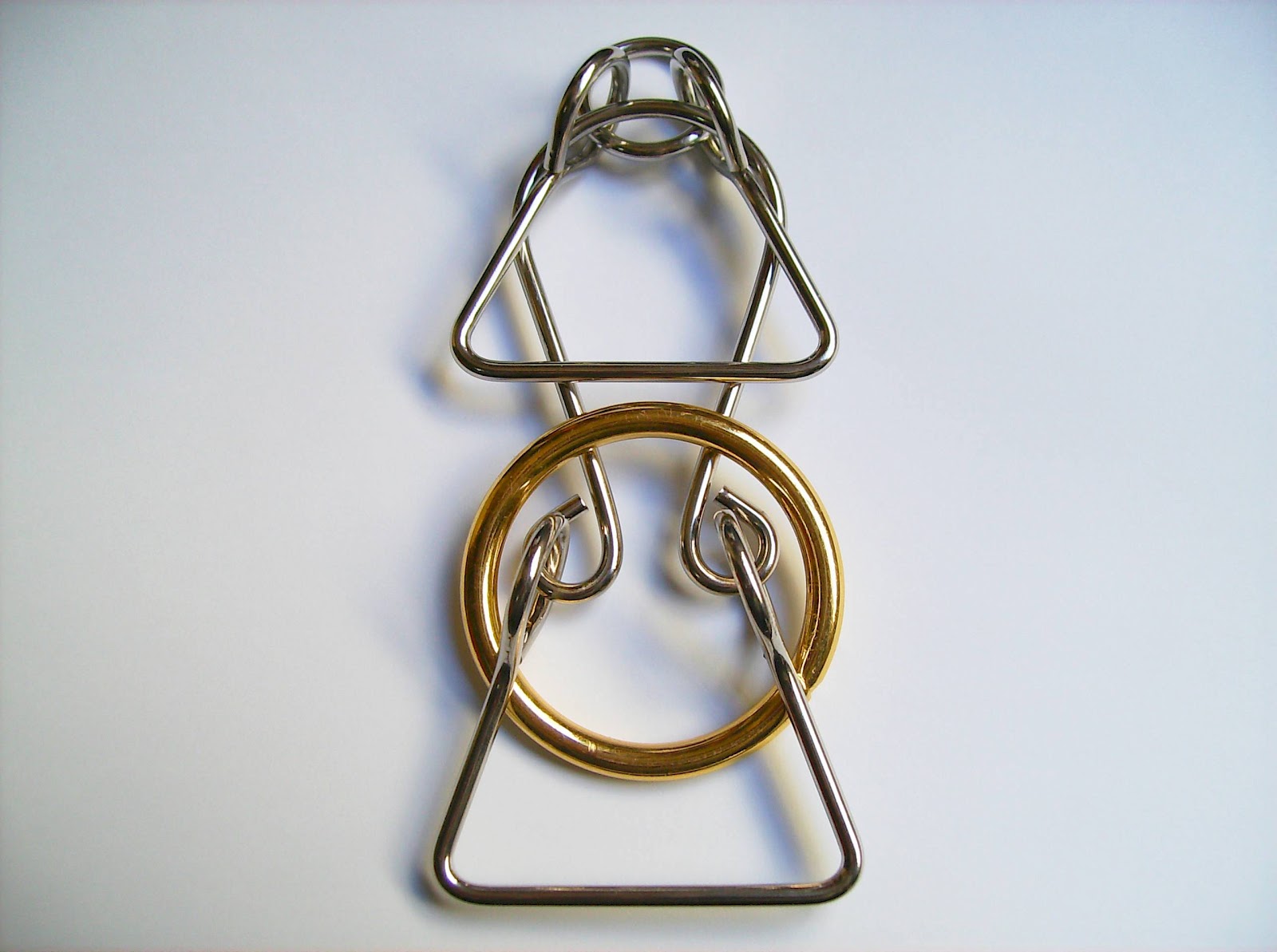
The puzzle is very well named, as it resembles a figure of a maiden in uniform. The goal, as always, is to separate or remove a part of the puzzle. In this case, a golden ring.

When you first inspect the puzzle, you quickly notice that the ring is not large enough to pass through either of the two triangular parts at both ends. It can easily go around the curved middle part, though, but it doesn't help much, as the top end gets in the way. The solution for this one, or for any other wire puzzle, is not so straightforward, but can be easily accomplished with persistence. This one took me about 10 minutes to solve.

This is rated by PuzzleMaster as a 6/10 (Tricky) and belongs to Tucker-Jones' second group of puzzles from 8 (8 being the hardest). It's far from being a complex puzzle, however it does has its advantages. If you're a beginner on this type of puzzles, these are great to learn some key movements that will prove very useful in solving many other higher level puzzles. Although you won't be using the same exact movements in other puzzles, you'll be able to solve them more intuitively.

I'll try not to give too much away about the solution, to avoid spoiling it for you. Instead, I'll write just a couple of pointers that can guide you in the right direction. As I mentioned above, the middle curved part is the only one that allows the ring to pass freely back and forth - Use this to your advantage. Another thing to keep in mind is the bottom part of the puzzle. When you try to move it past the 180º, it appears to require a little more force to come down and touch the middle part. Don't be afraid to break it. It will bend a little bit, but it's a necessary move and that part returns to the original position on its own. If after this, you still need a graphical solution, go here.

(Click to Enlarge) - Solved

The Iron Maiden is available at PuzzleMaster for about $11 CAD. If you prefer the original version produced by Tucker-Jones House, you can also get it at PuzzleMaster for $25 CAD.

Closing Comments:

For experienced puzzlers, the Iron Maiden won't be so ruthless. For beginners though, it can be still be quite the challenge, but a nice training for harder difficulty levels. This is also a recommended level to torture you friends with, but it's not so frustrating to the point that it'll make them hate you for a long time.

Related Posts Plugin for WordPress, Blogger...