PuzzleMaster

Magic Domino

Posted on Jun 25, 2014 by Gabriel | 1 comments
Labels: , , ,

(Click to Enlarge)
Vanishing puzzles have been around for over five centuries, but they weren't so popular until one man came around and change that completely. His name was Sam Loyd (1841-1911) and he created one of the most recognizable Vanishing puzzles ever, called Get Off the Earth, which was invented in 1896. He also created other interesting designs, and since then other designers followed in his footsteps. One of this designers is Jean Claude Constantin and the puzzle is called Magic Domino.

The principle behind the vanishing puzzles is quite simple and deceiving. Each puzzle is divided into smaller pieces that compose a picture. When you rearrange the pieces in a specific order it's possible to make some objects in the original configuration disappear. This trick seems like pure magic, but it's far from that. It's merely a well designed puzzle with every little detail carefully thought out to play with your mind.

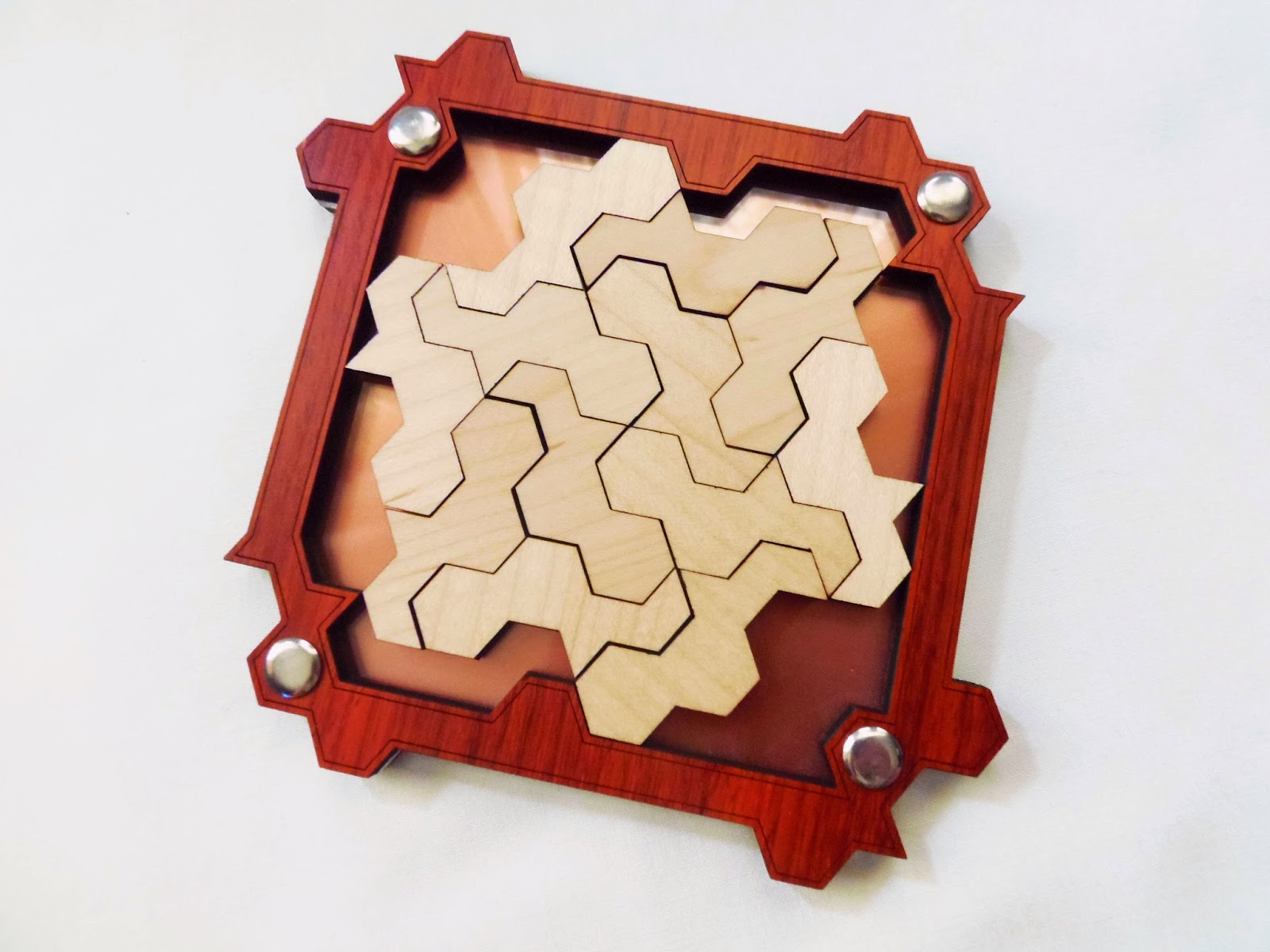
The Magic Domino is exactly like the above description. There are two sets of domino pieces, one with eight white pieces and another with seven dark brown pieces. The goal is a little more complex than the vanishing puzzles, but still similar. The idea is to swap the brown domino pieces in the tray with the bottom white pieces. Since there's a difference between the number of white and brown pieces, you need to rearrange all the square pieces inside the tray so they can accommodate the eight dominoes.

(Click to Enlarge)
The puzzle is way more difficult than I thought. It is rated as a level 8/10, and while I expected some challenge I didn't think it was that hard. It took me a few sessions and the total time must be around three hours, more or less. You might not notice this right away from the pictures, but the white pieces are slightly smaller than the brown ones. This is a key to solve the puzzle and I didn't notice it at first.

Rearranging the brown pieces at the bottom was relatively easy compared to the challenge at the top. You just need to make a slight change to the rectangular pieces. The 12 square pieces at the top, however, seem much more complicated to swap around. It's only 11 pieces actually, as the piece that reads "Magic Domino" doesn't have any indent cut into it - Could've been even harder, but the slight easiness was more than welcome. Still, finding a correct arrangement was a pain, but the result is very rewarding.


Closing Comments:

Constantin's Magic Domino is the first puzzle of this kind - not a picture, that is -  that I know of, so far. It's a brilliant puzzle and I really recommend it to anyone that knows Sam Loyd's puzzles. It provides a great challenge and, of course, it's a must-have in any collection.

Availability: You can buy a copy of Magic Domino at PuzzleMaster for $31 CAD. For other Constantin's designs click here.

Links:


MetroVille

Posted on Jun 19, 2014 by Gabriel | 0 comments
Labels: ,

(Click to Enlarge)
If you're like me and you love multi-level logic games, I bet that sometimes you feel overwhelmed with so many choices the market has to offer. It's a great time to be a fan of these games right now, with their increasing popularity. The reason for this, in my opinion, lies in several factors, like the user-friendly rules, the decent number of challenges available, and of course, the most important one, they're very addictive and fun to play, wherever you are, since they're great travel companions.

MetroVille by SmartGames is my latest addiction, from the mind of - who else? - Raf Peeters. With so many designs currently available, I'm yet to find a multi-level game I dislike. This type of games is so fascinating by the fact that there's endless designs possibilities, and whenever I try a different game, I always experience something different. MetroVille is unlike anything I've ever tried. With a dynamic board that's always changing from challenge to challenge, it'll be a while before you find yourself tired of it.

(Click to Enlarge)
The concept, I must confess, was a little harder to understand than other more traditional multi-level games. The challenge cards, for example, is one of the main differences. MetroVille has only eight challenge cards, but actually contains 64 different challenges and four different levels of difficulty. How come? It's simple, since each card features a different city and on each side of the card there's four distinct challenges (two for each difficlty). So, in total, each card has actually eight challenges. Multiply by eight cards, and there you go, 64 challenges.

The game board is where the concept really shines. Each of the nine track counters is easily removable and you can rearrange them according to each challenge card. When you pick a card and all nine counters are placed on the board, you can then twist them in 360º into four different positions. By twisting the counters you'll allow the metro to go from station to station, not necessarily all five in one challenge.

(Click to Enlarge) - One of the Starter and one of the Junior challenges solved

Each challenge has a specific order for each station the metro should pass. The metro can only go in one direction at a time and can't make sharp turns, like turning left at a crossroads. You can pass through the same path more than once, but once you start you cannot change the disposition of the tracks anymore until you reach the final station.

The challenges, like usually, start out quite easy, but as you progress to harder levels it becomes increasingly more challenging. At harder levels it's very hard to find a continuous path that passes through all the stations indicated in the challenge. You'll find yourself twisting the tracks quite a lot in an effort to find the only possible solution for each challenge. I did several of the harder levels and never found the game overly frustrating. Some challenges did took over 10 minutes to solve, but it's never boring and you'll get a great rewarding feeling once you solve one of the "master" levels.

(Click to Enlarge) - One of the Expert and one of the Master challenges solved

Closing Comments:

MetroVille by SmartGames is yet another great logic game. It promotes logical thinking and strategic planning skills as well as visual and spatial perception. It's great for kids, but also quite useful to keep your adult brain healthy. This kind of games is awesome and I can't stress enough how great they are. Highly recommended, whichever logic game you end up choosing.

Availability: MetroVille came from PuzzleMaster, but unfortunately it's out of stock at the moment. Check back soon, because they're always updating their stock. In the meantime, check out other great designs by SmartGames.

Links:


Swing Lock

Posted on Jun 13, 2014 by Gabriel | 0 comments
Labels: , ,

(Click to Enlarge)
Why do Trick Locks arouse so much curiosity in us? Why are we so attracted to these intriguing objects? Is it because they have the power to lock away secrets? Is it because they offer the possibility to be unlocked by alternate methods other than the traditional turn of a key? Or is it simply because everyone, puzzler or not, are in the same playing field, since it's up to each one's intuition and cunning to unlock its secret. Whatever it is, one thing is certain, Trick Locks are here to stay and challenge our most inner curiosity.

(Click to Enlarge) - Burgh Lock (in orange)
The object that recently attracted my curiosity and demanded to be explored and discovered is Splinter Spierenburgh's Swing Lock, his second contribution to the Trick Lock family. After Splinter's Burgh Lock (seen above), which was made from 3D-printed nylon, a material not entirely recommended for trick locks, the designer wanted to try something different...and what better way to make a Trick Lock than in stainless steel. The result is a near perfect presentation with a stunning and very well polished design, accomplished after some trial and error, also seen by the accompanied .pdf where we can witness the various stages of design and prototyping (from the LEGO concept to the first prototype in fiberboard) that took place before the final stylish version you see here.

(Click to Enlarge)

Metal Version:


(Click to Enlarge)
The puzzle has an extraordinary feel to it, much due to its heavy weight that lets you perceive the tiniest of the movements inside the mechanism which are extremely precise. This was not at all possible with the Burgh Lock, as the material was much more fragile. The puzzle measures about 8cm in diameter and 2.2cm in width (3.4" x .9"), and weighs about 625g (1.38lb) - for its size, you can see how heavy it really is. The puzzle has three screws in one of the sides, but I'm sure I don't need to tell you that they're not part of the solution...and not part of the problem either...

Like many Trick Locks, you are provided with a key - A very stylish key, I might add. How the key belongs in the solution is for you to find out for yourself. Sometimes they're necessary, sometimes they're not. One thing you'll immediately notice though, is that the key interacts with some kind of magnet (or magnets) inside the puzzle. As you push the key inside one of the two keyholes and turn it, you can feel it being attracted to something and interacting with some parts of the mechanism. You'll also be able to hear some parts rattling inside, as if there were parts moving freely around the puzzle. You need to feel the shackle's movements with your hand at all times, to know when or if you've made any real progress. The shackle has three positions: neutral, half down and fully down. When you manage to get it fully down you have solved it, and you just need to pull it up and remove it.

When you finally open the puzzle you're not all done, though. You're still half way there. Now, you need to reset the mechanism and be able to close it again. After you've successfully closed it and opened it again in a matter of seconds, thus understanding the mechanism, you can finally say you've solved it. I recommend now to remove those screws and take a look at the mechanism inside - It's a thing of beauty. You'll see the clear window that will let you peer inside, but still protects the mechanism to be accidentally tampered with. You can also put the lid back at a 33º angle so the keyhole allows you to see just a tiny portion of the mechanism. You can use it as a hint for someone struggling with the solution.

Plastic Version:


(Click to Enlarge)
Unlike the Burgh Lock, where the only option was the 3D-printed version, the Swing Lock has two version, the metal one and the plastic one. They're basically the same puzzle, but since the two materials are so distinct there's bound to be some differences. The most obvious differences (not counting the price) are the look, as the plastic (PMMA, perspex) is colored black and, of course, the weight, with the plastic version weighing only 114g (.25lb). The dimensions are about the same for the two versions.

As for the solution, there's no major differences from one version to another. I was able to solve the metal version first, in about 20 minutes or so, although it took me much more time to figure out how to close it and ultimately, understand its mechanism. Once I knew what to do I was able to replicate it without any problems in the plastic version. If you ask me what version do I prefer, I'll tell you without a shadow of a doubt, the metal version. But, if you ask me if the plastic version suffers in any way on how the mechanism behaves, I'll tell you absolutely not. It's just a matter of affordability.

Difficulty-wise, I found the Swing Lock slightly easier than the Burgh Lock. The metal surely made me more confident to maneuver it without worrying about breaking it - although you still need to worry about not breaking other things if you drop it on the floor. You need three steps to solve it, but to reset it I found that only one move is necessary. There are at least a couple of different ways to close the lock, but none of it involves doing the steps required to solve it in reverse. You have to be creative.

Quality-wise, the Swing Lock is two steps forward from the Burgh Lock, no question about it. It looks and feels professionally made, and while I don't have something similar to compare it to, like a Popplock, it's certainly worth its high price.

(Click to Enlarge)
Closing Comments:

Any Trick Lock collector and enthusiast will love the Swing Lock. I have solved many locks over my years of collecting and I can say that the mechanism is completely unique and original. Both puzzles function as they should, there are some good red herrings along the way to keep you from discovering the solution too soon, and whichever version you end up choosing I'll guarantee you you'll have an amazing experience with it. A must have for any puzzle collector.

Availability: You can get both metal and plastic versions at MFAVE. If at any time there's a shortage of stock, you can be placed on a waiting list by contacting Splinter directly here.

Links:

Another review and discussion about the Swing Lock

Yet another review for the Swing Lock


Euro Krise

Posted on Jun 11, 2014 by Gabriel | 0 comments
Labels: , , ,

(Click to Enlarge)
With all the current economic situation in Europe, Siebenstein-Spiele's Euro Krise seems like an appropriate choice to spend some free time. You won't need a doctorate in economy to solve this one, but it might be harder than you think. Can you solve, at least, this small crisis and put some order back in the provided tray?

Designed by Siebenstein-Spiele's main designer Jürgen Reiche, and made from laser-cut wood in two colors, the circular tray measures only 10.5cm in diameter (about 4.1"). Inside, it holds 12 coin-shaped pieces cut in different ways. With the exception of two perfectly round coins, the other ten pieces all have distinct shapes that can only be arranged in one unique solution. This makes for one rather challenging puzzle, and since this is a packing puzzle, be prepared for a lot of trial and error.

(Click to Enlarge)
The design of the Euro Krise is fantastic. The cuts in the pieces give the illusion of a 3D effect, as if the pieces overlap each other. Each coin is engraved to look as close as possible with a real Euro coin, although the diameter is slightly bigger on the wooden version (27mm, as opposed to 23mm on a real coin). The width is also thicker in the wooden version.

Rated as a level 8/10, the difficulty of the puzzle is right at the limit of what can be considered a frustrating puzzle. Because the pieces are round, there's a lot of possibilities when you're placing a certain piece. It took me over an hour and a half to finally solve the puzzle, and even then the pieces didn't move as loosely as they did before I took the pieces out. It requires a little adjusting to get the pieces in the right places, at first giving the impression that it's not the real solution you've just found. The pieces are only engraved on one side, so they can't be flipped - It can be a positive thing, since there's less possibilities to place a certain piece.

(Click to Enlarge)
Closing Comments:

Euro Krise is a cleverly designed puzzle, very challenging, but also quite rewarding when you finally solve it. It's not among the best by Siebenstein-Spiele, but certainly above average for a packing puzzle, especially how well presented it is - Something that this company excels at.

Availability: You can find the Euro Krise puzzle at PuzzleMaster for about $19 CAD. For others designs by Siebenstein-Spiele click here.


Ring on a Stick

Posted on Jun 6, 2014 by Gabriel | 0 comments
Labels: , ,

(Click to Enlarge)
Ring on a Stick is the second puzzle from Dimiter Vakarelov I've had the pleasure to solve so far. Recently, I've received a very nice package from Dimiter with several unique string puzzles, all designed and handmade by him, and among them there were these three amazing puzzles that were made using real wooden sticks - Something I had never seen before, although Dimiter took inspiration from one of Kirill Grebnev's designs, the Attached Ring.

The Ring on a Stick puzzle is a little different from the first puzzle I reviewed from Dimiter, the Cherries on a Stick, but not that different... On the outside, both puzzles look quite different from each other, and besides the stick and the metal rings, there's not much similarities. So how come they are so similar in their solving methods? This is what's so fascinating about this type of puzzles. You have to discover for yourself what principle - or combination of principles - comprise the solving method for each puzzle.

See, all these string/wire puzzles you ever saw are based on only 5 or 6 different principles. It's up to designer to find different ways of utilizing these principles and using different combinations to create a new puzzle. So, for every string/wire puzzle you solve there may be one, two or even more principles represented in the design, and the fun in them is to apply your previous knowledge learned from other puzzles. It sounds easy in theory, but I'm far from understanding all principles, and sometimes it's quite difficult to visualize how to solve a certain puzzle, even if you've solved a hundred different ones before. It all depends if the designer was successful to mask and hide as best as possible the principles used in the puzzle.

The goal in the Ring on a Stick sounds easy enough to understand. Just find a way to remove the big wooden ring. To make your task a bit more fun, a metal ring and a string, which is too short to be stretched across the entire length of the stick, make the design quite challenging but still easy enough for an experienced puzzler. Attached at the end of the string is a small wooden bead that's too large to pass through the opening in the metal ring, and the protuberance at one of the stick's extremities is too large for the wooden ring's diameter, but there's a simple way to overcome that...

The Ring on a Stick was a very pleasant surprise in the way that it only took me a couple of minutes to solve after I had solved the Cherries on a Stick - which by the way took me a few hours. This is a bit difficult to explain in words, but to make it simple, both puzzles use the same principle. I had the fortune of finding out almost right away that the Ring on a Stick had to be solved in a similar way, in other words, the string had to pass from the inside of the metal ring to the outside. After that, the wooden ring was all but free.

In terms of difficulty, the Ring on a Stick is slightly easier than the Cherries on a Stick. Not only because I already knew the solving process, but because I believe it's easier to do the steps required to solve. They're easier to understand. I'd classify it as a level 7/10. As a reference, the Cherries were to me an 8/10.

(Click to Enlarge)
Closing Comments:

It's hard to choose from the two puzzles which one I prefer. They're both so original and fun to solve, I wouldn't want to choose. For a beginner, the Ring is probably a better choice to start, but it's always a bit relative when it comes to classify string/wire puzzles.

Availability: Dimiter can produce any of these puzzles on request. For prices and other questions, drop me an e-mail and I'll put you in contact with him.


3L

Posted on Jun 4, 2014 by Gabriel | 2 comments
Labels: , , ,

(Click to Enlarge)
Another puzzle from the genius of Jean Claude Constantin, 3L is a perfect example of simple becoming complex. Not among his hardest puzzles - not even close - but probably the hardest 3-piece packing puzzle I've ever tried.

The design is a bit intriguing, since the tray is shaped like a horseshoe. Not sure what's the significance behind that choice. Also, if you look closely, there's three holes in the right part of the tray and four in the left. I'm probably over-thinking, but it does make you think if there's more to it than meets the eye... The colors chosen for the puzzle, as always, work like a charm giving the puzzle more character and elegance - There's a total of five different wood colors, including the three pieces.

The goal of the puzzle couldn't be simpler. You're given three different sized L-shaped pieces and a tray with an irregular area, and the object is to try and pack all the pieces. There's only one way to do it, and the pieces can't go over the edges. The dimensions of the pieces and the tray are just right to make you believe a certain arrangement is possible, but you always end up a millimeter or two short of packing that final piece.

The difficulty of the puzzle is rated at a level 7/10, and I reckon it's quite accurate. It's not so easy that you'll be able to solve it in a couple of minutes, but not throw-it-out-the-window difficult either. I've managed to solve it in about 15 minutes or so. The solution is not that obvious, but with a lot of trial-and-error - yes, I know that's not the ideal strategy - you'll eventually solve it as well. Just don't think in straight angles...

Solution: If you're stuck, click here to check out the solution.

Closing Comments:

3L is a fantastic puzzle. Constantin manages to create a simple and yet challenging puzzle that's perfect for anyone to try, even non-puzzlers. It's a good one for someone that usually doesn't get along with packing puzzles, since it's not frustratingly hard.

Availability: Unfortunately, the 3L puzzle is currently unavailable at PuzzleMaster. Check back often to see if it's back in stock, and in the meantime you can browse other great designs by Constantin.

Links:


Combination Lock

Posted on Jun 2, 2014 by Gabriel | 2 comments
Labels: , , ,

(Click to Enlarge)
Nowadays, Trick Locks seem to be made from many different materials, as opposed to the traditional metal locks that can be seen everywhere. An example of this type of puzzles is the IQ Locker series by Mi-Toys, a collection of four different Trick Locks made from natural wood. There are some downsides associated with the choice of wood for Trick Locks, but the low production cost seems to weigh more in the end, and the quality is fairly decent to dismiss them, as they're a nice and cheap alternative to their more expensive metal counterparts.

The first puzzle from the IQ Locker series I've acquired is the Combination Lock, an intriguing design reminiscent of a number locking mechanism seen in many products, like suitcases. The only difference is that there's no numbers in the Combination Lock, but something more subtle instead... The puzzle seems well built, considering how low the price is, with a polished and clean look. Its dimensions are 14.5cm x 5.9cm x 1.8cm (5.7" x 2.3" x 0.7"), which is pretty nice overall for this kind of puzzle.

The mechanism in the Combination Lock is rather interesting, because it has its similarities to another known mechanism, but it still manages to differentiate itself from it with a clever design. The cogs, at first sight, don't seem to have anything special to them - Just three simple acrylic cogs. However, at close inspection, you'll see something surprising. The dents in each of the three cogs have different thicknesses and are spaced in different intervals. Now, I can't say everything about the mechanism, but I'm sure you can have an idea of how they should interact with the internal parts of the shackle. The goal is open and then close the lock.

(Click to Enlarge) - Partially Opened
The Combination Lock looks more difficult than it actually is. I also find it strange that it's classified as a level 5/5 - Far from it, actually. It took me less than 5 minutes to open it, but here's the kicker, I didn't know right away it was solved. Why? Because I was under the impression that I had to completely remove the shackle from the puzzle. It turns out that you only need to open the shackle twice as high as its original size over the top edge. It actually took more than 10 minutes to figure it out, so I guess you could say I took around 15 minutes to solve it. It all comes down to interpretation of the instructions, which only mentions "Open it" and "Unlock it". There are cases where you can completely remove the shackle from the puzzle (including one I've recently solved), so that's what my initial confusion was all about.

The puzzle has two different stages until it's fully opened, so you need to rotate the cogs one a time to pull the shackle all the way up. Closing the lock is much easier, since you can see how the cogs will interact with the shackle. Difficulty-wise, I'd say it's more like a 3.5/5.

(Click to Enlarge) - Fully Opened (Without Revealing Much)
Closing Comments:

The Combination Lock was a nice surprise, considering my expectations weren't as high as for a metal lock. Yes, you have better feedback from a metal mechanism, but in this case I believe you don't lose too much with the wooden/acrylic mechanism. Pretty good puzzle, overall, and recommended for Trick Lock enthusiasts.

Availability: The Combination Lock, as well as the others in the IQ Locker series, can be found at Brilliant Puzzles for just $10.95 USD each.


4 Plaques

Posted on May 28, 2014 by Gabriel | 0 comments
Labels: , , ,

(Click to Enlarge)
4 Plaques is an interesting puzzle from Jean Claude Constantin, very much different from the packing puzzles he usually makes. It's also not much of a surprise, since he often makes other kinds of puzzles, which is always welcome.

The name of the puzzle is self-explanatory. Four plaques with holes in different combinations are held in a cubic shape by four pieces with pegs (one peg in each of the four sides), and all of the pieces rest in a half-cube frame, which also features holes in its walls to fit the two plaques touching it. The goal is to take all the pieces apart and try to put them back to their cubic form. Classified as a level 8/10, this will be a little bit tricky once all the pieces are mixed up. Also, both the plaques and the pieces can be flipped and rotated, so it all adds up to a high number of positions.

(Click to Enlarge)
The puzzle itself is very well built with natural wood (hence the higher price). The plaques have a darker tone whereas the square pieces have a more lighter color, giving it some contrast, so the puzzle doesn't appear as a cube of the same color. Note that the colors may vary from the pictures, as you can see from mine and PuzzleMaster's. The dimensions are just right, neither not too small nor too big, measuring 7x7cm (2.8").

Solving the puzzle may seem a bit intimidating at first, due to the different configurations of the plaques and the possible high number of combinations, but it's actually not that complicated. The idea is to go by a process of elimination. You should start by trying to fit the first piece with all four plaques around it. Bear in mind that sometimes more than one piece will fit in a 2-plaque configuration, so be prepared to make changes as you progress.

If you get stuck by the third or fourth piece, try to put a different piece at the bottom, and so forth. Since there's only four pieces, you shouldn't be looking at more than an hour's worth of puzzling. It took me about 20 minutes to solve it, and I never felt frustration kicking in. Once you have the plaques all in their positions you still have to place them correctly in the frame, but here you only to make a couple of rotations until it all fits.


Closing Comments:

Constantin's 4 Plaques is a nice change of pace from his 2D puzzles and presents a different kind of challenge. The quality, as always, is unquestionable and that will reflect on its price. It's nevertheless a great puzzle for any collector or serious puzzler.

Availability: The 4 Plaques puzzle is available from PuzzleMaster for about $40 CAD.Click here for more designs by Jean Claude Constantin.

Links:


Cherries on a Stick by Dimiter Vakarelov

Posted on May 27, 2014 by Gabriel | 3 comments
Labels: , ,

(Click to Enlarge)
A few weeks ago I got in the mail a nice package with several string puzzles, all designed and made by my puzzle friend Dimiter Vakarelov. Dimiter is a mathematician, so coming up with all these different and interesting designs comes natural to him. As you can see from the image above, his designs are highly original and, of course, quite difficult. I'm going to describe in more detail one of the puzzles I already solved, the Cherries on a Stick.

(Click to Enlarge)
The design of the Cherries on a Stick is quite unusual, especially if you're used to the mass-produced string puzzles. Inspired by Kirill Grebnev's Attached Ring puzzle, Dimiter decided to use for this puzzle an actual wooden stick from natural wood. Only the wood bark was peeled off, leaving a beautiful natural color. The rest of the design is complemented with two bright red beads and a highly malleable string, which is actually quite useful in the solving process. The main piece - the one you're supposed to remove from the puzzle - is an odd-shaped metal ring that moves somewhat freely along the stick's length.

The goal of the puzzle is pretty straightforward. As I mentioned above, all you have to do is find a way to remove the metal ring from the stick. The "how", however, is anything but straightforward. Keep in mind that even though this was the first of the seven I've managed to solve, it doesn't mean it's easy. It just means it's easier than the others. In terms of difficulty, I'd say it's around a level 8/10.

So, how do you solve this thing? On one end, the stick stretches out in two opposite directions, making it physically impossible to remove the ring from that side. That means the ring has to come out from the bottom end of the stick. The only problem is that both Cherries prevent that from happening, since the string is too short to guide the ring all the way to the end. That's when a couple of tricks involving the string and the ring come in handy. The idea is to free one of the cherries from the ring, which in turn frees all the string's length enabling you to slide the metal ring out of the stick. It's not easy to discover this process, although with a lot of experimentation and persistence you'll start to see it from another perspective.

It took me a few hours to solve this puzzle and, on the first time I was able to remove the string I didn't have a clue how I got there. I managed to reset it after much trial and error, and after another dozen times solving it, I am now able to understand what's going on. I could still be solving it with an extra step or two, but I can do it fairly easy now, both the solving and the resetting parts.

(Click to Enlarge)
Closing Comments:

Dimiter's Cherries on a Stick is a brilliant puzzle. I've never seen anything even remotely similar in my six years of collecting. Both the design and presentation are flawless, and because it's handmade it has even more meaning for me.

Availability: Dimiter produces his puzzles in very small quantities, and in some cases he might need some time to make extra copies, but if you're interested in any of his designs drop me an e-mail and I'll send you his contact.


IQ Link

Posted on May 21, 2014 by Gabriel | 0 comments
Labels: , ,

(Click to Enlarge)
SmartGames is fast turning into one of the best companies that produce the ever so popular multiple-challenge games. Also present in the virtual world (PCs, Tablets and Smartphones) just as much as their games in the physical form, it's no wonder they're taking the games' market by storm. I'm a sucker for these logic games and I own many of them in my collection. My latest addition is the new IQ Link, designed by Raf Peeters, who's responsible for most of the SmartGames' creations.

What captured my attention right away were the colors and shapes of the pieces, which are quite unique in this type of games. The colors are vibrant and have this transparency that absorbs light from all angles and gives them an extra shiny look. The pieces consist of three parts and each one features a different combination of them: these parts can be a closed ring, an opened ring or a ball.

There are 12 pieces and a total of 36 parts, and all of them have to be packed inside a frame with space for only 24 parts. How will you do that? You have to find ways to link the pieces so that some of them will occupy the same space (like a ball linked to an opened ring). There are a total of 120 challenges - which is a lot compared to other games in the market - and they're divided in five different levels of difficulty, giving you a sense of progression as you work your way to the hardest level, Wizard.

The challenges start out very easy, with most of the pieces already placed inside the frame. All you have to do is find a way to link the remaining pieces in the few spaces left. As you progress into harder levels, the number of pieces already packed will slowly decrease until only a couple of them lie scattered in the frame. The last challenge (#120) only shows one piece in the frame.

Also worth noting is the fact that each challenge only has one possible solution. I found that most challenges until the end of the third level are fairly easy to solve, not taking you more than a couple of minutes. As you reach the last two levels, though, the challenges will get rather tough and some of them took me over 10 minutes to be solved. I haven't reached the last challenge yet, but it does look scary...

(Click to Enlarge) - Challenges 5-51-115 Solved

Closing Comments:

These games are described to develop logical thinking skills, strategic planning and visual and spatial perception. While they won't make you smarter, they'll certainly help to keep your brain healthy.

To my knowledge, there are three games in the IQ series by SmartGames: the IQ Fit, the IQ Twist and the IQ Link. By what you've read, it shouldn't be a surprise then, which one is my favorite. I strongly recommend these games to anyone, because the different levels of difficulty cater to any skill level. Raf Peeters is a genius and I look very much forward to find out what his next big game will look like.

(Click to Enlarge) - Why can't a 6 or 7-year-old play IQ Link?
Availability: PuzzleMaster is the place to find everything SmartGames.

Links:


T-Puzzle

Posted on May 14, 2014 by Gabriel | 0 comments
Labels: , , ,

(Click to Enlarge)
The Tangram has been around for so long that it is believed to have originated over 4000 years ago in ancient China. While that may be an exaggeration due to folklore, it is no doubt one of the first puzzles ever to be invented. The puzzle has inspired so many variants over the centuries that it's impossible to name all of them. In this review I will show you a cool and simple puzzle made by the Siebenstein-Spiele's main designer, Jürgen Reiche, the T-Puzzle.

What mainly differentiates the T-Puzzle from the original Tangram, besides the shapes themselves, is the number of pieces. The T-Puzzle only has 4 pieces, as opposed to the 7 pieces of the Tangram. Does that make it harder or easier, you may ask? I believe it's neither. The difficulty level is about the same between the two puzzles, simply because the goal is the same: to solve one of the many different shapes you can only count on the silhouette of the shape, since you can't see the outlines of individual pieces. That's what makes the puzzles so challenging.

(Click to Enlarge)
The T-Puzzle comes in a nice arrow-shaped tray - another difference from the square-shaped tray that Tangram is usually presented in. Actually, it's not even possible to make a square out of those four pieces. The pieces are surprisingly thick (8mm, or .3"), because they feature a different color on each side. The material used is the usual laser-cut wood which, even though is not very good in quality, makes it very easy to work with and it's quite affordable to produce. The presentation of the puzzle, like many other Siebenstein-Spiele designs, is perfect: different wood colors, laser engraved pieces and tray, extra smooth finish...

(Click to Enlarge) - Some Random Shapes

As expected, like in a Tangram variant, you can build countless shapes with the four pieces provided. The description does mention that the main shape you should try and solve is a T, but it also comes with many other interesting shapes to build. The possibilities don't end there, since you can also come up with your own shapes. Although most of the shapes are challenging to solve, the difficulty varies slightly from shape to shape. The main challenge, which is to build the letter T, is actually rather easy, but there were others much harder to solve, some even look impossible to create with just those four pieces. The shape that you see in the tray, the arrow, is the easiest to make, simply because you can use the edges of the tray to your advantage. The pieces have two colors, but when you're trying to solve a particular shape don't mind the colors, because more often than not the final arrangement of the pieces will be a mixture of both light and dark colors.

Update: Unlike I first thought, the T-Puzzle wasn't developed by Jürgen Reiche, but actually by the late Nob Yoshigahara, known as Nob's T Puzzle. Jürgen only updated the design to include pieces with two sides of different colors.


Closing Comments:

The T-Puzzle is an excellent puzzle to keep around, as you can always build something different every time. Like the Tangram, it can create more shapes than you will ever build, and you'll also be tired of it long before that.

Availability: PuzzleMaster is the place to get a copy of the T-Puzzle. They also have many other interesting puzzles by Siebenstein-Spiele.


Bloß Nicht Schwarz Sehen

Posted on May 9, 2014 by Gabriel | 3 comments
Labels: , , ,

(Click To Enlarge)
Bloß Nicht Schwarz Sehen - This is a rather original name for a puzzle, and knowing Jean Claude Constantin, you should expect it quite often. If your German is a little rusty, don't worry: it literally means "Just Don't See Black". At first, this might not make much sense to you, but that's exactly what you're supposed to do with it...

With a very cool design, also to be expected by Constantin, Bloß Nicht Schwarz Sehen will be quick to draw your attention, as its particular geometry and uniquely shaped pieces have a way to mesmerize even the most oblivious. The tray is made with a combination of laser-cut wood and acrylic, and a reflective sheet of special paper makes the mirror effect really stand out. This effect isn't made for merely aesthetic purposes, though. Its use is actually very important for both the goal and solution of the puzzle. The 12 pieces are all identical (each a combination of 9 rhombi) and they're also made with laser-cut wood, but in a different color for a more dramatic effect. The puzzle measures about 13.8cm (5.4"). Note: The puzzle I received has a different color combination than the photo on the website, but it's basically the same puzzle.

(Click to Enlarge)
So, as the name suggests, you are expected not to see black when the puzzle is solved. What does that mean exactly? Well, the puzzle comes in a state that looks solved but that's actually not the main goal. As you can see from the first photo, the pieces are scattered around the tray, but in a way that let's you see some parts of the black circle in the middle. The object here is to rearrange the pieces so that no parts of the circle can be seen.

The solution is also symmetric, but in a different form. When solved, the pieces should not be able to move freely around the tray. The puzzle is somewhat challenging, but not to a point of frustration. The pieces are identical, so that part is a plus. You only need to worry about rotations and flipping them - The solution requires using half the pieces on one side and half on the other. To my knowledge, excluding those rotations and flips, there's only one solution.


Closing Comments:

Bloß Nicht Schwarz Sehen is a great puzzle. Not because its concept is completely new - I've seen some puzzles that use this cover concept - but because its design is absolutely stunning. The presentation of Constantin's puzzles are always perfect and this one's no exception. Definitely recommended for collectors and enthusiasts alike.

Availability: You can get a copy of the Bloß Nicht Schwarz Sehen at Brilliant Puzzles for about $30. You can also see here other designs by Constantin.


Related Posts Plugin for WordPress, Blogger...