PuzzleMaster

Gerdig UFO

Posted on Aug 1, 2010 by Gabriel | 0 comments
Labels:


(Click to Enlarge)

The Gerdig UFO is a Slovak brainteaser invented by the engineer Gerhard Huncaga in 1991.

The puzzle has two layers that slide in relation to each other and eight spheres that are split in half in order to rotate with the two-layer disc. At the center of the disc is a button that can be pushed up or down, but only after you rotate the discs, to mix up the spheres. When you push this button, a sphere (or more than one, depending on the difficulty) is rotated 180º and each half is now at opposite layers.

After the puzzle has been all scrambled up, it's time to solve it. Here you'll have five choices regarding it's difficulty. At the back side of the middle button there's a screw that when opened, will reveal the mechanism inside responsible for rotating the spheres. You can manipulate it to allow one sphere to be rotated, two opposite spheres, four spheres in a cross pattern, two spheres separated by 90º and three spheres, also separated by 90º from each other. The first level is trivial to solve, but the others are a bit more complicated, where you'll have to think about a strategy to solve them.

In terms of appearance, the puzzle could look a lot more cool, perhaps if it were chosen a different color scheme. As it is, it kinda looks like a baby rattle. Not that there's anything wrong with that... Other than this, the puzzle is a lot of fun to play with and the different levels of difficulty add to it a great replay value.

You can buy the Gerdig UFO at Milan's Puzzles.

(Click to Enlarge)

Links:

Jaap's Puzzle Page (Solution and JavaScript version of the puzzle)

Atomic Chaos

Posted on Jul 29, 2010 by Gabriel | 0 comments
Labels:


(Click to Enlarge)

Atomic Chaos (a.k.a. Kaos) is a Rotational/Sequential puzzle invented by Christoph Hausammann in 1990. 

It has six half-filled tubes with colored balls. The version I have is comprised by one back ball, two whites, three green, four red, five blue and six yellow. There's at least another version with different color arrangements, like six red balls instead of six yellow.

The goal here is to scramble the puzzle by tilting the tubes right or left and rotate it at the middle to join tubes with different lengths, thus getting different colored balls in the same tube. When you have scrambled it, the most efficient technique is to use a sequential type of movements to get the balls back into their correspondent tube. You can start by tilting the puzzle to one of its sides and join the longest tube with the shortest. Now just rotate it, clockwise or counterclockwise depending on the side you tilted the puzzle, and you can see the balls falling one by one to each tube. Try to restore first, the longest tube with its respective balls and lastly, the shortest one.

It's not a very difficult puzzle, although a bit tedious to solve. Once you get how it's supposed to be solved, it's just a matter of time, due to its nature of sequential movements. It's more fun to scramble, though :-p ... The Tower of Hanoi, the Spin Out or even the Olympic Wander Rings are puzzles of similar difficulty, where you have to perform a sequence of movements to solve them. 

They're quite rare to find these days, but as of the time of writing, there's still a few for sale here.

(Click to Enlarge)

Links:

Jaap's Puzzle Page (Solution)

Youtube Video (Solving)

Varikon Box-2x2x2 - Random Pick #8

Posted on Jul 25, 2010 by Gabriel | 0 comments
Labels: ,


(Click to Enlarge)

This is the 8th Random Pick from My Collection.

This week, I picked the Varikon Box, invented by Csaba Postasy, Gabor Eszes and Miklos Zagoni in 1981.

The puzzle has 7 internal cubes and you move them by sliding one cube at a time to an empty space inside. This is accomplished by just tilting the box.

There are several color versions of this box size and other versions for the 3x3x3, as well. The 3x3x3 is closely related to other puzzles of the same type, like the Vadasz Cube or the Peter's Black Hole.

The 2x2x2 is a starter version for the larger one so, if you have both versions, start with the smaller to get familiar with the movement and solving techniques. It's a fairly simple puzzle, but with a deceptive solution, because when you inspect the puzzle, it appears as if it has two possible solutions for the outside color, although just one is actually solvable. The 3x3x3 is just slight difficult, as it only moves the outer cubes of its faces, due to the fact that the center ones are fused together with the central cube, reducing the total number of possible movements.

It's very enjoyable to play with, if you're into this type of sliding puzzles and has a very original and simple design, because you don't have to actually touch the cubes to make them move, unlike the similar versions.

The puzzle is now quite rare to find, though you may be able to find one of its version at eBay sometimes. Just keep looking regularly or you can use the 'Save Search' feature on eBay, and you'll be notified every time it appears one for sale.

Links:

Jaap's Puzzle Page (Solution and Javascript version of the game)

Youtube (Video Review)

Svetnashki - New Versions

Posted on Jul 21, 2010 by Gabriel | 2 comments
Labels:

A couple of months ago, I made a review about a new type of puzzle, the Svetnashki. Refer to this review for a detailed explanation of the puzzle.
Now, I'll review two of its new versions along with the 10cm Classic version (the first one had 7cm).


(Click to Enlarge)

This new version extends the playing field to a 6x6 grid, so now you can make much more elaborate patterns.

The goal is the same. Get all the tiles polarized (dark), all transparent or just let your imagination run free to create all sorts of patterns. Like the 4x4 Svetnashki, you can also make any possible pattern you can think of in a 6x6 grid, because you can polarize any tile that you want. 

The design is similar to the 4x4 Svetnashki that I first reviewed, with the slimmer body. Only the outer boarder is purple, giving it a more classy finish.

Regarding its difficulty, it's a little bit more tricky to handle than the 4x4, mainly because this time you have more tiles to maneuver, which can make you slide a tile that you didn't want to move or you may find yourself frustrated, trying to get a tile to a particular place without moving the others behind it. Now, If you don't want to turn this into a dexterity puzzle, you have to apply a technique to help you move a tile and, at the same time, keep the others in place. The best I've come up with is this: when you want to move a specific tile, hold and push the first tile of the perpendicular row just behind that one. This is going to stop the other tiles of the same row to slide together with the one that you want. Now just tilt the puzzle on the direction you wanted, to allow the desired tile to slide into place.

To conclude, when you have total control on which specific tiles you want to move, the puzzle will be very fun to play with and much more entertaining than the 4x4, giving that you can make more complex patterns.

(Click to Enlarge)

VIDEO - The video isn't top-notch, but you get the general idea. It's a little hard to manipulate the puzzle in front of a camera, when you have much more control over it, playing face down. Also, because the puzzle is made out of clear glass, you can see some light reflexions on it... 

**************************************************

Svetnashki Double


(Click to Enlarge)

This is a tricky one... As the name suggests, it has two playing fields, one on each side.

The size and design is equal to the smaller 4x4, but larger in width and it's orange. Again, nice finishing touch to distinguish the different versions.

The main goal is similar to the previous ones except with this one, things get a little more complicated. Now, you not only have to think about creating patterns on one playing field, but you have to worry about the other side as well. 

Difficulty wise, this is the harder one of them all, even if you're now the master of the 6x6. When you move a tile from one side, the others from the back side move too and it's much more difficult to block these from slide, with just two hands. In order to get a particular pattern, you have to move both fields synchronous with each other, so that each correspondent tile from each side moves together in the same direction. Like the 6x6 Svetnashki, you have to come up with a practical technique to manipulate the puzzle (a suggestion would be to insert a piece of paper in the empty tile space and just solve one field at a time, but I think that would be a sort of cheating...).

Besides the main goal, in other words, to create an exact pattern in both sides, you can take advantage of the double fields to create other shades of polarized tiles and make different patterns. So you'd get clear tiles, back side polarized tiles, front side polarized tiles and both sides polarized tiles.

In conclusion, it's a joy to play with and a very challenging puzzle, but isn't that what a puzzle lover is after?

(Click to Enlarge)


**************************************************

Svetnashki Classic


(Click to Enlarge)

This is my favorite, design wise. It's visually the most pleasing one, with the same 4x4 field, but larger in both length and width and with more beautiful finishing touches. Definitely a must have for a collector. 

The classic design has a few advantages over the slimmer 4x4. For example, you can manipulate the tiles much more easily, because the apertures in the field let's you slide all four tiles of the outer boarder, instead of just two in the slimmer design. Also, because of the larger and heavier size, it's easier to hold it without the fear of letting it slip out of your hands.

It would be great to have the other versions made in this design as well. Looking at them from a collector's point of view, it would be much more appealing to have each version with all these amazing finishing touches (maybe a suggestion for the building company, when they release new versions). Until then, I urge everyone that still don't have a Svetnashki puzzle, to buy at least the version that pleases you the most.

(Click to Enlarge)


Availability: PuzzleMaster has several different versions available.

Sloyd Puzzles

Posted on Jul 19, 2010 by Gabriel | 5 comments
Labels: , , ,


Sloyd (Tomas Lindén) is a Finnish wooden puzzle builder. His puzzles range in difficulty, but the harder ones are the better. The particular two puzzles below are among these latter ones.

First, I present the 'Lox in Box II' designed by Vesa Timonen (also the designer of the Cast Loop by Hanayama). As the name suggests, it's the successor of the 'Lox in Box' also designed by Vesa.

(Click to Enlarge)

The puzzle presentation is visually very pleasant with very nice finishing touches, like its name engraved in the box, making a great contrast with the light color wood.

In comparison with the first version of 'Lox in Box', this new design is a little bit harder. The box is smaller, but the number of logs are the same. You also have to think "outside the box", like the first version, to solve this one. 

I will not show a picture with the solution, as it would ruin the solving experience and spoil the "surprise factor" after solving a difficult puzzle...

****************************************************

Next, I present the 'Capital H' puzzle, also built by Tomas and Designed by Vesa.

(Click to Enlarge)

The goal is simple. You have to build the letter H with the seven pieces.

This one is even more difficult than the 'Lox in Box II'. Looking at the pieces, it appears like any other Letter puzzles (i.e. Letter T) though, things aren't always what they look like. Based on this, you may want to approach a solution at "another angle".

It's a simple looking puzzle, but with a very clever design and an unexpected "twist". As the previous puzzle, I will also not show a solution picture. I'll leave it to the puzzle enthusiasts that like a real brainteaser...

In conclusion, I was very impressed by the overall quality of the puzzles. They provide a nice challenge and look amazing on a shelf or a desk. Highly Recommended.

Edit: Refer to this newer post for another review of a Sloyd puzzle.

Gordian's Knot - Random Pick #7

Posted on Jul 17, 2010 by Gabriel | 4 comments
Labels: ,


(Click to Enlarge)

This is the #7 weekly random pick from My Collection.

Gordian's Knot (also known as Extreme Torture) is a concept with hundreds of years old. Frans de Vreugd is the person behind the creation of this mind-boggling modern version, released in 2002.

This Gordian's Knot is made out of six colored interlocking pieces and you complete it by taking it apart. At first, only one piece is able to move back and forth. Then, with each slide of a piece, other possible moves become available. It requires at least 69 different moves to be completely taken apart. It's one of the most difficult puzzles of this category and it's also as difficult to put back together as to take it apart, where you have to take into account the position of each piece and the exact order that each needs to be inserted.

The history of the original Gordian's Knot is found on the solution booklet of the puzzle and says:

The original Gordian Knot is a famous story from the eigth century B.C. Asia Minor. As the story goes, the people had lost their king and their oracle announced that the next person to ride into town pulling an oxcart would be the new ruler.

That person was Gordius, who, once crowned, tied up his cart with an extremely intricate knot. Over time, legend grew that the person who solved the knot would rule the world. For 400 years the knot remained a puzzle until Alexander the Great solved it and went on to rule great Kingdoms.

Since ancient times, the Gordian Knot has been synonymous with the unsolvable puzzle. Today the tradition of the world's toughest puzzle continues. Our modern version will challenge your intellect and try your patience, but who knows, once you solve Gordians Knot, you too may rule great kingdoms."

Video Demonstration


The puzzle can still be bought at Puzzle Master and is often found on eBay.

2x2x4 ShengShou - God of Freedom

Posted on Jul 10, 2010 by Gabriel | 0 comments
Labels:


(Click to Enlarge)

This is a 2x2x4 ShengShou - God of Freedom or simply a Super 2x2x4.

Well, this puzzle is a breath of fresh air. Looks a bit unusual, not that there's anything wrong with that, but very original. For some reason, it resembles LEGO. The wheels in the middle add it a deeper challenge than a regular 2x2x4, assuming all kinds of forms. Now, besides solving for the original cubic form, you also have to bear in mind the wheels, which may look a bit scary at first, but a nice touch on an otherwise simple cuboid. You can also see my video showing some movements of the puzzle.

The stickers are all made of plastic so, no problem with peeled stickers (see photo below of the internal mechanism with stickers out of cubies and a wheel piece). 

The internal mechanism, with screws inside, shows that the tension of the puzzle can be adjustable, although it turns rather good as it is. The wheels can be a bit tricky to turn when there's not a cubie (or more) attached to them, but if it's well aligned you shouldn't have any problems. 

The puzzle is very fun to play with and solving wise, although I didn't try to make a full solve yet, it's a bit more difficult than a 3x3x3, but perhaps not more than a 4x4x4. You'll probably want to try and solve the original cubic form first and then, rearrange the wheels as the last step. If you're too scared to mess with the wheels, you can just solve it by cubic form, which could also be a bit challenging when you have it all scrambled up.

Edit: I just made a full solve and I loved it. It looks harder than it actually is. It's not so hard that just makes you frustrated, but also not so easy that just takes the fun of it after a while. You're gonna enjoy it very much. 
The method I used to solve it was simple and it's like I said above: First, you have to rearrange the top and bottom faces (red and orange). After that's done, you just have to think about it as a 2x2x2 cube. When you have it returned to a cubic form, you just have to worry about the four wheels in the middle, and those are easy to solve.

It would be a cool way to make a 2x2x2 with six wheels if the cube came with a set of two extra wheel pieces (the red and the orange). If you take the small cubies apart, you can see that it could be very easy to put wheels on the upper and bottom faces. Maybe a suggestion for the manufacter, to just sell these two extra wheel pieces separately at a small cost, like they do with sticker sheets.

You can purchase a 2x2x4 ShengShou at Lightake. Possibly, the cheapest you'll find at online stores around.

(Click to Enlarge)


Lan Lan 2x3x3 Round

Posted on by Gabriel | 0 comments
Labels:


(Click to Enlarge)

The Lan Lan 2x3x3 round. As you would expect, it's a shape modification of a normal 2x3x3, which is also known as a Domino (in reference of the classic Rubik's Domino). 

This specific puzzle, as you can see by my video, turns very well right out of the box. No extra lube necessary. The internal mechanism is the same as a normal 2x3x3 so, if you have one, you're definitely going to like this one because, as turning goes, this is pretty much as good as it gets. It's also good with cutting corners, making it a safe bet for speedsolve.

The sticker pattern is a bit different from the normal 2x3x3, with yellow and black on opposite faces and green, red, blue and orange on the side. The sticker job is well done and I don't see them peel off very easily.

The Lan Lan 2x3x3 Round is currently available at Lightake.


(Click to Enlarge)

The Bedlam Cube - Random Pick #6

Posted on Jul 4, 2010 by Gabriel | 0 comments
Labels: ,


(Click to Enlarge)


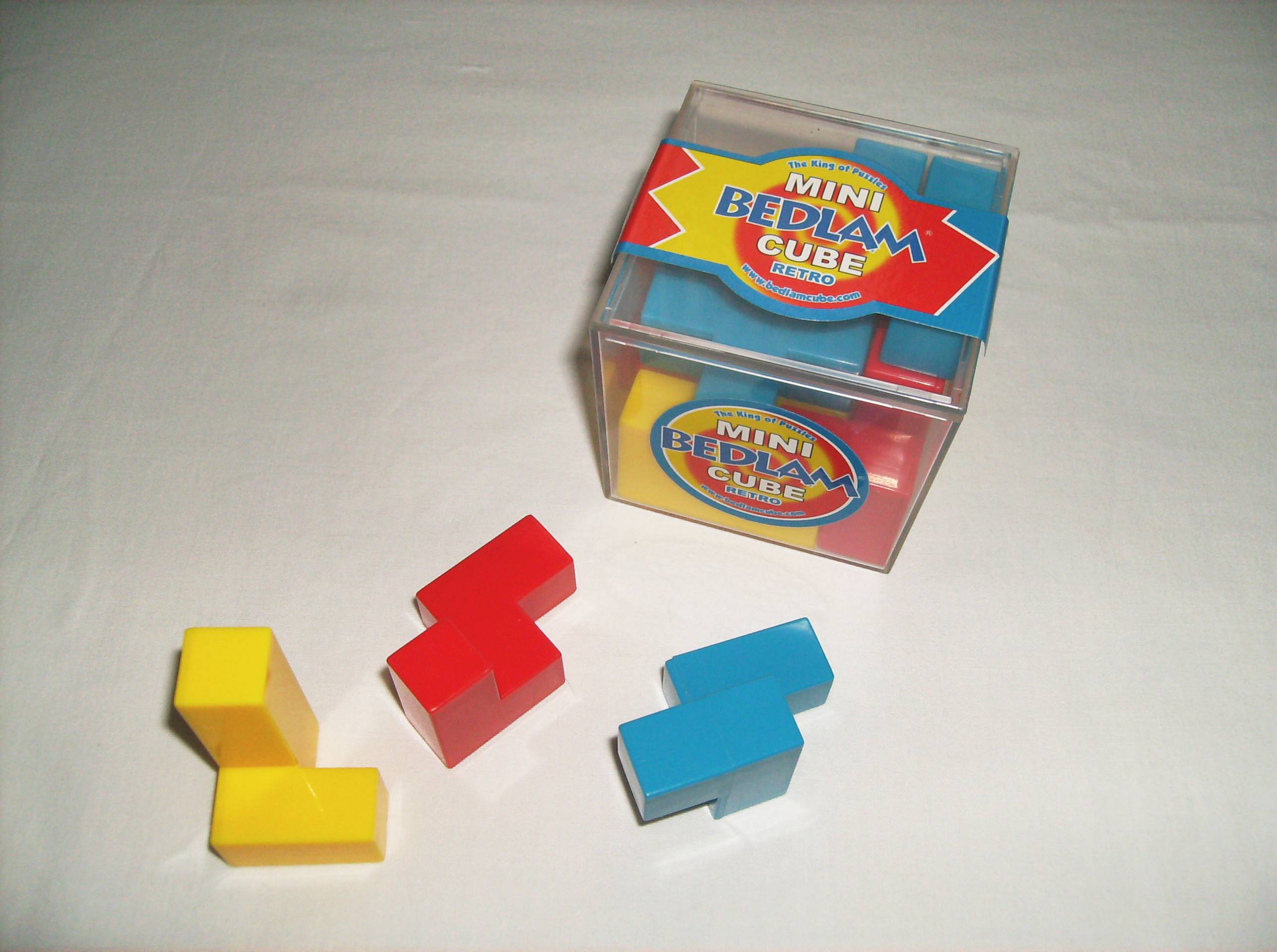
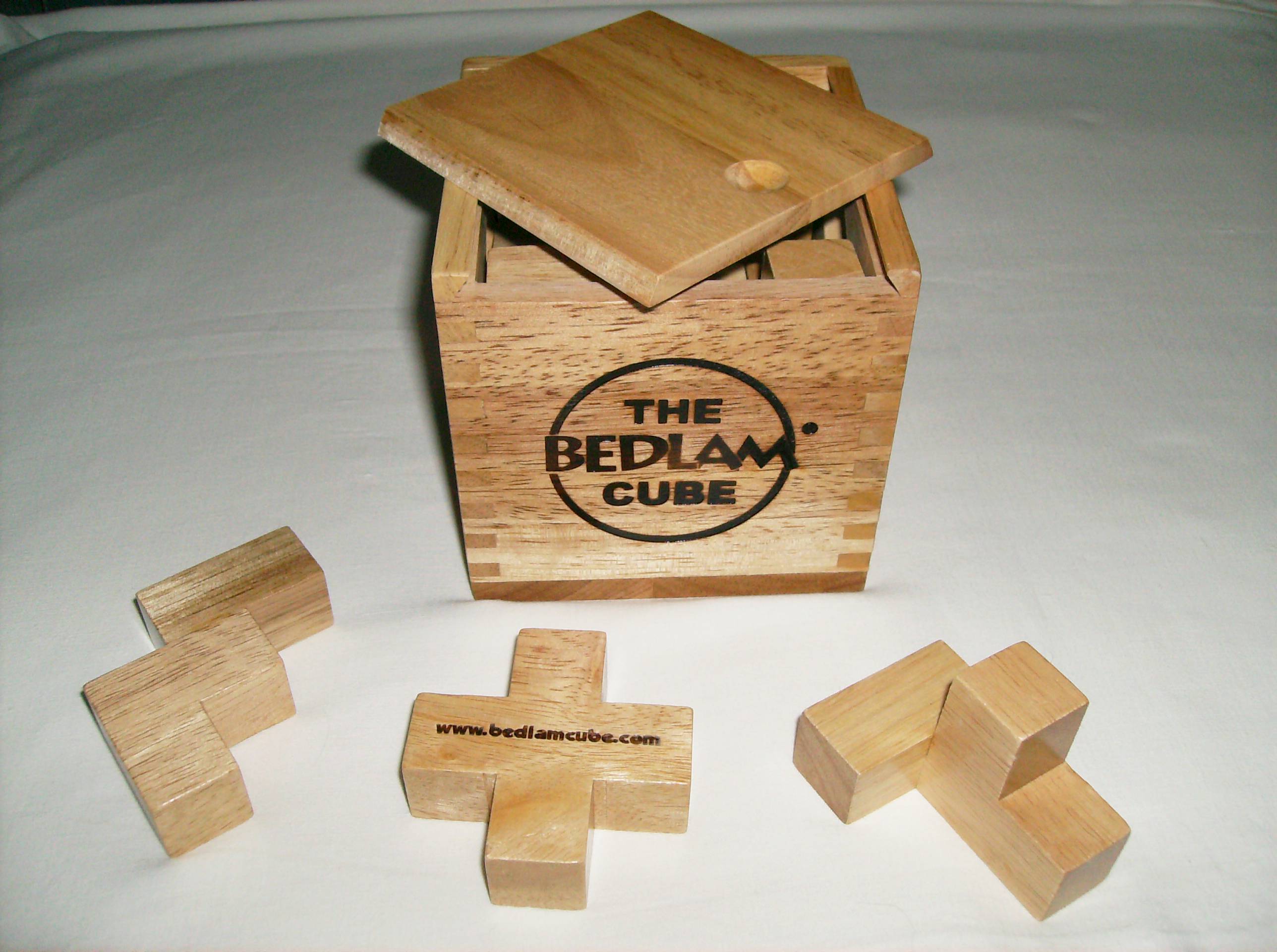
The Bedlam Cube. A simple assembly/packing puzzle, but a headache to solve...
Invented by the British Bruce Bedlam and commercialized since 2005, the cube is comprised by 13 pieces and you solve it by assembling a 4x4 cube with all of its pieces. You have 19,186 ways to do it. Sounds a lot, but it's very hard to work out a solution. There's another easier version, the Bedlam Treasure Chest Cube, with only 9 pieces and 37 solutions (also has a few color variations).

To me, the bedlam cube is the sub-collection within the collection. It all started with the Mini Retro Bedlam Cube, almost in the beginning of my main collection. But when I saw a large Wooden Bedlam on eBay, I bought it straight away. The presentation of the outer wooden case caught my attention and after a few months with a small plastic one to play with, the madness had started. With a search on eBay for Bedlams, I discovered a lot more color variations and I became obsessed for collecting them, although I'm yet to find a single solution for it. I guess it's kind of ironic, huh? I still have a few to purchase in order to get them all, but it's just a question of time...

With all these variations, there's a lot to choose from, with color, material and size. You can buy some of these variations at Puzzle Master.
Links:


Gear Cube

Posted on Jun 30, 2010 by Gabriel | 0 comments
Labels: , ,

(Click to Enlarge)

The Gear Cube is another one of Oskar's masterpieces (which of his puzzles aren't one?...). 

The story of the Gear Cube starts with the Caution Cube, designed by Oskar van Deventer in 2009. When it was first produced, the Caution Cube, as its name implies, required great care to handle, because of its razor sharp gears. It was then picked up by Uwe Meffert, as a partnership with Oskar, for mass-production and its sharp edges were rounded up for better maneuver and less dangerous handling. 

The puzzle uses a unique 3x3x3 mechanism with gears and although being a bit different, you can use the same techniques used to solve a regular 3x3x3 cube and apply them to the Gear Cube.

The movement of the puzzle's achieved by its edge pieces that have gears and rotate when you twist any face. Unlike a regular 3x3x3 cube, here you're restricted with 180º turns, as a 90º turn would lock any other movement you'd make, because an edge would be in the place of a center, thus disallowing further turns.

The feel of the puzzle is excellent. Its movement is very smooth, which tells that it's already well lubed out of the box. It also feels stiff, meaning that its weight is pleasant to hold in the hand, hinting that the structure of the puzzle is not hollow like the cheap cubes.

The sticker color pattern used is comprised by yellow, orange, red, green, blue and purple. As of now, you can also apply other sticker variations on it that use other unstickered areas, making it an overall more challenging puzzle. You can order these sticker variations from here

The Gear cube is also available in a white body and you can purchase both versions at Meffert's for a discount. Now also available at Puzzle Master.

(Click to Enlarge)


Links:


Babylon Tower - Random Pick #5

Posted on Jun 27, 2010 by Gabriel | 0 comments
Labels: ,

(Click to Enlarge)


The Babylon Tower (a.k.a. Ivory Tower), invented by Arxon Spiele and Freizeit in 1981 and manufactured by Ideal, is a slide puzzle comprised by six gradient colored balls in six columns. The main goal may not be visible at first but, it's simple: You push a ball from the bottom, to a hole inside the tower, thus creating a gap for the rest of the balls to move around. You  can move a ball up or down or just rotate one of the six discs. It's a simple 3D slide puzzle just like the Whip-it, the Varikon or even the Missing Link.

I personally love this type of puzzles (3D rotational/slide puzzles). Not because they're easy but, because they're very fun to play with. You can check several of these puzzles in the Slide section of my collection.

There's another darker version of the Babylon Tower, although it's much harder to find it. Besides the classic version, there's also two other versions as well. A Key-chain and a Junior (with only four balls). Along with the different versions of the Ivory Tower, you can also have different package versions (refer to the puzzle case), like French or German. I have a French one and you can read on the case "Babylone Tower".

You can still buy one at Puzzle Master.

(Click to Enlarge)


Links:


Block Chain

Posted on Jun 25, 2010 by Gabriel | 0 comments
Labels: , ,

 (Click to Enlarge)

Block Chain. At first glance, you may not know how this puzzles behaves or what is its purpose but, once you figure out how to move it, you'll see clearly what you're suppose to do. This was one of the entries at the 24th IPP Design Competition, in 2004 and at the time it was simply called QRIN X.

The presentation of the puzzle resembles a bicycle drive chain and the goal of the puzzle is similar to the Elastic Cube (a.k.a. Snake Cube), where you take it apart and then assemble it back to a cube form. All the parts in the puzzle connected, except at both ends. Some segments are connected by a screw, limiting some movements (just like in the Elastic Cube, where you have two or three cubes connected in the same orientation) but, at the same time you can rotate these segments in the screw's perpendicular plane. One thing to take into consideration, which helps to solve it, is that each segment belongs to one face of the cube and one face only, although you may have more than one segment per face.

Once you take the puzzle apart for the first time, you're in for a surprise, because it's actually two puzzles in one. As you'll notice, the inner core of the Block Chain is a three-piece Burr as you can see from the pictures below.

Overall, a very nice puzzle. Original for its looks and for the hidden extra puzzle.
Currently, you can get a Block Chain at Dino Direct.


                             (Click to Enlarge)

Rubik's UFO - Random Pick #4

Posted on Jun 20, 2010 by Gabriel | 0 comments
Labels: ,

 (Click to Enlarge)


Launched in 2001, the Rubik's UFO is a close relative of the older Rubik's Cheese but, a little more complex. It's also close to a Puck but, the differences here are a rotating center and twelve segments instead of six.
The mechanism is essentially the same, except that it adds one more layer, making the puzzle more challenging. There's six segments besides those two layers and you rotate three segments at a time in a vertical plane, while between layers you can only rotate them in the horizontal plane.

The puzzle is very attractive and great to look at, though it's a little hard to rotate the layers, because they have to be perfectly aligned. If you can solve a Puck or a Rubik's Cheese, you can for sure solve this one. Its colors make it pretty straightforward to work out a solution on your own.

There's another color version, dark gray and light gray, which was first released but, it's now rare to find one for sale.

You can still buy the genuine transparent green one at Popbuying for $19 USD with free worldwide shipping.


                                        (Click to Enlarge)


Links:

Youtube Video

How to disassemble and reassemble

Solutions Hints Booklet

Guo Jia Diamond

Posted on Jun 17, 2010 by Gabriel | 0 comments
Labels:

(Click to Enlarge)

Guo Jia Diamond. A simple 3x3 shape mod made by the Chinese company Guo Jia, who produces many more twisty puzzles.

Visually very appealing, due to its reflective stickers and its truncated hexagonal dipyramid shape, the Guo Jia Diamond has a pretty decent quality for its price ($6 USD). Probably not for speedsolving but, it's almost there.

Also available in red, you can purchase one at Popbuying. This one came from there and I can tell you that they are trustworthy. Took around two weeks to arrive.

You can also see a video of the puzzle and its shape-shifting abilities here and judge it by yourself.

(Click to Enlarge)

Rainbow Masterball - Random Pick #3

Posted on Jun 13, 2010 by Gabriel | 3 comments
Labels: ,

(Click to Enlarge)

This is the 3rd weekly Random Pick from My Collection.

This week, I present to you the Rainbow Masterball (a.k.a. Geomaster), an invention of Hungarian Dr. Geza Gyovai.

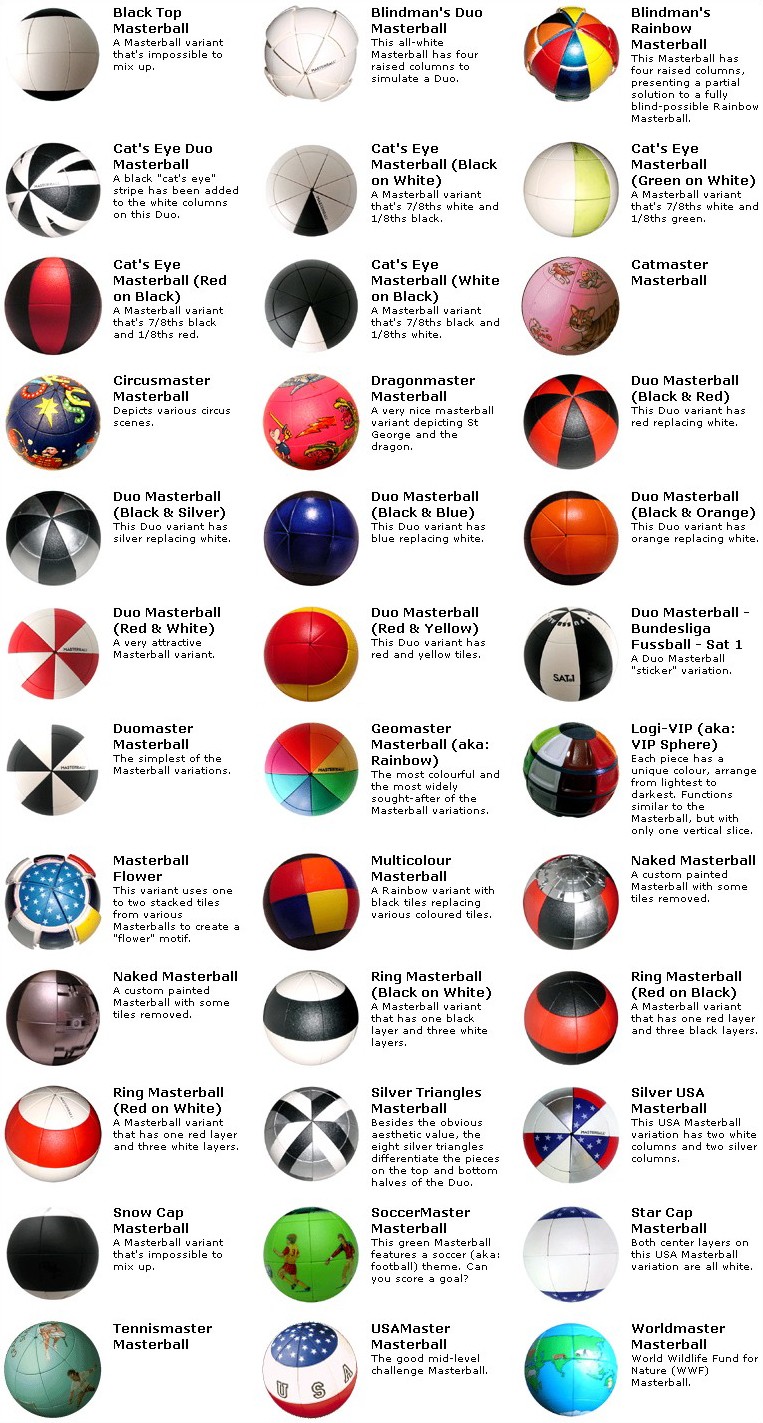
The puzzle consists in 8 segments (each with a different color) and 4 layers and belongs to the family of Twisty Polyhedra. This particular Masterball is one of the easiest versions to solve, not like the picture ones where you have a much harder challenge. 

Regarding its maneuvering, it's very pleasing to turn due to its "clicky mechanism" that tells you when the pieces are in place, which makes the whole experience with this puzzle much more satisfying.

Launched some 18 years ago, the puzzle has now dozens of color and picture versions. You can still buy some versions today (see links below), although much of them are now quite rare to find.

Links:

Puzzle Master (For sale)

Milan's Puzzles (For sale (scroll down))

Puzzle-Shop.de (For sale (click first link in right menu and scroll down to 'Ball Puzzles'))

Jaap's Puzzle Page (Solution)

Youtube Video

Lucky Clover

Posted on Jun 10, 2010 by Gabriel | 0 comments
Labels: , ,

(Click to Enlarge)

Lucky Clover is one of many masterpieces created by the great genius mind of Oskar van Deventer.

The puzzle is formed by four rings, two of them are golden and the other two are silver. The goal is very simple, separate the rings and then assemble them back to the original clover design. There's an alternative challenge, which is to form a set of handcuffs (see first bottom picture).

This is one the most difficult Entanglement puzzles I've seen. After you have removed the last ring which, by the way, is no easy task, the real challenge (torment) is now just beginning. Next, your most difficult challenge  will be putting the puzzle back together. I have to say, even with a solution sheet you'll be frustrated, because it's not a straightforward step by step solution. You have to understand how the pieces interact with each other in order to get the final rewarding achievement.

This puzzle was first presented at the 24th annual IPP and you can buy one at Puzzle Master (they also have a solution available for download).


                                       (Click to Enlarge)


Links:


Mona Lisa Codebreaker - Random Pick #2

Posted on Jun 6, 2010 by Gabriel | 0 comments
Labels: ,

(Click to Enlarge)

Weekly random pick #2 from my collection. This week I picked the Mona Lisa Codebreaker to make a post. 

Invented by Dave Nesis, the Codebreaker is a slide puzzle where you slide the tiles in place to make the image of Mona Lisa. Sounds simple, but don't be fooled... The puzzle is not so straightforward as it seems. 

There's a handle in the back that makes all 4 corners turn simultaneously and there's a system of rails in each corner piece that prevents sliding a tile in both vertically and horizontally at the same time. Instead, if you need to slide a tile horizontally, you have to push the handle and rotate it so that the rails can have the same orientation as the move you want to make. There's also an empty slot at the top for storing a tile, leaving you with 8 tiles to move around and solve the puzzle.

Its design is very original, adding a more challenging approach to the classic slide puzzle.

There's also available two alternative designs. Twisted Mind (with numbers) and Twisting Rings (with colored rings designed by Jaap Scherphuis).


                                       (Click to Enlarge)


Links:

Enigma

Posted on Jun 4, 2010 by Gabriel | 0 comments
Labels:

(Click to Enlarge)

Enigma is a rotational/rearrangement puzzle. Comprised by three layers, you rotate these to scramble or rearrange the puzzle to its original picture. The top layer rotates only four circles and the second center ring (see first bottom picture), whilst the bottom layer rotates all the parts.

This puzzle is usually available with a company's logo, because they only make them as promotional items and sell them as wholesale.

As of writing this article, there's an eBay seller with over 80 enigma puzzles available in 6 designs/logos. He also has a video that shows how the puzzle moves.


                                       (Click to Enlarge)


Links:

Jaap's Puzzle Page (Solution) 

TwistyPuzzles.com (More information)

TwistyPuzzles.com (Mechanism) 
Related Posts Plugin for WordPress, Blogger...