PuzzleMaster

Breadbox

Posted on Jan 19, 2012 by Gabriel | 8 comments
Labels: , ,


Share

(Click to Enlarge)

David Litwin is best known in the puzzle community for his great sequential movement designs. The Elemental puzzles and the Kilominx are just two examples of his beautiful work.

The puzzle I bought from him, though, doesn't belong in that category (sequential movement category, of course), as this is his first attempt at something different. With Packing Puzzles, especially 2D, being among my favorite type of puzzles, it's no wonder I had to get his Breadbox puzzle when I first saw it.

The original design was what caught my attention first. The concept was Bram Cohen's, with two sizes of eight rectangles each, but David added the bread theme with curves on the pieces to make the challenge a little tougher. It was David's exchange puzzle for last year's 31st IPP.

The puzzle is nicely presented in a silver tin case and inside, you can see that the frame has an elegant maple bread shape. There are eight pieces of two sizes from laser cut laminates, plus a small bread crumb piece for a second challenge. The cut pattern is very well done, resembling slices of toast. The smaller piece sizes are made of walnut and the bigger ones are made of cherry. Both sides of the pieces can be used and since they're not symmetrical, orientation matters. David has made several other combinations from those three wood types. You can find out more about them at the end of the review.

The goal is very simple to understand, even by a casual puzzler, although solving it is another whole different matter. You have two challenges: the first one is to simply place the two loaves of bread, neatly packed inside the frame. The other, which is a little more complicated, is to add the bread crumb to the already tightly packed frame. Looks almost impossible, right? - But there's enough wasted space there to find a way. You're very lucky if you can solve the second challenge in your first try. I'm saying this, because you need to understand first, how the pieces are packed and then, when you have overcome that task, you can think of a better way to pack the pieces, and find the necessary space to add the tiny piece of bread.

It took me about two hours of experimentation with the pieces to solve the first challenge. What makes this packing puzzle so special and very different from others is that it has 17 pieces, and that, in a packing puzzle is a lot. There are so many wrong ways to combine and fit the pieces together, that it's very hard to find a solution in just a few minutes of play. The pieces have these curvy lines that will waste a lot of space in the frame and in most of the attempts, the last piece on a row will stubbornly not fit in the bounds of the frame. The reason? - Probably, placing the pieces in rows or columns is not the best strategy, after all...

Spoilers Ahead - The next two italic paragraphs will describe a couple of strategies to get to the final solution. If you're not interested in reading anything about it and just find out about it for yourself, jump to the closing comments instead (just below the tin box photo).

As I hinted above, placing the pieces in a straight row won't get you anywhere. I had to give up that strategy after many failed attempts, so I started to experiment with a four piece combination. The goal is to get the best possible fit between the pieces, in order to save the most space. At first, I made these combinations in the middle of the frame, but I always ended up short of one piece to fill the first half. So, after several other attempts I was getting somewhere: The best I could come up with, was a checkered pattern between one small and one big piece in a four-piece square. When I placed another four piece combination, I saw that it fit almost perfectly and filled half of the frame, with just a very small space between the pieces. It was my best arrangement so far... I continued next with two identical combinations and to my surprise, all the pieces were finally packed, except for the bread crumb...

My first thought after I have solved the first challenge was: "Do I need to find another whole different arrangement for the pieces or do I have to make just a few adjustments?" - I found that out, approximately 10 minutes later. Dividing the pieces into four sets of four pieces each (in a square), the answer is to mirror two or all four sets, depending on your final arrangement, so that the bread crumb will fit in the middle. By mirror, I mean to flip the four pieces, as if you were turning a page and saw through the other side of it, or you can just place a small mirror beside the pieces and see the result. Do this a few times, always keeping in mind that the solution is very symmetrical. If you've read through all this and still feel the need to look at the solved puzzle, you can see an image of the two challenges, first here and second here.

(Click to Enlarge)

Closing Comments:

As I stated above and also in several other reviews, I just love Packing Puzzles, and this particular one by David Litwin is among my favorites now. The concept is absolutely brilliant for this category and I think it's perfectly achieved. For a first timer in this type of puzzles, David sure outdid himself. I look forward to see what he will do next.

At the time of writing this review, David still has 5 Breadbox puzzles for sale in four different wood combinations (you can also see this information on the TwistyPuzzles.com forum). This is a very unique design and after they've gone, it might be a while before you see new ones available, if ever, so be quick to get one if you're really into this type of puzzles. The price is $40 USD with free world wide shipping:

1x Cherry Frame, Walnut Large Slice, Maple Small Slice
1x Cherry Frame, Maple Large Slice, Walnut Small Slice
1x Walnut Frame, Maple Large Slice, Cherry Small Slice
2x Maple Frame, Walnut Large Slice, Cherry Small Slice

For reference, the one in the review is Maple Frame, Cherry Large Slice, Walnut Small Slice.

EDIT: They now have all been sold out. 

Links:


Get My Goat

Posted on Jan 18, 2012 by Gabriel | 7 comments
Labels: , ,


Share
(Click to Enlarge)

Puzzle Crafthouse has been responsible for bringing new life to some nice classic puzzles, that otherwise would've been very difficult to obtain. Get My Goat, which dates back from 1914 and designed by J. I. Wiley, is one of such examples.

This classic design is a Slide Puzzle with a very original theme. By sliding the pieces, the goal is to get the goat block inside the octagon cage (at the center), without disturbing the correct orientation of the blocks.

The puzzle is very well done, all built in hardwood with its own base and cover, and the patterns of the blocks are deeply laser engraved. The cover is also engraved with the starting position, in order to get the puzzle ready for solving it.

(Click to Enlarge) - Cover

Not counting with the piece that's supposed to be removed to play, there are 10 blocks in the puzzle, with one of them having a 2-piece length (it's the one where it reads "USA patent 1914"), which will block some of the movements. Because of its size and having only one free space to move, the large piece can only move in the upper row, back and forth.

If you've seen many slide puzzles, you'll notice that this one is a little different, with an area of 4x3 units. Usually, most puzzles have an area of 3x3 or 4x4 (like the 15 puzzle). With the 2-piece block, the strategy to solve this puzzle will also have to be different.

It takes a minimum of 28 steps to solve it, although it's very difficult to achieve that goal (John Rausch has an online Java version of this on his website, by Nick Baxter). My objective, though,  was just to get the goat where it was supposed to be, and that was a hard challenge on its own. After many tries, I think I have solved it, but here's the catch: (Spoiler Ahead) - If you look closely, the top left piece of the cage is identical to the bottom right piece. Both have a pattern of forward lines. When I solved the puzzle, I noticed that these two pieces exchanged places, because even though they have identical patterns, one is slightly darker toned than the other.

(Click to Enlarge) - Left: Starting Position; Right: Solved Position

After having noticed that unusual feature on the puzzle, I think that it has indeed, a very clever solution.

Closing Comments:

Although I'm still not certain if I actually solved it (I am certain now, after reading the first two comments left by Coaster1235 and George - Thanks), the Get My Goat puzzle is a very nice example of a different take on a classic and simple concept. I recommend it to anyone interested in Slide Puzzles.

You can get your own copy at Puzzle Crafthouse for $20 USD. If you can afford it, there's an original from 1914 for $95 USD here.

Links:

Transposer Puzzles

Posted on Jan 17, 2012 by Gabriel | 0 comments
Labels: ,


Share
(Click to Enlarge)

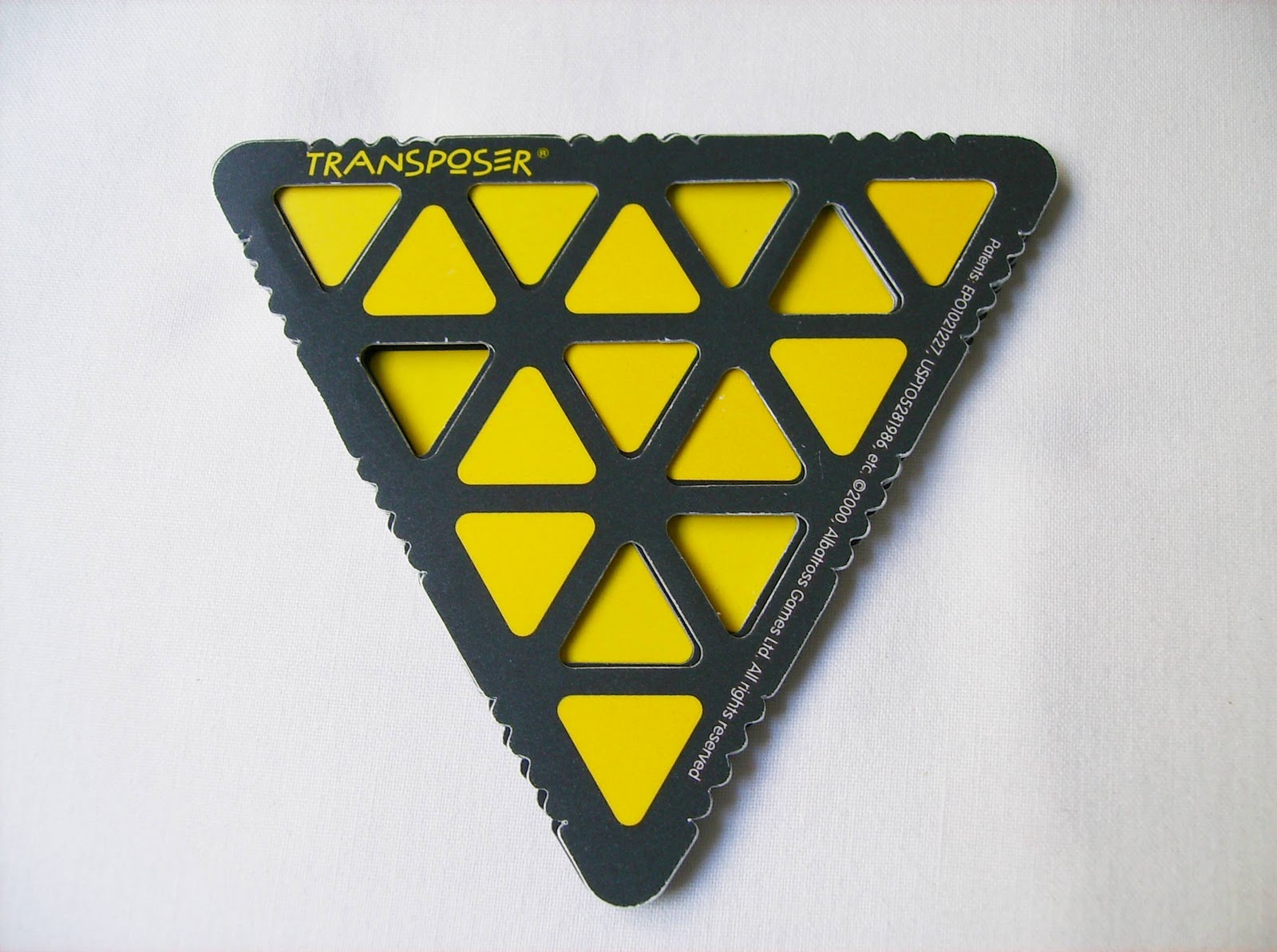
The Transposer Puzzles are a series of plastic (polypropylene) puzzles manufactured by Toysmith. The ones I have here today for review are the Transposer 6 and the Transposer Genesis.

These Pattern Puzzles consist of a certain number of layers and the goal is to stack them in a correct order and orientation so that they show a unique color on one of the sides or as a harder challenge, on both sides. Each layer has a cell color arrangement that can vary from one color up to four and some of the cells are cut out to allow cells of lower layers to be seen through.

First, the Transposer Genesis. I got this one from PuzzleMaster:

(Click to Enlarge)

The Transposer Genesis is shaped like a 6-point star and has seven layers. Each layer has a combination of colors or cut out cells, except for two layers, which only have one solid color on each side, used as the first to solve a particular color.

There are eight different challenges you can attempt. Four of them are to make just one color on one side: red, yellow, green and blue. These first challenges are easy enough to understand how the layers can be stacked on top of each other. When you solve those ones, the other four challenges are a little harder, as you have to solve them to show one single color on both sides at the same time: the first one is to make one side solid yellow and the other side red; the second is a combination of green and blue on both sides; the third is red and green and finally, the last one is a combination of blue and yellow.

(Click to Enlarge) - Yellow and Red Combo

Even though the harder challenges take a little more time to solve, the overall difficulty of the puzzle isn't that tough. PuzzleMaster rates this as a 7/10 (challenging) and and I agree, because every solution is accomplished with just a bit of patience and the good old trial and error. With a careful analysis, though,  you can also eliminate many possibilities, thus making it much easier.

... And next we have the Transposer 6:

(Click to Enlarge)

As the name suggests, this one has only six layers instead of seven, like the Genesis puzzle and it's triangular shaped. The use of one less layer does make it easier than the previous puzzle, but it can also be challenging.

The object of the Transposer 6 is very similar to the Genesis. You have four colors and you need to solve each particular one to show on either side of the puzzle or both sides at the same time. The colors are the same except orange is used instead of red. The harder four challenges are: green/orange; blue/yellow;  yellow/green and orange/blue.

(Click to Enlarge) - Blue and Yellow Combo

The packaging for the Transposer 6 says that the Transposer 7 is also available, but I'm yet to see one at a store.

Closing Comments:

The Transposer puzzles are a very affordable choice for a nice puzzle. Currently, PuzzleMaster only sells the Transposer Genesis for about $6 CAD, so you can't go wrong with that. The use of plastic ensures that it will last long and the concept is interesting enough to try it.

Links:

Jaap's Puzzle Page - Info and solutions for the Transposer puzzles by Jaap Scherphuis.

Remove The Yolk

Posted on Jan 13, 2012 by Gabriel | 2 comments
Labels: , ,


Share
(Click to Enlarge)

A few days ago, I reviewed Robrecht Louage's 4 Steps Visible Lock and I was very impressed with the concept of removing a coin from the puzzle. It's like getting a reward for solving it... 

Today, I have another one of Robrecht's puzzles to review and this one requires to remove a coin as well. How does it compare to the previous puzzle? - Continue reading to find out.

Remove the Yolk was entered at the 2010 30th IPP Design Competition and it's about the same size as the 4SVL, also built with trespa and manufactured by Robrecht himself. The appearance of the puzzle is made to resemble an egg and the coin represents the yolk. The goal is to remove the coin, but for that you have to work out how a hidden locking mechanism works.

The mechanism consists of what appears to be small steel balls, judging by the rattling inside, and they lock some movements depending on the way you're holding it. By tilting the puzzle at different angles, it will make some of the balls inside shift back and forth, allowing this way the sliding platform with the coin to move.

(Click to Enlarge)

The big difference between the Remove the Yolk and the 4 Steps Visible Lock is that the latter had most of the mechanism visible and you knew what you were doing, despite the last step being a "blind step". In this puzzle, however,  there's no visual perception of what's going on inside, so you have to rely only on your hearing and your sense of touch.

I solved this puzzle after the 4SVL one, and my impression is that it's a bit harder. It took me about an hour to get the coin out, and even when I solved it, I wasn't sure what I had done specifically to accomplish that. It does have its advantages, because since you don't know exactly how to do it, you can solve it multiple times and still enjoy it, until eventually you figure out the exact process to get it opened.

I found a YouTube video showing how to solve it, and after seeing it I had another try and it did work. If you have one and had enough of frustration, you can see the video here.

(Click to Enlarge)

Closing Comments:

After solving two of Robrecht Louage's puzzles, I can honestly say that I've became a fan of his work and I will look forward to seeing other designs by him. He also entered in other two previous IPP's with La Cerradura Doble in 2008 and La Cerradura 3D in 2009. I'm very curious to see what he prepared for his next puzzle entry at this year's IPP.

If you'd like to buy a copy of the Remove the Yolk puzzle, contact Robrecht Louage.

Cube Art

Posted on Jan 12, 2012 by Gabriel | 1 comments
Labels: , , ,


Share

(Click to Enlarge)

Cube Art was one of the 72 entries in last year's IPP Design Competition. Unfortunately, it didn't win an award, as it faced some tough contestants, but it doesn't mean that it's less interesting.

Inspired by the work of Dutch painter Piet Mondrian, Durandus Dijken from The Netherlands, invented and designed the Cube Art. It comes in a nice plastic container cube with a sliding lid and it sort of reminds me of the Pattern Puzzle Instant Insanity, where you had to arrange four cubes in a row, so that it showed four different colors on each side. 

In the Cube Art, the goal is similar: you have eight blocks divided in three categories: a 1x1x1 cube, a 2x2x2 cube, three 1x1x2 and three 2x2x1 blocks, and they can have a combination of six colors, although some blocks won't feature all six different colors on them. Instead, they can have a repeated color, which adds to a much higher level of difficulty. By choosing a four different color combination, you have to assemble the blocks into a cube and repeat that combination on each of the cube's six faces.

To maintain the blocks into a cube form without falling apart, the designer implemented magnets on each piece and a magnetic plate between the two layers. This way, it becomes much easier to assemble the cube.

(Click to Enlarge)

At first, your task is simplified at choosing the right color combination, because you are given the three known solutions. You can see three small pictures in a sticker, found at one of the magnetic plate's sides, showing which colors are part of each of the three solutions. Solution 1 has white, yellow, red and blue; solution 2 has orange, red, green and blue and solution 3 has white, yellow, orange and green.

Don't think that because you know which colors to use, that the puzzle is halfway solved. When you receive the puzzle, it already comes solved with one solution, to better give you an understanding of how it works. It took me about two hours to find the first solution, or second, if you count the one it came solved, although a while after you take it apart, you don't remember anymore, how the blocks were organized. There were many times when I had only one block left to place, but it resulted in disappointment and frustration every time, until finally in a surprising moment, I had solved it. Not easy, at all...

(Click to Enlarge) - Solution 2

Finding the last solution, however, it was much faster for me. It only took me about half an hour. Not sure if it was a stroke of genius or just pure luck, though, but the important thing is that I solved it. Now, all I need is just to find the correct block placement for the first solution, the one that the puzzle came in... Or is it? - I wish it were that simple...

(Click to Enlarge) - Solution 3

One of the coolest things about the puzzle is that, after you solve the three known color configurations, you have a much harder challenge in your hands, which is to find a fourth secret solution. This time, you don't have any information regarding the colors you're supposed to use, you're simply on your own. I still haven't found this solution yet.

The fourth solution was found by the designer himself, after the puzzle had been published, by analyzing it in further detail. In theory, there could be 15 possible configurations with the six existing colors, but only four of them are solvable. Is it really possible to have more solutions? Now there's a nice challenge for a mathematician...

Closing Comments:

I enjoyed very much, playing with the Cube Art. Besides using magnets, which is always cool in a puzzle, I liked the challenge. It requires just the right amount of frustration from you, so that it never feels overcomplicated, and yet providing a satisfying rewarding feeling.

To buy your copy, you can visit the puzzle's website or contact Durandus Dijken directly.

Shipper's Dilemma

Posted on Jan 11, 2012 by Gabriel | 13 comments
Labels: , , ,


Share
(Click to Enlarge)

The Shipper's Dilemma (or Conway's Packing Box) by mathematician John Horton Conway is no ordinary Assembly Puzzle. The version I have, manufactured by Puzzle Crafthouse is a puzzle solver dream, but it can also turn into a nightmare in just a few hours of failed attempts.

There are 17 pieces and they can be grouped into three categories. Counting the smaller five cubes as a unit area, the other two types are 2x2x3 and 1x2x4 cuboids with six pieces each. Your task is to unpack the pieces and be able to assemble them again into a 5x5x5 cube.

The mathematical relations between the three types of pieces is fascinating. For instance, two 3x2x2 side-by-side pieces standing up, have the same length as a 1x2x4 piece lying down... And there are several more lengths relationships between the pieces. You will notice them as you try to solve and analyze the puzzle yourself.

I have seen this concept before, where you have to assemble a certain number of regular-shaped pieces into a given shape. I have two small puzzles in my collection that fall into this category, but with less pieces (both with 9), thus much easier. See here and here. Since I've solve these two in a relatively short time, I thought that the Shipper's Dilemma, while having more pieces, shouldn't be that hard. How wrong I was...

Usually, I like to solve a puzzle before writing a review for it. Not just as a personal goal, but also to have more insight and understanding of the mechanics involved, behind the puzzle itself. This time, however, that requirement wasn't met and I'm yet to solve it. I have been trying unsuccessfully for more than a week and I've lost count how many different ways the pieces were packed.

(Click to Enlarge)

An interesting observation by the inventor himself is that the puzzle is almost impossible to solve by randomly assembling the pieces, and I have to agree. The number of pieces involved, which is uncommon for most Assembly Puzzles, makes a random approach pointless, because the possibilities are almost endless. You do have to carefully analyze the puzzle and try to do it in steps, always keeping in mind the very important length relationships between the pieces.

I'm not sure how many solutions are there for this puzzle, but I'm assuming by the nature of the pieces and by the large number of packing combinations, that there are several possible solutions. Finding one might prove to be a tough test to your patience and solving skills. If you know the exact number of solutions, let me know by leaving a message in the post's comments.

EDIT: Thanks to the quick answer by Coaster1235 and contrary to what I previously thought, I know now that the Shipper's Dilemma has indeed 1 unique solution. Proof that this is one devilishly hard puzzle... Feeling challenged enough now?

EDIT 2: Dave Janelle from Puzzle Crafthouse has sent me a presentation with analysis and instructions of the Shipper's Dilemma written by Mike Czerwinski. I gotta say, the analysis is brilliant and it just makes the whole concept seem so simple, that it's used by educators to explain various mathematical principles, such as areas and volumes or size relationships between different cubic shapes. If you're interested in knowing more about this, please contact Dave at Puzzle Crafthouse.

Closing Comments:

Even though I haven't solved it yet, doesn't mean I dislike the puzzle any less. On the contrary. The Shipper's Dilemma is one of the hardest Assembly Puzzles I've tried and I will continue to try it. You are provided with a solution sheet, but I will resist to look at it for as long as I can... Until I give up someday...

Besides the solving part, the presentation of the puzzle is very nice and the quality is flawless. I love the straight lines that criss-cross the entire outer box, which gives it a more elegant look. Oddly enough, I also love this smokey smell of the pieces, particularly coming from inside the cover. Not very commonly "seen" in puzzles, but I still like it.

The Shipper's Dilemma can be found at Puzzle Crafthouse and you can choose between two size models. $13.5 USD for the 0.7lbs version or $16.95 USD for the 1lbs version.

(Click to Enlarge)

Mad in China

Posted on Jan 10, 2012 by Gabriel | 2 comments
Labels: , , ,


Share
(Click to Enlarge)

Puzzle designer Jean Claude Constantin from Germany has an extraordinary collection of mechanical puzzles with his name on them. Ranging from Packing Puzzles to Wire Puzzles, he has such a wide variety of original designs, I bet you have one in your collection that you probably didn't even know it was designed by him.

Mad in China (no, it's not a typo), pun intended, will drive you mad and it's one of those examples of Constantin's genius.

The puzzle is a classic Packing problem, where you have to fit a given number of pieces into a tray, when at first glance, just seems impossible. There are four laser-cut wooden pieces, all different from each other and they resemble what you usually see in a maze pattern. In the tray, there are four small protrusions that seem to be an extension of the pieces themselves and may or may not be part of the actual solution.

PuzzleMaster rates the Mad in China puzzle as an 8/10 in difficulty and they are probably right. It is in fact, quite challenging to solve. When you try to fit the pieces into the tray, you realize that in order to pack them all, they need to overlap at least, part of another piece, since their combined areas are greater than the packing area... And this was the hardest part to figure out - How to find the correct way to connect them?

Looking at each individual piece, they look almost the same from both sides, but you can feel that the backside is  much smoother than the front side. The question is, can you use any side of a particular piece in the solution? - After solving it and analyzing the result, the answer is no, leaving less possible combinations and a unique orientation. Even though this is true, it doesn't make it much less harder, because you still need to find the correct overlapping position for each piece. 

I won't show a picture of the solved puzzle here, because there could be someone reading, that doesn't want any spoilers. Instead, if you really want to take a look at the puzzle in its solved state, click this link.

(Click to Enlarge)

Closing Comments:

Everyone that reads my reviews regularly, knows that I'm a sucker for Packing Puzzles, and Constantin's Mad in China is no exception. I love how different it is from other puzzles found in this category, so previous experience on how to solve them won't do you much good at solving this one. Definitely worth a try.

The Mad in China puzzle can be found at PuzzleMaster for $17.99 CAD.

Links:


4 Steps Visible Lock

Posted on Jan 9, 2012 by Gabriel | 0 comments
Labels: , ,


Share

(Click to Enlarge)

Robrecht Louage is a puzzle designer from Belgium. His latest design, the 4 Steps Visible Lock, has earned him the Jury Grand Prize at the 31st IPP Puzzle Design Competirion, held last year in Berlin, Germany.

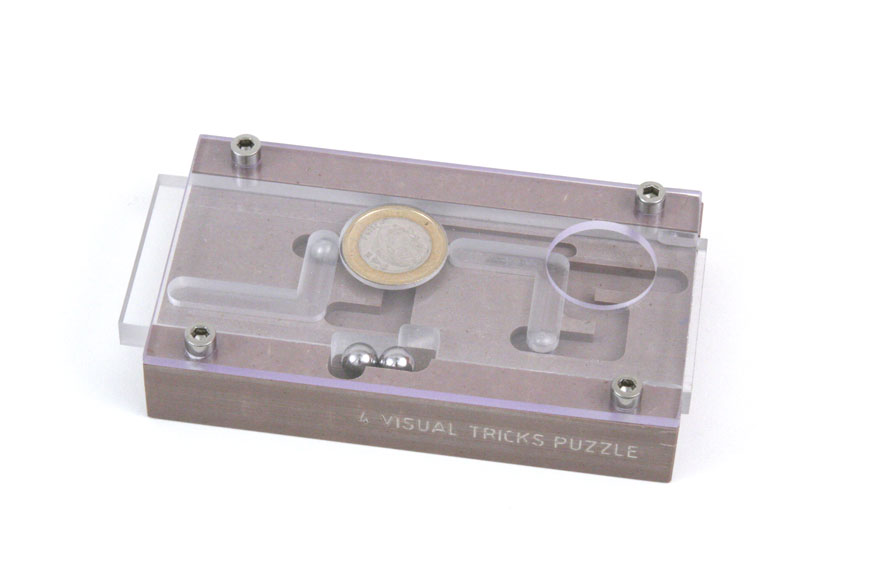
The puzzle is made of acrylic and a material called trespa. There are four steel balls, two for each different size and it measures 11.5cm Length x 6.5cm Width x 2.5cm Height (4.53"x2.56"x0.98").

The 4 Visual Tricks Puzzle, as it was first called and suggested by its name, consists of four distinct movements that keep a coin well locked inside. Your objective, as you might have guessed by now, is to slide the platform enough, so that it reaches the hole found at the right, to be able to remove the 1 Euro coin.

The beauty of the 4 Steps Visible Lock is that there are actually 5 steps you need to complete, in order to solve it, but the 5th and last one is hidden... And that's all I can say about this (un)visible step, without spoiling the solution too much.

As you first pick up the puzzle, you'll notice that the first step is a two-part locking mechanism done by a couple of small steel cylinders, located at the top and bottom of the sliding platform. The intriguing part is that, if you try to get one of the cylinders out of the way, by tilting the puzzle at the opposite direction, the other one falls into place and locks the mechanism again. You have to be patient and come up with a strategy to free both of them, at the same time and get to next step. After you overcome the first part, the three following steps are easier to achieve.

(Click to Enlarge) - Top View

The second step is related to the larger couple of steel balls at the bottom. As you tilt the puzzle to get each ball to their specific spot, they tend to follow each other, because of the nature of the movement you're trying to do. This is not that hard to achieve though.

The third and fourth steps are similar and are interconnected, as they need to be done at the same time. The two paths are executed by the two smaller steel balls and are easily accomplished.

The tricky part however, besides the first one, where you had the cylinders, is the one that you can't really see and when you finally solve it, it's when you realize its whole purpose and use for the actual coin.

Closing Comments:

After solving the 4 Steps Visible Lock, I can understand the reason why it was awarded the Jury Grand Prize at the 31st IPP. The concept is brilliant and the elegant and attractive design is what makes it so appealing to a puzzle lover.

To get a copy, you can contact Robrecht Louage by e-mail at "rlouage(at)telenet(dot)be".

(Click to Enlarge) - Solved

Culica

Posted on Jan 5, 2012 by Gabriel | 5 comments
Labels:

Share

(Click to Enlarge)

There have been quite some interesting puzzles and games coming out of the UK lately, and already reviewed by me. The iball3 and the Dioctipoid come to mind, and of course the Revomaze (V2 soon to be reviewed).

My latest discovery from the UK is the puzzle/game Culica, released in 2011 and was created by the Mad Inventor Duo (M.I.D.), with James Eadon as the game's inventor and Chris Ollivier as the entrepreneur and the business brains. What inspired the inventor to create the Culica was actually an iPhone App that James designed in 2008, called Culica Mobile. Since then, his company has already launched two new games based on the real Culica, the Culica Plasma and Culica Quest, which can be bought from their website's online store.

Now, to the actual game of Culica. The great thing about it is that there's not one, but a wide variety of single player and multi-player puzzles/games that you can play with the Culica, ranging from easy to advanced. Inside the package comes a cube and 84 pegs (28 red, 28 yellow, 14 blue and 14 green). Why less blue and green pegs? - Because with two players you can fill the entire 54 slots (9 per face) available in the cube and with four players there's no need to have more than 14 pegs assigned to each player for that to happen. Also inside the package there's a bag to store all the pegs and 4 cards with instructions and information for 5 single player and 5 multi-player games. You can find several more on the game's website and new ones are being added regularly.

Every game or puzzle played with the Culica have the same thing in common: you win by placing pegs onto the cube, following a set of rules correspondent to each game you're playing. The pegs have a design, identical on both sides, that easily allows two or more game cubes to be connected and extend the game's area. There are at least two games that require more than one cube to be played, the CuPoker and the CuFootball.

Single Player Games/Puzzles:

Being a puzzle lover as I am, I liked the single player games more, but that's what's good about it, because it can please everyone. Since there are many games available for you to play solo, I'll just describe for you, the three ones that I enjoyed most:

CuColours - This is an easy one to start with, but a bit tricky to solve. The basic idea is to have all pegs on the cube, such that no two of the same colours are touching, whether they're side-by-side or diagonal, counting face edges as well.

You can start by placing a peg on the middle of a face and put pegs around it, following the game's rules. When you complete an entire face, start the next by keeping in mind that the edge pegs of the previous face have to comply by the same rules, so no diagonals or straight lines allowed between faces.

(Click to Enlarge) - CuColours Solved

Although it's not that easy, it's perfectly possible to fill the cube's six faces with pegs. When you complete two or more faces, you can see that a colour pattern has been produced. Just follow that pattern in order to solve the rest of the cube.

CuWizard - You can think of this one as a version of the popular Sudoku. The objective is to have a straight row of four different colours, with two on one face and two on another. Do as many rows as possible, until you can fill the entire cube.

(Click to Enlarge) - CuWizard Solved

This one was quite hard to solve. I had to remove an entire face of pegs several times before I was able to fill the 54 slots on the cube. Like the CuColours puzzle, after you complete the first two or three adjacent faces, you'll notice a repeated colour pattern that you can use for the rest of the remaining slots.

CuRing - This one is very challenging. Haven't yet been able to completely solve it. The goal is to have 48 pegs in the cube, with only six slots remaining, so that no two colours are closer than 4 spaces apart, although it's possible to have two pegs close to each other in diagonals.

(Click to Enlarge) - CuRing Partly Solved

Given the fact that every peg has to be separated 4 spaces from another one of the same colours, it will be very hard to place all 48 pegs into the cube. The photo above shows only a portion of this challenge solved.

Multi-Player Games:

Even though I liked the single player puzzles more, I still tried a few multi-player games and they were a lot of fun. Some of the games can take up to 12 players, so there's plenty of action to enjoy.

Two of the multi-player games I enjoyed most were the CuFrog and the CuSol. The CuFrog requires that each peg you put in the game, one turn at a time, be one space apart (hop) from the previous peg placed in the cube until there's no more valid moves. You win by being the last player standing.

The CuSol is similar to the classic marble game, Solitaire. Here, players start by completely fill at random the cube with 27 red and 27 yellow pegs for two players, 18 pegs of each three colours if it's for three players or for four players, then you'll fill the cube with 14 red, 14 yellow, 13 blue and 13 green pegs.

With each player taking turns for their colour, you remove a peg by hopping over it side-by-side, with diagonals being illegal moves. If you can't take an opponent peg, then you must remove one of your own. The game continues until there's only one player left.

There are still many more games and puzzles you can try and with the Culica team releasing new ones very often, there's a lot to expect from them in the near future, so stay tuned. If you want to see some videos by the Culica team, to better understand the game's dynamic, here's their YouTube Channel.

(Click to Enlarge) - Game Contents

Closing Comments:

The Culica is very different from what I've seen, in a good way, and as a puzzle collector, I've seen a lot of puzzles and games.

After you've played all those games and still feel unchallenged, why not create a game or puzzle with your own set of rules, if you're feeling creative, or just play with it to create cool patterns with the coloured pegs. The game is very versatile and you have everything you need to create very interesting games. You can also share your creations in the Culica Forum.

The game's company think that the Culica can be ranked alongside chess and playing cards as one of the most important games in history. Will this become true? - Well, it has many things in its favor, such as lasting appeal, variety of play and it's very affordable, so only You will tell...

Half Hour Puzzle

Posted on Jan 4, 2012 by Gabriel | 0 comments
Labels: , ,


Share
(Click to Enlarge)

The Half Hour puzzle is Stewart Coffin's #29 on his extensive list of more than 200 original designs. It was designed in 1980 and it was Stewart's (successful) attempt at creating a Soma-type cube with a unique solution. 

The copy I have for review today, is made by Puzzle Crafthouse, all made with wood with the cover measuring about 7,5cm (approx. 3").

There are a couple of key differences between the Half Hour and the Soma Cube. What they do have in common is that they're both 3x3x3 cubic dissections. 

- The first difference is that the Half Hour has six pieces instead of seven, all dissimilar. The Soma Cube had two similar pieces, but they were mirror images from each other.
- The Half Hour has only one unique solution and the Soma Cube has 240.

These differences are what makes the Half Hour puzzle so interesting. The name comes from the fact that Stewart thought half an hour was a good time to solve the puzzle.

As the puzzle has this very unique particularity with its name, I was actually curious to know the time it would take me to solve it and so, I timed my first attempt (about two weeks ago)... Well, it didn't take me exactly 30 minutes or less, but 36 minutes can't be that bad, can it? I was surprised to solve it so close to the actual 30 minutes, so I guess Stewart was absolutely right when he said that. My second attempt, just before writing this review was about 12 minutes. Probably the first attempt was still fresh in my mind, though, as I remembered how certain pieces should be placed...

(Click to Enlarge)

You might be asking yourself, how does the Half Hour puzzle compare in difficulty, to the Soma Cube? Is it more difficult just because it has only one solution, or the fact that it has so many placement restrictions for a given piece, makes it even easier? - In fact, I can answer those questions, because I have a Soma Cube in my collection and gave it a try, to see how long it took me to find one of the 240 solutions. Answer: 2 minutes! I guess it's clear which one is harder...

Closing Comments:

Puzzle Crafthouse's own version of the Half Hour puzzle is definitely worth a look. The puzzle is very well made and contrary to what I thought it was, what appears to be the lid, is meant to be the actual base for solving the puzzle and the longer part is the cover. For what you get, the price is also very affordable at $16 USD.

(Click to Enlarge)

Cupid's Dart

Posted on Jan 3, 2012 by Gabriel | 0 comments
Labels: , , ,


Share
(Click to Enlarge)

The Cupid's Dart is PuzzleMaster's own version of Uncle's Suffacator puzzle. PuzzleMaster's version does have a more attractive design, instead of some random figure though.

As I've said in previous reviews of Wire/String puzzles, my relationship with them is somewhat of a love/hate type. They can seriously frustrate you for several weeks or months straight without even a slight advance in figuring out its solution. But when you do finally discover the so much coveted solution, the rewarding feeling is worth the wait.

I have to be honest, I fear String puzzles even more than all-Wire Puzzles. They're quite sturdy and can stand up to most attempts at bending or breaking them, but you can mess up a String puzzle pretty good with some serious knots, which is quite scary, actually. Some of them can be messed up almost beyond repair, so when you're solving one and you're uncertain of the end result, proceed with caution. You've been warned...

The Cupid's Dart has its name because of its appearance, which really looks like a dart. The object is to remove the string from the wire frame. To make your task even tougher, the string goes through a ball that's large enough so that it doesn't pass inside the two ring loops in the frame. It does go through the arrow part of the puzzle, though.

The difficulty of Cupid's Dart is rated as a 9/10 (Gruelling) by PuzzleMaster and I wouldn't be surprised if it were indeed a 10/10, although its solution was kind of spoiled for me.

When I was trying to solve the puzzle for the first time, I noticed that one of the loops found at the arrow part (not to be confused with the actual bigger ring loops), was a bit more open than the other. This gap in the frame was actually big enough to let the string pass, so before I knew it, the string was out.

I became a little suspicious after solving the puzzle so fast, in about 10 minutes. It seemed much easier than I was expecting, so, even though I don't normally see the solution, unless I gave up completely, I had to download PuzzleMaster's solution and take a look to see what was going on. I should've known better... The solution had nothing to do with what I did to solve it. Then, after a moment of pure discontentment for my poor attempt at solving it, I put the string back to its original state. If you have given up, you can find the solution here.

(Click to Enlarge)

I have to say, from what I saw in the solution, it is quite hard to figure it out, even after several hours dedicated to it. I guess it's one of those companions for months of hard work... I'm gonna have to give it another go, when I don't have the solution so fresh in my head.

Closing Comments:

Despite the fact that I didn't actually solved it, I liked the Cupid's Dart. It has a recognizable shape, which not all Wire/String puzzles have and it's a real challenge if you're feeling courageous enough.

The Wire/String puzzles have something that it's truly hard to achieve and not all puzzle types can do this effectively: value for your money. Most of them are relatively cheap to buy, but you'll use it for quite some time until you solve it, so it's really worth it.

The Cupid's Dart is available at PuzzleMaster for $9.95 CAD.
Related Posts Plugin for WordPress, Blogger...