PuzzleMaster
Showing posts with label Recent Toys. Show all posts

The Harbour Puzzle

Posted on Jun 25, 2019 by Gabriel | 0 comments
Labels: , , , , ,

(Click to Enlarge)
It's been a while since I reviewed a Framed Picture Puzzle. I always loved these, though. It's a packing puzzle, but the pieces don't get to be all neatly packed with straight angles. Since there are empty spaces in between, you also need to carefully plan where every piece should go.

Jean Claude Constantin has a new series with Transport Arrangements as the main theme, with four puzzles like this, all distributed by Recent Toys. Each puzzle has its own theme and the one featured in this review is all about vessels you can dock at a harbour. The Harbour Puzzle has nine pieces, each with a different shape and color.

One negative side about this puzzle is that it comes in its solved state, which I completely disagree. What were they thinking? The moment you see the puzzle, you can't avoid not seeing it completed, which will surely affect the way you solve it later, since you will probably remember how some pieces were packed. You can ask someone to unpack it for you, though, which I highly recommend.

(Click to Enlarge)
The puzzle itself, however, is well built and despite being made from laser-cut wood, its quality is really good. The different wood colors give it a sophisticated look and elegance you can't get from using the same wood color. Compared to other Picture Frame Puzzles I have, the size is on the small side, but still quite enjoyable to play with.

As for difficulty, it's exactly how you would expect it with a puzzle of this type - quite challenging. You can't avoid being at the mercy of trial and error, but not as much as a convencional packing puzzle, since you do need to carefully think how each piece can be packed without wasting too much space inside the frame. The frame itself is irregular which will make it even more difficult.

Closing Comments:

Solving these puzzles is a quite enjoyable and rewarding. The replay value is low, since there's usually only one solution, but for less than $20, you get quite good value for your money, because it's still a rather challenging puzzle. There are four different puzzles in this series.

Availability: You can find the new Constantin puzzles and The Harbour Puzzle at PuzzleMaster for just $17.99 CAD. Check out dozens of other interesting puzzles from the German designer.


Icosoku Junior

Posted on Oct 23, 2018 by Gabriel | 0 comments
Labels: ,

(Click to Enlarge)
Sometime ago I reviewed one the best puzzles by Recent Toys, the Brain Dice. Today, I'm going to talk about another nice puzzle from them, but this time from 2011. The puzzle is called IcoSoKu Junior and it was designed by the same person, Andrea Mainini.

The name can be confused with the widely popular Sudoku game, but it's not even remotely similar. The only thing the two games have in common is they both use numbers, but that's it. If you've played with Brain Dice, then the concept is somewhat similar, since you also have to match the dots on the tiles with the numbers on the puzzle.

This is the easier version of the IcoSoKu puzzle. On this one, the numbers are only 1 to 4, but on the original version it's from 1 to 12. Both puzzles are the same size, though, and are quite big, which is great for a puzzle like this.

The idea of the puzzle is to remove the tiles from the puzzle and the numbers. Then, you mix all pieces and put them back in the puzzle so that the sum of black dots on the tiles match the numbers 1/4 on the puzzle. Each number has three pieces scattered around the puzzle, and each number is surrounded by five tiles. The puzzle is solved when all numbers match the sum of all tiles surrounding them. A great thing about this puzzle is that all configurations have at least one solution.

In terms of difficulty, this puzzle is a little easier than the Brain Dice. There are some tiles that don't have any black dots so it becomes easier to place all tiles in the puzzle. This one is good to practice for the more challenging 12-number IcoSoKu.

(Click to Enlarge)
Closing Comments:

IcoSoKu is a puzzle that you won't want to put down. The replay value on this puzzle is huge with endless configurations and solutions, so you always have a different challenge to solve. Andrea Mainini is definitely a puzzle designer you should pay more attention.

Availability: You can get a copy of IcoSoku Junior at PuzzleMaster for just $25.99 CAD. Check out other puzzles by Recent Toys.


Brain Dice

Posted on Mar 15, 2016 by Gabriel | 1 comments
Labels: ,

(Click to Enlarge)
I haven't reviewed a puzzle from Recent Toys in a while, so I was very curious to try their new puzzle Brain Dice, designed by Andrea Mainini. In short, this is probably the best puzzle I've seen in the last year - Very original design and extremely addicting. But, since this is a review, I'll elaborate some more on my thoughts about this one.

One thing that I always liked about Recent Toys is their ability to find new and original ideas, and transform them into superb puzzles. I have many puzzles from their extensive catalog, but finding a favorite would be a tremendously difficult task. As for the Brain Dice, I reckon it's one of the best from their entire catalog. That says a lot about it, no?

The first thing that captures your attention when you first look at the Brain Dice is its six dice, one in each side. The puzzle uses actual dice that you can see in any board game. Each side is surrounded by four arms, each with a rotating knob that shows three circles (each of the three circles can be either blank or black). You will only count the circles that are shown in black.

The goal of the puzzle is to first remove the dice from the frame and scramble them. Next, place the dice again, one by one, in the frame with the side that's facing you on the top. Finally, you need to rotate the four knobs in each side of the puzzle so that the sum of the black circles is equal to the number on the dice. It's simple to understand, challenging to solve and, most importantly, very addictive. And the best part? Whichever dice combination you have on the puzzle, there's always a solution, so you just need to keep trying until you solve it.

The difficulty of the puzzle is rated by the manufacturer as a level 4/5, and I completely agree. It's not frustratingly hard, but still challenging enough to keep you hooked and always coming for more. This is what makes the puzzle addicting, and of course, it's quite fun to play with.

(Click to Enlarge)
Closing Comments:

The Brain Dice is a superb puzzle and one that should not be missed by anyone remotely interested in puzzles. It's one of the best by Recent Toys in years. If you like a good challenge, this one is definitely for you.

Availability: You can find the Brain Dice on many puzzle stores. Brilliant Puzzles and Amazon are just two examples.


MindJewel

Posted on Oct 2, 2014 by Gabriel | 4 comments
Labels: ,

(Click to Enlarge)
MindJewel is yet another interesting puzzle released by the Dutch company Recent Toys. Invented by Alexander Polonsky in 2012, MindJewel is an Assembly colorful puzzle where the idea is to dismantle it and then reassemble it into a closed shape, a dodecahedron jewel.

The concept used in the MindJewel is similar to another one used in the Elastic Cube, where an elastic rope is used to join the pieces together into a continuous string. After the puzzle is disassembled, which is not that difficult, you need to figure out how to connect the pieces into the original shape, which is a little more challenging and fun.

Mindjewel is composed by 12 pentagonal pyramids, all connected by an elastic rope from one end to the other. The puzzle comes in its original state, so its easier to visualize how it's supposed to look like when solved. At first, it might look like the puzzle doesn't come apart, but when you study it in more detail, you'll discover that the first piece comes off pretty easily, followed by the others in quick succession. In no time, you'll have the dodecahedron shape undone and all the pieces laid out in a zig-zag line. Now the real fun begins, as you struggle to put the puzzle back together.

(Click to Enlarge)
The design of the puzzle is also quite interesting. Measuring about 9cm in diameter, each of the 12 pyramids is made from a transparent plastic in three different colors (red, green and blue), giving the puzzle a shiny and translucent appearance, reminiscent of a real jewel.

This puzzle looks a little more challenging than the Elastic Cube, but not that much actually, as both puzzles can be easily solved with a little patience. With the exception of the two pieces at both ends, in each of the remaining 10 pieces you can change the direction or the angle at which the elastic can be connected with other pieces. This makes the task of reassembling the puzzle a little more difficult, unless you don't change its directions when you disassembled it. Each pentagonal piece also has a tiny hole and a protuberance on its five edges, facilitating the connection between the pieces and keeping them in place, avoiding that they slide off from the original shape.

(Click to Enlarge)
Closing Comments:

MindJewel by Recent Toys is a nice addition to any collection. It won't be challenging enough for an experienced puzzler to feel satisfied, but as a fun puzzle to keep around and entertain you while you wait for a doctor's appointment or a meeting, is a great acquisition.

Availability: You can find the MindJewel puzzle at PuzzlesdeIngenio.com. Click here for other designs by Recent Toys.


Equal7

Posted on Sep 26, 2014 by Gabriel | 0 comments
Labels: , ,

(Click to Enlarge)
Gravity Puzzles are not a recent invention. In fact, one of the first puzzles in this category, the Bloxbox, appeared in 1972 and was invented by Piet Hein, the inventor of the Soma Cube. Equal7 was designed by Vladimir Krasnoukhov in 2012 - notice that I'm not saying "invented" because this concept already existed - and it gives a new twist to the sliding blocks/gravity puzzles by adding a much more difficult challenge.

Equal7 is to a regular gravity puzzle what a Rubik's Cube 5x5x5 is to a Rubik's Cube 3x3x3. That's a simple analogy to make you see how difficult and more demanding the Equal7 puzzle really is. There are many different challenges, but fear not, as there are easy levels, as well as medium and hard ones. Are you good at addition?

The Equal7 puzzle is a cube measuring about 5cm in diameter. Inside it are seven special dice, with each face marked with one to five dots - the face where six dots should've been is just blank. The empty space allows for the dice to slide and move across the cube by tilting it, creating a dynamic environment where each face of the cube is always changing with each move you make.

The idea is to get the same number of dots on all six faces of the cube at the same time. As mentioned above there are different challenges, each one asking you to get all faces of the cube with a different number of dots. The easiest difficult level is to get all six faces of the cube with exactly 10 dots. Level 2 requires you to have all faces with 11 dots. Level 3 with 12 dots. And finally, the hardest level is for you to get exactly 7 dots on each face of the cube. Doesn't seem logic, having the hardest level with the fewer number of dots, but believe me, it's very difficult.

(Click to Enlarge) - Notice the painted die in the front
The cube has a special feature which allows the proposed challenges to be a little "different" - not sure if I should classify them as easier or harder. Since each of the cubes' faces can be divided in four, which carry four dice, there are three faces of the cube where the space of a die is already painted with a specified number of dots. Any die can be placed behind this space, but it will not be visible. Since the total of dots in that space is already pre-determined, you can anticipate which dice should be used for the other three spaces.

Adding this constraint can be viewed as making the puzzle both easier or harder, depending on your interpretation of the puzzle's concept. On one hand, you don't need to worry about that space, since any die can be placed behind it, but on the other hand, it restricts the number of possibilities, thus making it harder getting the right die for the other three spaces. Whichever your interpretation, though, one thing is certain... Equal7 is a great puzzle, capable of challenging even the sharpest minds.

Closing Comments:

Equal7 by Recent Toys isn't a puzzle for mathematicians only, and even though it seems intimidating, it can be extremely fun to play with. The movement of the dice sliding inside the cube is very smooth and satisfying. The different levels of difficulty allows for everyone to try it, even a beginner.

Availability: The Equal7 is available to purchase at PuzzlesdeIngenio.com for €11.50.


Brainstring Advanced

Posted on Mar 27, 2014 by Gabriel | 0 comments
Labels: , ,

(Click to Enlarge)
Brainstring has been a well known brand for many years, synonymous of fascination and curiosity. The way the puzzle is built and the infinite possibilities this apparently simple design is capable of is astonishing. Following the success achieved by the Brainstring Original, Guido Lap, the inventor of the first version, collaborated with the famous puzzle designer Oskar van Deventer to come up with the Brainstring successor, the Brainstring Advanced.

There are clearly some differences between the two puzzles, but some things remained the same, like the intricate mesh of strings, remarkably untangled, as they stretch from one end of the puzzle to the opposite side, as if defying logic. That's the most common characteristic between the two puzzles - So similar, and yet so different.

Now, to the differences: First, the overall shape of both puzzles is what stands out immediately. The first Brainstring was basically a cube, while the newer version is a truncated octahedron, which is visually more attractive. The number of total elastic strings is surprisingly the same, twelve, although the arrangement is different (three per face on the Advanced version and four per face on the Original version). Another welcome improvement over its predecessor is the inclusion of colored strings, which is easier to distinguish from inside the puzzle's transparent surface. The aspect of the pegs also took an overhaul, now looking more like a porcupine, adding a more stylish and bold visual effect.

(Click to Enlarge)
The goal hasn't changed either. Your task, or should I say tasks, is to move the pegs around the puzzle, making different patterns, while making sure to untangle all knots after you finish. When solved, the puzzle should have all strings as a straight line and not touching each other.

There are three main patterns you can attempt when solving the Brainstring Advanced, although you can create your own: The puzzle already comes solved in one of them, which is three of the same colored pegs on each face. You can revert to this pattern when you try any of the others. Another pattern is to have any three different colored pegs on each surface, and finally, any two of the same colored pegs on each surface. All patterns require you not to leave any entangled strings.

I found the difficulty level between the two puzzles about the same. In other words, expect any of the two puzzles to be quite challenging, no matter which pattern you choose to solve first. When you first attempt to solve the puzzle, it looks quite confusing and it's hard to understand what you're supposed to do with the elastic strings. There are two opposite faces where the strings can cross paths, but there's no mention in the rules about how many strings you can maneuver at any given time. For that reason, take it as a clue that you can manipulate as many as you can handle. Be careful though, because it's very easy to lose track of the strings you have out of place and, before you know it, you'll have an entangled mess difficult to get out of. Start with two strings at a time, and as you gain confidence, you can add more strings to your juggling.

Closing Comments:

The Brainstring Advanced is definitely a great improvement from the first version. Its design is more attractive, but above all, it stayed true to the original concept - A fascinating puzzle like no other, perfect for the whole family to try. You won't regret it, that I can promise you.

Availability: The Brainstring Advanced is available at PuzzlesdeIngenio.com, with worldwide shipping available.


Crossteaser

Posted on Apr 23, 2013 by Gabriel | 0 comments
Labels: , ,

(Click to Enlarge)
Crossteaser is one of the most interesting puzzles manufactured by Recent Toys. Its colorful appearance is sure to intrigue even the least curious minds. Prepare to be frustrated as well, because this puzzle is very hard to solve.

The Crossteaser is comprised of 8 identical crosses, each with six different colors, arranged in a 3x3 grid. There is an empty space which you use to move any adjacent piece into. By holding the puzzle with the “Crossteaser” logo facing you, you move the pieces up and down along the vertical slots, and left and right along the horizontal slots in the backside of the puzzle.

The goal of the Crossteaser is to mix the pieces and solve it so that each cross shows one single color in the front and another on the back, also with the side colors in the same orientation. Achieving this is extremely difficult, though, so expect some serious puzzling.

The design of the puzzle is very pleasant with a round frame that’s very comfortable to hold in your hands. The transparent frame is also very practical to see where all the colors are situated at all times. In terms of size, the Crossteaser has about 12cm in diameter, which is big enough to manipulate. The pieces make a distinct click sound when you put them into place – Quite a noisy puzzle, though.

As hinted above, this puzzle is one hell of a challenge, comparable in difficulty to the Rubik’s Cube. I have tried to solve it on several occasions, but unsuccessfully so far. I have also tried to follow a solution guide, but even that proved to be quite difficult to read. This one has to remain unsolved for a while longer, until I have the patience to put it back to its former glory.

Closing Comments:

Although I have been unable to solve it, I love the Crossteaser, and I’m sure solving it would be extremely rewarding. Playing with it is highly satisfying, due to its pleasant mechanism, and the colorful design is very elegant and attractive. I most certainly recommend it, even if you think you won’t be able to solve it.

Availability: You can find the Crossteaser at the Spanish puzzle store PuzzlesdeIngenio.com.

Links:


Mirrorkal Escher

Posted on Feb 29, 2012 by Gabriel | 3 comments
Labels: , ,


Share

(Click to Enlarge) - M.C. Escher: Sky and Water I 1938

World-renowned puzzle inventor Ivan Moscovich is the designer of this fascinating Mirrorkal Escher. The design and concept is similar to the Mirrorkal - You and Mona Lisa, also invented by Ivan, although the mechanics and the way you manipulate the puzzle is totally different. Curiously enough, Ivan actually met M.C. Escher in person, back in 1964.

The main difference between the two Mirrorkal puzzles is that the "You and Mona Lisa" is basically a slide puzzle and the blocks are confined to frame. In the Escher puzzle, however, you can hold and manipulate each block how you want, sort of... Although, don't think for a minute that this particularity makes the puzzle easier. On the contrary, as I found the Mirrorkal Escher to be much more challenging, because ultimately, it has many more possible combinations - Wrong combinations, if you will.

If you've never played with a Mirrorkal puzzle before, I'll explain the basics. You have nine blocks, each with four pictures covering all faces except for two, which are left blank or transparent. These two faces that are adjacent to each other, have a strategically placed mirror parallel to their common edge. When correctly placed in the frame, the mirrors will reflect each of the nine picture fragments and compose a whole image. Featured in the puzzle are five of M. C. Escher's most famous images.

(Click to Enlarge) - Blocks and Frame

Each block is roughly 3cm in length (1.18"), so including the sides of the frame, the entire puzzle measures about 13cm (5.12") in length. Since all nine cubes don't have the necessary picture fragments due to the use of the mirrors, you can find the remaining ones inside the walls of the frame. These wall fragments are very useful to know the picture orientation and actually help you to plan where to place each block. A nice design feature found in the frame is that there are nine holes in the actual place where each block goes, allowing you to easily remove any incorrectly placed one.

Solving any of the five images can be a little challenging, particularly your first one. After you get the hang of it, the last ones can be solved in about 5 minutes. The logic you have to follow is to know exactly how each picture fragment will look after being reflected. If you look closely to a fragment on a block and its counterpart on the puzzle's leaflet, you'll see that the one in the block is actually mirrored. When you use the mirror to reflect the image, it'll show it with the correct orientation.

(Click to Enlarge) - Left: Drawing Hands (1948); Right: Hand with Reflecting Sphere (1935)

The first thing you have to do in order to solve a specific image is to separate the blocks that have your picture fragments from the ones who don't. Those few blocks that don't have your fragments will only serve for reflection, so use them wisely. Next, find the correct orientation for the frame, seen from inside the frame's walls and start placing the most obvious ones first. As you place more blocks, it'll become clearer where each one goes.

The Mirrorkal Escher is widely available in the market and you can find it pretty much at every large online puzzle shop. The Recent Toys website, which is the distributor, only does wholesale.

(Click to Enlarge) - Left: Print Gallery (1956); Right: Reptiles (1943)

Closing Comments:

I really enjoyed solving all five puzzles. Ivan Moscovich did a wonderful job at transforming Escher's images into a magnificent puzzle. The use of mirrors is a fantastic concept and I can see anyone being captivated by its original design and the mesmerizing images.

Links:

Mirrorkal - You and Mona Lisa

Posted on Sep 24, 2010 by Gabriel | 0 comments
Labels: , ,

Share
(Click to Enlarge)

Update (29 Feb. 2012) - In September 2010, I reviewed the Mirrorkal - You and Einstein. Since then, Recent Toys decided to discontinue that puzzle and changed it to the picture of Mona Lisa. The puzzle and its mechanism is still exactly the same, with the only change being the pictures themselves. Below, you'll find the original review with all links updated. Hope you enjoy the puzzle.

Mirrorkal - You and Mona Lisa is an invention by Ivan Moscovich, and distributed by Recent Toys since 2009.

The puzzle is a step up from the previous Mirrorkal Escher, where you have a 3x3 grid with nine cubes, each one made up of pictures and mirrors on each side (one mirror and three pictures for every cube, with different arrangements between pictures and mirror). This new version of Mirrorkal takes slide puzzles into another dimension, because it's not just a slide puzzle. You have to figure out where each cube goes before solving the final slide puzzle. There are two challenges available.

Since it's not at all, easy to photograph a puzzle full of mirrors, I'll try to explain it as clearly as possible. Like the first Mirrorkal, this one also uses a 3x3 grid with nine cubes, each one with a mirror in one of four possible orientations and three pictures on the other remaining sides. Note that the upper and bottom sides of the cubes aren't used for pictures. The puzzle comes out of the box, solved with the bigger picture of Mona Lisa. Your goal is to slide the cubes, like any other 3x3 slide puzzle, and have the same picture, but smaller at the middle cube, with the surrounding eight cubes showing a mirror to see yourself.

(Click to Enlarge)

Before trying to solve the final challenge, the 3x3 slide puzzle, you have to study the configuration of the cubes to figure out how the mirrors interact with each other and where each one of them goes. One tip to do this is that, you have to place each cube with its mirror facing the exact opposite in orientation. This will make each cube to reflect itself and this way, create the mirror effect around the middle picture.

After you have the correct configuration for the mirrors figured out, you still have to find the cube with the smaller picture of Mona Lisa, and place it in one of the four adjacent spots of the middle cube. When all of the cubes are identified, you're left with a classical 3x3 slide puzzle. Just slide the 3rd cube into the empty slot and solve the final challenge. It will be much easier than the previous challenges. If the middle cube has the correct mirror orientation, you'll be able to see the reflection of Mona Lisa in the middle. The puzzle is solved and now you have to return it to the original bigger picture. Not a simple task either, because you have to find all the pictures that form the bigger one and solve the slide puzzle backwards. To solve this one, you also have to think how to block every mirror from reflecting the opposite cube's mirror, so the final scheme would be to have all mirrors perpendicular to each adjacent cube. Sounds confusing, but you'll understand better once you try...

Watch out for parity problems. Since you have just four possible orientations for the mirrors, there are two possibilities for each 1-8 correspondent slide numbers. If you're having trouble to solve the slide puzzle, just switch one of the problematic cubes to another similar orientation one, until you find the solution. There's only one way to have all the cubes in the correct positions, so it may take you some time to solve it.

Closing Comments:

The Mirrorkal - You and Mona Lisa is a great improvement of the first Escher concept. It takes a simple slide puzzle and with a new approach, turns it into a wonderful brainteaser. The use of mirrors to reflect images is a clever idea and the parity problems make it much harder than it looks. The result couldn't be more spectacular. If you can, get the two versions of Mirrorkal. It's definitely worth it.


(Click to Enlarge)

Cubigami7

Posted on by Gabriel | 0 comments
Labels: , ,

Share
(Click to Enlarge)

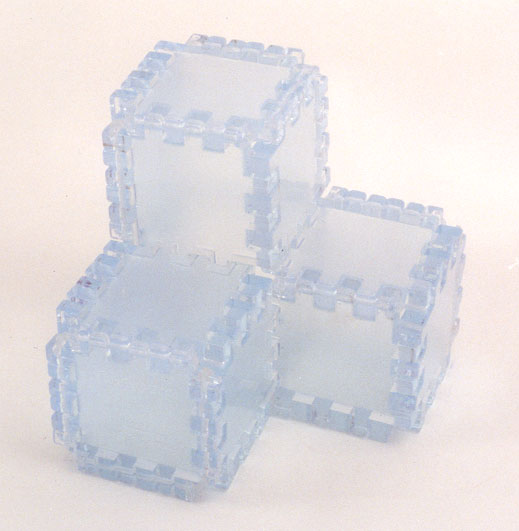
Created by puzzle inventor George Miller and distributed by Recent Toys since 2009, Cubigami7 is a Folding Puzzle. In 2005 it was entered at the 25th IPP Design Competition. At the time, the prototype was only in acrylic, as you can see from this photo.

Cubigami7, named like this because you can only make 7 shapes with its 18 pieces. The puzzle can be unfolded to a 6x6 grid and from that configuration, any of the seven shapes can be assembled. The pieces are all linked together by their sides, which varies from one to all four sides (only one piece is linked with others at its four sides).

 (Click to Enlarge)

The most common color scheme used is 5 yellow, 5 purple and 8 green, although you can see different schemes used in other countries.

It's very easy to manipulate the puzzle. Each linked piece can rotate on its axis up or down and since you don't have any loose pieces, you have to use every one of them in all 7 shapes. However, this fact doesn't make it any easier to assemble all possible shapes. On the contrary, because you have to figure out which pieces to fold and where each one belongs in the shape you're trying to make. Most of the times, a trial and error will get you there, but it's way more fun to visualize the shape first and then work around that image.

 (Click to Enlarge)

As said on the box, the first shapes might be easy to build, but to assemble all seven shapes it's no easy task. If you use the pictures of the shapes displayed in the box as a guide, you might get your work facilitated, because you can see where each color is placed on the specific shape. As a first challenge, try to assemble the desired shape only by your instinct, and then if you have trouble to get there, you can use the pictures to help you...

(Click to Enlarge)

In conclusion, the Cubigami7 is a nice 3D puzzle. It's a great way to stimulate your 3D thinking and visualization and it's recommended to anyone that likes creative toys with the ability to make different shapes.


(Click to Enlarge)

Wurmm and Bronco

Posted on by Gabriel | 0 comments
Labels: , ,

Share
(Click to Enlarge)

The Wurmm... and Bronco are two designs by Dutch puzzle inventor Oskar van Deventer, with George Miller making the prototype for the Wurmm. They're essentially Route Finding Puzzles, where the goal is always to find the correct path, usually to set free a piece of the puzzle.

Wurmm...

(Click to Enlarge)

Distributed by Recent Toys since 2008, the puzzle is a shape of a green apple with 22 holes and a worm-like figure.

The goal is to free the worm from one of its many starting points to the exit below the apple. In the way, you'll find some holes joined together. This is where you find the eight so called pivot points, where you can rotate your Wurmm to change direction and find the exit point.

The puzzle itself isn't that hard to solve. Once you get how direction changes work, you'll eventually find the correct path to free the Wurmm. The concept is a bit similar to the classic plate design, although it's nice to see the puzzle here, with an added twist, like the direction changing ability. It definitely made the puzzle a bit more difficult and fun to solve.

The design is also what differentiates it from the other similar type puzzles. Such a simple idea, and yet nobody thought of that before Oskar did.

Video made by Recent Toys

(Click to Enlarge)

*********************************************************************************


(Click to Enlarge) 

Also distributed by Recent Toys, this time since 2009, Bronco is another Route Finding Puzzle. The concept is similar with the Wurmm, but with the Bronco you have a shape of a horseshoe arena with 15 holes and a wild horse figure.

Here, you can also have different holes as a starting point. Once you choose one, jump your horse forwards or backwards into a hole and rotate it to an available space. Note that, not every adjacent hole will fit, since each one have a pair of opposite spikes that block certain moves. Once you make it to the last hole, which by the way, is the only one that doesn't have spikes, you can rotate the horse freely and guide it to the escape point.

Just like Wurmm, Bronco is a nice use of a simple idea by turning it into a beautiful design, recognizable by everyone. It doesn't provide much of a challenge, as it's much easier compared to Wurmm, but a great collectible for a puzzle lover, though.


(Click to Enlarge)
Related Posts Plugin for WordPress, Blogger...